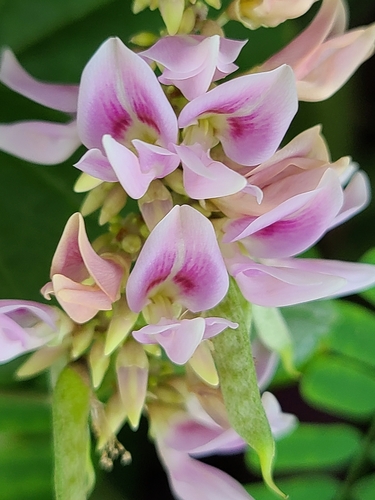
Rothia indica
(Linn.) Druce
Rothia

iNaturalist · cc-by-nc
(c) Gigi Laidler, some rights reserved (CC BY-NC), uploaded by Gigi Laidler
(c) Gigi Laidler, some rights reserved (CC BY-NC), uploaded by Gigi Laidler

gbif · cc-by
Moscow State University (copyright is managed by Dr. Alexey P. Seregin)
Moscow State University (copyright is managed by Dr. Alexey P. Seregin)

iNaturalist · cc-by-nc
(c) janeennichols, some rights reserved (CC BY-NC)
(c) janeennichols, some rights reserved (CC BY-NC)

wikimedia · cc-by-sa
Marshman at English Wikipedia / Eric Guinther (via Wikimedia Commons)
Marshman at English Wikipedia / Eric Guinther (via Wikimedia Commons)
What to Eat
Edible parts: Leaves, Pods, Seeds
The leaves and pods are boiled and eaten as a vegetable. The seeds are also edible.
Where to Find It
It is a tropical plant. It can tolerate salty soils. It will grow in alkaline soils. It grows in sandy soils and can tolerate occasional flooding.
Asia, Australia, China, India, Indochina, Indonesia, Laos, Malaysia, SE Asia, Sri Lanka, Thailand, Vietnam,
Countries: United Arab Emirates, Afghanistan, Armenia, Australia, Azerbaijan, Bangladesh, Bahrain, Brunei, Bhutan, China, Georgia, Indonesia, Israel, India, Iraq, Iran, Jordan, Japan, Kyrgyzstan, Cambodia, North Korea, South Korea, Kuwait, Kazakhstan, Laos, Lebanon, Sri Lanka, Myanmar, Mongolia, Maldives, Malaysia, Nepal, Oman, Philippines, Pakistan, Qatar, Saudi Arabia, Singapore, Syria, Thailand, Tajikistan, Timor-Leste, Turkmenistan, Turkey, Taiwan, Uzbekistan, Vietnam, Yemen
How to Identify
An annual herb. It lies along the ground. It grows 40 cm high. The leaves are 1-2 cm long by 4-8 mm wide. The flowers are in groups of 1-3 and are yellow, orange or red. The pod is 4-6 cm long by 0.2 cm wide. There are over 20 seeds. These are brown and 1.3 mm across.
Other Information
Famine food
Notes
Also as Papilionaceae.
Names & Synonyms
Hongdau, Nucha kura, Nurreypitten keerai
Rothia trifoliata Pers.Trigonella indica L.
Check Rothia trifoliata DC.
References (7)
- Ambasta S.P. (Ed.), 2000, The Useful Plants of India. CSIR India. p 530
- Bot. Exch. Club Soc. Brit. Isles 3:423. 1914
- Dobriyal, M. J. R. & Dobriyal, R., 2014, Non Wood Forest Produce an Option for Ethnic Food and Nutritional Security in India. Int. J. of Usuf. Mngt. 15(1):17-37
- GAMMIE, (As Rothia trifoliata)
- Paczkowska, G . & Chapman, A.R., 2000, The Western Australian Flora. A Descriptive Calatogue. Western Australian Herbarium. p 445
- Singh, H.B., Arora R.K.,1978, Wild edible Plants of India. Indian Council of Agricultural Research, New Delhi. p 40 (As Rothia trifoliata)
- WATT, (As Rothia trifoliata)