Apocynum cannabinum
L.
Black Indian hemp, Hemp Dogbane, Canadian hemp

(c) kqedquest, some rights reserved (CC BY-NC)
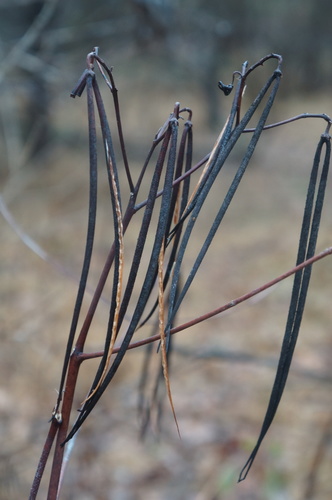
(c) Sara Rall, some rights reserved (CC BY-NC), uploaded by Sara Rall

(c) 2009 Keir Morse, some rights reserved (CC BY-NC-SA)
What to Eat
Edible parts: Seeds, Caution - poisonous
Edible Parts: Seed Edible Uses: Gum Seed - raw or cooked. It can be ground into a powder and used as a meal. A latex obtained from the plant is used as a chewing gum. After the latex has been squeezed from the plant it s allowed to stand overnight to harden into a white gum. The latex was sometimes mixed with clean clay.
Known Hazards
Where to Find It
A temperate plant. It needs a well-drained moist soil. It can grow in sun or light shade.
Asia, Canada, Europe, Korea, North America, Turkey, Türkiye, USA,
How to Identify
A herb that keeps growing from year to year. It has milky sap. It grows 1 m high and spreads 50 cm wide.
How to Grow
Plants are grown from seed. Seed need cold treatment to germinate well.
Propagation: Seed - best sown as soon as it is ripe in late summer and overwintered outdoors. The seed requires a period of cold stratification if it is to germinate well. Prick out the seedlings when large enough to handle and grow them on in a cold frame for their first winter, planting out in late spring of the following year. Division in spring just before active growth begins. Plants can also be divided in the autumn.
Medicinal Uses
Antirheumatic Cardiotonic Diaphoretic Diuretic Emetic Expectorant Tonic Urinary VD Vermifuge Warts Indian hemp is an unpleasantly bitter stimulant irritant herb that acts on the heart, respiratory and urinary systems, and also on the uterus. It was much employed by various native North American Indian tribes who used it to treat a wide variety of complaints including rheumatism, coughs, pox, whooping cough, asthma, internal parasites, diarrhoea and also to increase milk flow in lactating mothers. The plant is still used in modern herbalism, but it should be used with great caution, and only under the supervision of a qualified practitioner if taken internally[. See the notes above on toxicity. The root is cardiotonic, diaphoretic, diuretic, emetic and expectorant. It is harvested in the autumn and dried for later use. The fresh root is the most active part medicinally. It has been used in the treatment of syphilis and as a tonic. A weak tea made from the dried root has been used for cardiac diseases. A tea made from the root has been used as a vermifuge. The milky sap is a folk remedy for venereal warts.
Other Uses
Fibre Gum Latex The flowers are attractive to bees. Other Uses: A very good quality fibre obtained from the bark is used for making clothes, twine, bags, linen, paper etc. It is about 12 - 18mm long. Very strong, it is used as a flax substitute, it does not shrink and it retains its strength in water. The fibre is produced late in the season, it can be harvested after the leaves fall in autumn but are probably at its best as the seed pods are forming. When making paper, the stems can be retted by leaving them in the ground until they are dry in the winter or they can be harvested in late summer, the leaves removed and the stems steamed to remove the fibre. The stems are then cooked for two hours with lye and pounded with mallets. The plant yields a latex which is a possible source of rubber. The latex is also used as chewing gum. Carbon Farming - Industrial Crop: hydrocarbon, fibre. The dogbane-milkweed family Asclepias, Apocynum, Calotropis, and Trachomitum spp) has been used for fiber industrial crops for millennia with a number in cultivation as regional crops. All of these crops are dual-purpose fibres, offering bast fibres from the stem and seed fibre or ‘floss’ in the fruit pods. Many have also been identified as potential hydrocarbon crops due to high latex content. Could be integrated into various agroforestry systems rather than as monocultures [1-1]. Special Uses Carbon Farming
Wikipedia
Source ↗Apocynum cannabinum (dogbane, amy root, hemp dogbane, prairie dogbane, Indian hemp, hemp dogsbane, rheumatism root, dogsbane, wild cotton, or Weihkippeis) is a perennial herbaceous plant that grows throughout much of North America—in the southern half of Canada and throughout the United States. It is poisonous to humans, dogs, cats, and horses. All parts of the plant contain toxic cardiac glycosides that can cause potentially fatal cardiac arrhythmias if ingested. Some Lepidoptera can withstand the toxins and feed on this plant.
Notes
There are 4-9 Apocynum species. It is used in medicine for heart disease as a substitute to digitalis.
Names & Synonyms
Wihowi
References (8)
- Beckstrom-Sternberg, Stephen M., and James A. Duke. "The Foodplant Database." http://probe.nalusda.gov:8300/cgi-bin/browse/foodplantdb.(ACEDB version 4.0 - data version July 1994) (As Apocynum angustifolium)
- Bodkin, F., 1991, Encyclopedia Botanica. Cornstalk publishing, p 92
- Brown, D., 2002, The Royal Horticultural Society encyclopedia of Herbs and their uses. DK Books. p 125
- Coutre, M. D., et al, 1986, Foraging Behaviour of a Contemporary Northern Great Basin Population. Journal of California and Great Bason Anthropology Vol. 8(2) pp 150-160
- Kermath, B. M., et al, 2014, Food Plants in the Americas: A survey of the domesticated, cultivated and wild plants used for Human food in North, Central and South America and the Caribbean. On line draft. p 76
- Kiple, K.F. & Ornelas, K.C., (eds), 2000, The Cambridge World History of Food. CUP p 1785
- Plants for a Future database, The Field, Penpol, Lostwithiel, Cornwall, PL22 0NG, UK. http://www.scs.leeds.ac.uk/pfaf/
- Sp. pl. 1:213. 1753


