Rubus adenothallus
Focke
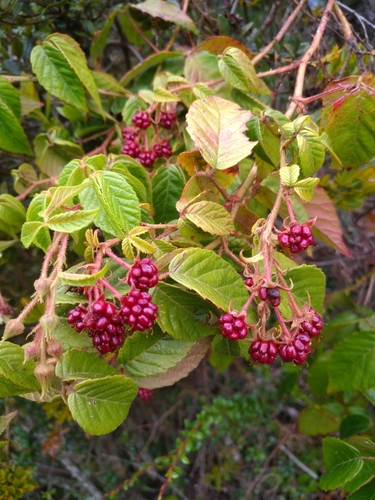
(c) Kabir Montesinos, some rights reserved (CC BY-NC-ND), uploaded by Kabir Montesinos
What to Eat
Edible parts: Fruit
The fruit are edible.
Dangerous Lookalikes
This plant can be confused with the following toxic species. Always verify identification carefully before consuming any wild plant.


Red Baneberry: Short herbaceous plant (no thorns), berries on thick red stems, each berry has a single seed, compound sharply-toothed leaves.
Rubus adenothallus: Thorny woody canes (brambles), aggregate berry made of many drupelets, berries pull easily from receptacle.
Where to Find It
A tropical plant. In the Andes it grows between 2,100-3,000 m above sea level.
Andes, Bolivia, Ecuador, Peru, South America,
How to Identify
A shrub in the Rosaceae family found in the tropical Andes at elevations between 2,100-3,000 m above sea level.
How to Grow
Species in this genus are generally easily grown in a good well-drained loamy soil in sun or semi-shade. Plants in this genus are notably susceptible to honey fungus.
Propagation: Seed - germinates best if given a period of cold stratification prior to sowing in containers. Stored seed requires one month stratification at about 3°c and is best sown as early as possible in the growing season. Prick out the seedlings when they are large enough to handle and grow on until large enough to plant out. Cuttings of half-ripe wood in a frame. Tip layering towards the end of the growing season Division just before the plant comes into new growth or as it enters dormancy.
Medicinal Uses
An infusion of the leaves, combined with the leaves of Perezia multiflora, Senecio calvus, Jungia rugosa, Eucalyptus sp., etc, is used in the treatment of coughs and flu.. The young leaves, harvested from the stem apex, are chewed as a treatment for throat pain and inflammation. A traditional treatment for headache due to blood high pressure is to place the plant over burning charcoal - when the leaves are hot they are placed around the head and kept in place until they become cold. An infusion of the flowers is drunk as a treatment for digestive problems
Other Information
It is cultivated.
Notes
There are about 700 Rubus species.
References (5)
- Castillo, R. O., 1995, Plant Genetic Resources in the Andes: Impact, Conservation, and Management. Crop Science 35:355-360
- Mansfield's Encyclopedia of Agricultural and Horticultural Crops p 426
- Meded. Rijks-Herb. 19:56. 1913
- USDA, ARS, National Genetic Resources Program. Germplasm Resources Information Network - (GRIN). [Online Database] National Germplasm Resources Laboratory, Beltsville, Maryland. Available: www.ars-grin.gov/cgi-bin/npgs/html/econ.pl (10 April 2000)
- Wiersema, J. H. & Leon, B., 2013, World Economic Plants. A Standard Reference CRC Press. 2nd Ed. p 597
More from Rosaceae


