Apodanthera undulata
A. Gray
Melon loco

(c) Alex Abair, some rights reserved (CC BY), uploaded by Alex Abair
(c) Steve Ganley, some rights reserved (CC BY-NC), uploaded by Steve Ganley

(c) Fernando A. M., some rights reserved (CC BY-NC), uploaded by Fernando A. M.
What to Eat
Edible parts: Fruit - caution, Seeds
Loco or coyote melon has a long but uncertain reputation as a famine food. Some ethnobotanical accounts record that Native Americans consumed the fruits and seeds during times of scarcity, yet other sources warn that the seeds’ oil is inedible and potentially toxic. The fruits are consistently described as intensely bitter, and both fruits and seeds may contain harmful compounds similar to those found in wild gourds (Cucurbita spp.). Based on these warnings, consumption of any part is not recommended unless a safe preparation method can be reliably verified. Unlike true gourds, loco melon fruits are ridged rather than smooth, and while they superficially resemble edible cucurbits, their toxicity risk is high. Foragers should treat this plant with caution and avoid eating its fruits or seeds [2-3].
Where to Find It
It is a subtropical plant. It grows in desert and uplands. It can grow in arid places.
Central America, Mexico, North America, USA,
How to Identify
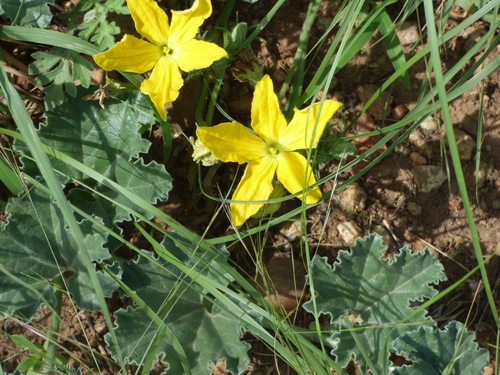
A pumpkin family plant. The vine can be 3 m long. The leaves are kidney shaped with wavy edges. They are white underneath. The flowers are yellow.
How to Grow
Habitat & Growing Conditions: Loco melon grows in deserts, floodplains, dry fields, and disturbed ground, preferring sandy or well-drained soils in hot, arid environments. It sprawls low to the ground, often climbing over other vegetation with the help of tendrils. It thrives in full sun and is well adapted to drought conditions of the American Southwest (Arizona to Texas) and northern Mexico. Growth & Ecology: A low, ill-scented perennial vine, it blooms in summer with bright yellow flowers and produces its distinctive hard-shelled gourds in autumn. It often grows in scattered populations but is locally common in suitable desert habitats. Its ridged fruits and free corolla lobes distinguish it from related gourds (Cucurbita). Pollination & Dispersal: Flowers are unisexual and insect-pollinated, most likely by bees and beetles that visit the large yellow blooms. Fruits develop into hard, ridged gourds, which may persist for months. Seed dispersal is largely gravity-based or aided by animals disturbing the dry fruits. Likely hardy to USDA zones 8–11, tolerating heat and drought but killed by frost.
Propagation: Seed.
Medicinal Uses
None Known
Other Uses
No significant traditional or modern non-food uses are recorded beyond possible experimental oil extraction from the seeds, though this was found unsuitable for human consumption. The hard-shelled fruits could potentially be used ornamentally or as small containers, but this was not a widespread practice. Loco melon plays an important role in desert ecosystems. Its sprawling vines help stabilize sandy or disturbed soils, while its tough gourds act as seed banks, protecting seeds from desiccation until rains arrive. Wildlife interactions are limited due to the fruit’s bitterness, but some small mammals may gnaw on the gourds to reach the seeds. The flowers, like many in the Cucurbitaceae family, attract native bees and other pollinators, providing nectar during summer bloom. Overall, while not a major food source, it contributes to desert biodiversity and resilience in arid habitats. Special Uses
Wikipedia
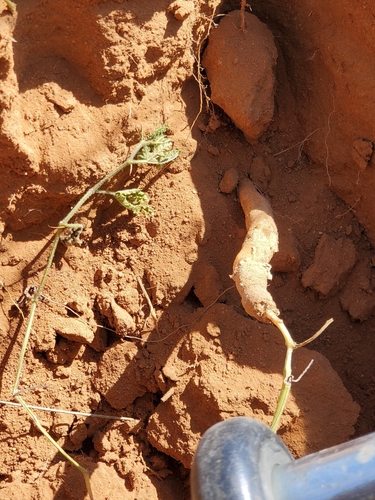
Source ↗Apodanthera undulata, common name melon loco, is a plant species native to the south-western United States (western Texas, New Mexico, and Arizona) and in Mexico as far south as Oaxaca. Apodanthera undulata is a monoecious, foul-smelling, perennial vine with a massive taproot up to 20 cm (8 inches) in diameter. Stems are prostrate, running along the ground up to 2.4 m (8 feet), sometimes climbing with tendrils. Leaves are round to kidney-shaped, up to 15 cm (6 inches) across, decidedly wavy. Flowers are yellow, trumpet-shaped. Fruits are egg-shaped with ridges running lengthwise, up to 10 cm (4 inches) long.
Notes
The fruit pulp is used as medicine.
Names & Synonyms
Loco or Coyote Melon
References (4)
- Lira, R. & Caballero, J., 2002, Ethnobotany of the Wild Mexican Cucurbitaceae. Economic Botany 56(4) pp. 380-398
- MacMahon, J.A., 1990, Deserts. Audubon Society Nature Guides. Knopf. p 404 Plate 141
- Pl. wright. 2:60. 1853 (Smithsonian Contr. Knowl. 5, Art. 6)
- World Checklist of Useful Plant Species 2020. Royal Botanic Gardens, Kew