Rubus coreanus
Miquel
Korean raspberry
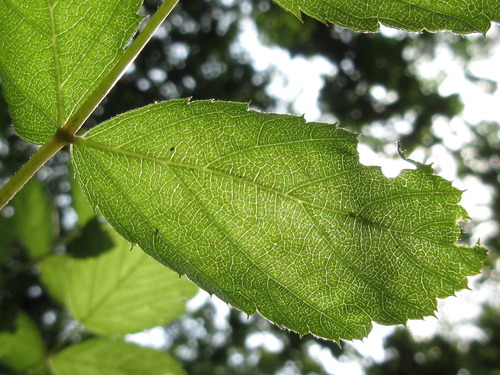
(c) onidiras-iNaturalist, some rights reserved (CC BY-NC), uploaded by onidiras-iNaturalist

(c) onidiras-iNaturalist, some rights reserved (CC BY-NC)

(c) Paul B., some rights reserved (CC BY-NC-ND), uploaded by Paul B.
What to Eat
Edible parts: Fruit
The fruit can be eaten raw or cooked, though it is small and has a poor flavour. The dark red or purplish black fruits are 5–8mm in diameter.
Dangerous Lookalikes
This plant can be confused with the following toxic species. Always verify identification carefully before consuming any wild plant.


Red Baneberry: Short herbaceous plant (no thorns), berries on thick red stems, each berry has a single seed, compound sharply-toothed leaves.
Korean raspberry: Thorny woody canes (brambles), aggregate berry made of many drupelets, berries pull easily from receptacle.
Where to Find It
It is a temperate plant. In China it grows between 100-3,100 m above sea level. In Sichuan and Yunnan.
Asia, China, Japan, Korea, Nepal, North America, USA,
How to Identify
A shrub that arches over. It grows 3 m high. The young branches are reddish brown. They have stout, hooked prickles. The leaves have leaflets along the stalk. There are 5-7 leaflets that are narrowly oval. They are 3-6 cm long by 2-4 cm wide. They are broadly wedge shaped at the base. There are unequal sharp teeth. There are hairs along the veins underneath the leaf. The flowers are pink and small. They are 8-10 mm across. They occur as 3-7 together. The fruit are small and 5 mm across. They are red to black.
How to Grow
Easily grown in a good well-drained loamy soil in sun or semi-shade. Plants are rarely cultivated for their edible fruit in Japan. This species is a raspberry with biennial stems, it produces a number of new stems each year from the perennial rootstock, these stems fruit in their second year and then die. Plants in this genus are notably susceptible to honey fungus.
Propagation: Seed requires stratification and is best sown in early autumn in a cold frame. Stored seed needs one month stratification at about 3°c and should be sown as early as possible in the year. Prick out seedlings when large enough to handle and grow on in a cold frame, then plant out into permanent positions in late spring of the following year. Division of suckers can be done in early spring or just before leaf-fall in autumn.
Medicinal Uses
The fruit is aphrodisiac, astringent, restorative and tonic. It is taken internally for complaints linked to disturbed liver and kidney function, including back pain, urinary dysfunction, premature greying, blurred vision, infertility, impotence and premature ejaculation. The fruit is harvested when fully ripe and may be used fresh or dried. The juice of bruised leaves or a decoction of the root is used to treat ophthalmia. The seed is astringent and tonic.
Other Uses
A purple to dull blue dye is obtained from the fruit.
Wikipedia
Source ↗Rubus coreanus, known as bokbunja (Korean: 복분자), Korean blackberry, or Korean bramble, is a species of raspberry native to Korea, Japan, and China. It produces edible berries (not 'true berries' in the botanical sense) that can be fermented into bokbunja ju (Korean: 복분자주), a Korean fruit wine (although the majority of fruit commercially grown for producing this drink are actually Rubus occidentalis, native to North America). R. coreanus fruits are usually harvested between May and July at peak harvest season. They can only be cultivated in a few areas in Korea, different to Rubus occidentalis, which can be cultivated widely across the country.
Production
In China plants flower in April to June and fruit June to Korea.
Notes
There are about 250 Rubus species.
Names & Synonyms
Bokbunjattalgi, Cipao, Dipao, Fupenzi, Fu P'En Tzu, Tokkuri-ichigo
References (10)
- Ann. Mus. Bot. Lugduno-Batavum 3:34. 1867
- Flora of China @ efloras.org Volume 9
- Hedrick, U.P., 1919, (Ed.), Sturtevant's edible plants of the world. p 581 (As Rubus tokkura)
- Hu, Shiu-ying, 2005, Food Plants of China. The Chinese University Press. p 456
- Hwang, HS, et al, 2014, Distribution characteristics of plant in the Ungseokbong Mountain, Gyeongsangnam-do, Korea. Journal of Asia-Pacific Biodiversity. 7(2014) e164-e178
- Kang, Y., et al, 2012, Wild food plants and wild edible fungi in two valleys on the Qinling Mountains (Shaanxi, central China) Journal of Ethnobiology and Ethnomedicine; 9:26
- Mansfield's Encyclopedia of Agricultural and Horticultural Crops
- Plants for a Future database, The Field, Penpol, Lostwithiel, Cornwall, PL22 0NG, UK. http://www.scs.leeds.ac.uk/pfaf/
- Song, M., et al, 2013, Traditional knowledge of wild edible plants in Jeju Island, Korea. Indian Journal of Traditional Knowledge. 12(2) pp 177-194
- Wang, J. et al, 2013, A Study on the Utilization of Wild Plants for Food in Liangshan Yi Autonomous Prefecture. Plant Diversity and Resources. 35(4): 416-471
More from Rosaceae


