Rubus cuneifolius
Pursh
Sand blackberry

(c) gloriamarkiewicz, some rights reserved (CC BY-NC)
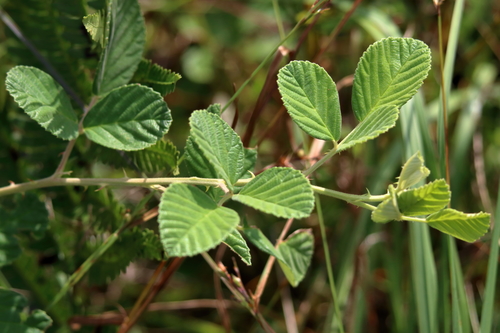
(c) Lauren McLaurin, some rights reserved (CC BY), uploaded by Lauren McLaurin
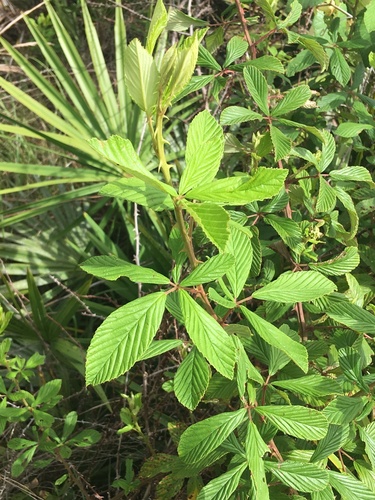
(c) Sam, some rights reserved (CC BY-NC), uploaded by Sam
What to Eat
Edible parts: Fruit
The fruit can be eaten raw or cooked. It is dry but sweet with a good flavour, about 9mm in diameter, and can grow up to 25mm long with a delicious flavour.
Dangerous Lookalikes
This plant can be confused with the following toxic species. Always verify identification carefully before consuming any wild plant.


Red Baneberry: Short herbaceous plant (no thorns), berries on thick red stems, each berry has a single seed, compound sharply-toothed leaves.
Sand blackberry: Thorny woody canes (brambles), aggregate berry made of many drupelets, berries pull easily from receptacle.
Where to Find It
It is a subtropical plant.
Africa, Eswatini, North America, South Africa, Southern Africa, Swaziland, USA,
How to Identify
A shrub. It grows 1-1.5 m tall. The stems have prickles. It often loses many leaves during the year. There are 3-5 leaflets. The fruit is black and 1-2 cm across with 15-50 small fruitlets.
How to Grow
Easily grown in a good well-drained loamy soil in sun or semi-shade. This species is a blackberry with biennial stems, it produces a number of new stems each year from the perennial rootstock, these stems fruit in their second year and then die. The plant produces apomictic flowers, these produce fruit and viable seed without fertilization, each seedling is a genetic copy of the parent. Plants in this genus are notably susceptible to honey fungus.
Propagation: Seed requires stratification and is best sown in early autumn in a cold frame. Stored seed needs one month stratification at about 3°c and should be sown as early as possible in the year. Prick out seedlings when large enough to handle and grow on in a cold frame, then plant out into permanent positions in late spring of the following year. Cuttings of half-ripe wood can be taken in July/August in a frame. Tip layering in July, planting out in autumn. Division can be done in early spring or just before leaf-fall in autumn.
Medicinal Uses
None known.
Other Uses
A purple to dull blue dye is obtained from the fruit.
Wikipedia
Source ↗Rubus cuneifolius, the sand blackberry, is a North American species of flowering plant in the rose family. It occurs in the eastern United States in every coastal state from Louisiana to New Hampshire, with the exception of Rhode Island. There are also reports of inland populations in Tennessee, Arkansas, and Oklahoma, and the species has become an invasive species in South Africa. Within its native range, R. cuneifolius has been observed in habitat types such as hardwood forests, longleaf pinelands, and in wooded floodplains. It has also been observed in disturbed environments such as along roadsides and firebreaks. The genetics of Rubus is extremely complex, so that it is difficult to decide on which groups should be recognized as species. There are many rare species with limited ranges such as this. Further study is suggested to clarify the taxonomy.
Notes
There are about 250 Rubus species.
Names & Synonyms
American bramble, Sand bramble
References (13)
- Beckstrom-Sternberg, Stephen M., and James A. Duke. "The Foodplant Database." http://probe.nalusda.gov:8300/cgi-bin/browse/foodplantdb.(ACEDB version 4.0 - data version July 1994)
- Fl. Amer. sept. 1:347. 1813-1814
- Jennings, D.L., 1979, Raspberries and blackberries, in Simmonds, N.W., (ed), Crop Plant Evolution. Longmans. London. p 251
- Kermath, B. M., et al, 2014, Food Plants in the Americas: A survey of the domesticated, cultivated and wild plants used for Human food in North, Central and South America and the Caribbean. On line draft. p 760
- Long, C., 2005, Swaziland's Flora - siSwati names and Uses http://www.sntc.org.sz/flora/
- Moerman, D. F., 2010, Native American Ethnobotany. Timber Press. p 488
- Plants for a Future database, The Field, Penpol, Lostwithiel, Cornwall, PL22 0NG, UK. http://www.scs.leeds.ac.uk/pfaf/
- Ruiters-Welcome, A. K., 2019, Food plants of southern Africa. Ph.D. thesis. Univ. of Johannesburg p 95
- Swaziland's Flora Database http://www.sntc.org.sz/flora
- Welcome, A. K. & Van Wyk, B.-E., 2019, An inventory and analysis of the food plants of southern Africa. South African Journal of Botany 122 (2019) 136–179
- Wiersema, J. H. & Leon, B., 2013, World Economic Plants. A Standard Reference CRC Press. 2nd Ed. p 598
- World Checklist of Useful Plant Species 2020. Royal Botanic Gardens, Kew
- www.eplantscience.com
More from Rosaceae


