Rubus geoides
J. E. Sm.
Falkland strawberry
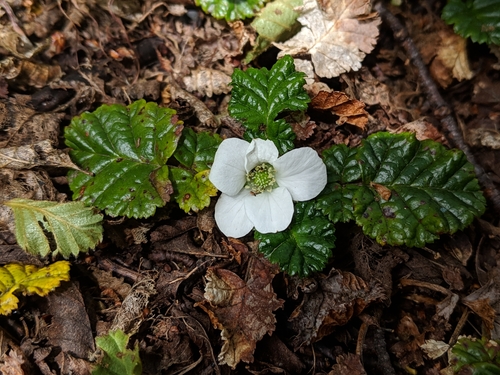
(c) Pat Deacon, some rights reserved (CC BY-NC), uploaded by Pat Deacon
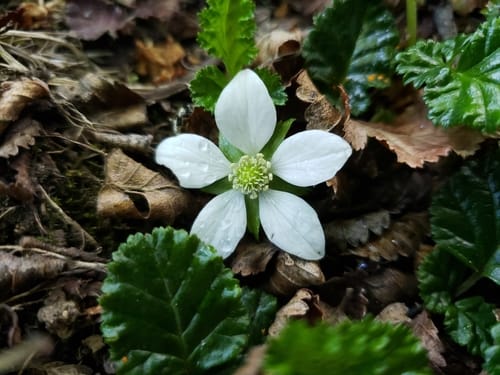
(c) Roy Mackenzie, some rights reserved (CC BY-NC)
What to Eat
Edible parts: Fruit
This raspberry-type plant produces large, juicy, greenish-yellow fruits with a delicious flavour, which can be eaten raw or cooked.
Dangerous Lookalikes
This plant can be confused with the following toxic species. Always verify identification carefully before consuming any wild plant.


Red Baneberry: Short herbaceous plant (no thorns), berries on thick red stems, each berry has a single seed, compound sharply-toothed leaves.
Falkland strawberry: Thorny woody canes (brambles), aggregate berry made of many drupelets, berries pull easily from receptacle.
Where to Find It
It is a temperate plant. In Chile it grows from sea level to 2,000 m altitude. It can grow in humid areas with constant rain and in drier areas with a winter rainfall or 400-800 mm. It can grow in some shade. It suits hardiness zone 7. It can tolerate frost and snow.
Argentina, Chile*, Falkland Islands, South America*,
How to Identify
A small herb. It grows 5 cm high. The stems can be 70 cm long and form roots at the nodes. The flowers are white. They have 5 petals. The fruit are greenish-yellow.
How to Grow
We have very little information on this species and do not know if it will be hardy in Britain, though judging by its native range it should succeed outdoors in many parts of the country. The following notes are based on the general needs of the genus. Easily grown in a good well-drained loamy soil in sun or semi-shade. Plants are self-compatible and occasionally self-pollinated. Plants in this genus are notably susceptible to honey fungus.
Propagation: Seed requires stratification and is best sown in early autumn in a cold frame. Stored seed needs one month stratification at about 3°c and should be sown as early in the year as possible. Prick out seedlings when large enough to handle and grow on in a cold frame, then plant out into permanent positions in late spring of the following year. Cuttings of half-ripe wood can be taken in July/August in a frame. Tip layering in July, planting out in autumn. Division can be done in early spring or just before leaf-fall in autumn.
Medicinal Uses
None known.
Other Uses
A purple to dull blue dye is obtained from the fruit.
Wikipedia
Source ↗Rubus geoides is a South American species of flowering plant in the rose family. It has been found only in the extreme southern part of the continent, in the Provinces of Tierra del Fuego, Santa Cruz, Río Negro, and Neuquén in Argentina, the adjacent Magallanes Region of Chile, and the Falkland Islands. Rubus geoides is a very small, spineless, trailing herb rarely more than 10 cm tall. It has trifoliate leaves.
Notes
There are about 250 Rubus species.
Names & Synonyms
Chaura del zorro, Frutilla de la cordillera, Frutilla de Magallanes, Frutilla del chucao, Mine-mine, Ngeru-quellen
References (11)
- Chamorro, M. F., & Ladio, A., 2020, Native and exotic plants with edible fleshy fruits utilized in Patagonia and their role as sources of local functional foods. BMC Complementary Medicine and Therapies. 20:155
- Cordero, S. E., Abello, L. A., & Galvez, F. L., 2017, Plantas silvestres comestibles y medicinales de Chile y otras partes del mundo. CORMA p 111
- Kermath, B. M., et al, 2014, Food Plants in the Americas: A survey of the domesticated, cultivated and wild plants used for Human food in North, Central and South America and the Caribbean. On line draft. p 761
- Leon-Lobos, P., et al, 2022, Patterns of Traditional and Modern Uses of Wild Edible Native Plants of Chile: Challenges and Future Perspectives. Plants (Basel) v 11 (6) Table S1
- Plants for a Future database, The Field, Penpol, Lostwithiel, Cornwall, PL22 0NG, UK. http://www.scs.leeds.ac.uk/pfaf/
- Pl. icon. ined. 1: t. 19. 1789
- Rapoport, E. H. & Ladio, A. H., 1999, Plantas comestibles. Bosque Volume 20 No. 2. ISSN 0314-8799
- Upson, R., & Lewis R., 2014, Updated Vascular Plant Checklist and Atlas for the Falkland Islands. Falklands Conservation and Kew.
- Velasquez, P. & Montenegro, G., 2017, Chilean Endemic/Native Plant Resources as Functional and Superfoods. Chp. 6 in Superfood and Functional Food - An Overview of Their Processing and Utilization
- www.chileflora.com
- www.eplantscience.com
More from Rosaceae


