Rubus glaucus
Benth.
Andean blackberry

(c) Maria Luisa Bravo Alarcon, some rights reserved (CC BY), uploaded by Maria Luisa Bravo Alarcon

(c) ypaulsalazar, some rights reserved (CC BY-NC)
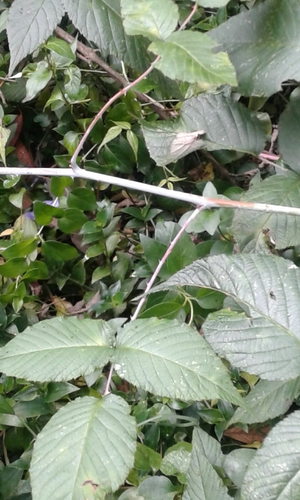
(c) jcepedav, some rights reserved (CC BY-NC), uploaded by jcepedav
What to Eat
Edible parts: Fruit
The fruit, up to 3cm long, can be eaten raw or cooked. Rich, tart, and very juicy, it surpasses most cultivated blackberries and raspberries in flavour and quality, and is similar to a loganberry in taste and utility.
Dangerous Lookalikes
This plant can be confused with the following toxic species. Always verify identification carefully before consuming any wild plant.


Red Baneberry: Short herbaceous plant (no thorns), berries on thick red stems, each berry has a single seed, compound sharply-toothed leaves.
Andean blackberry: Thorny woody canes (brambles), aggregate berry made of many drupelets, berries pull easily from receptacle.
Where to Find It
A tropical plant. It suits the tropical highlands. It grows in areas with a well distributed medium rainfall. In Colombia it grows between 1,800-2,400 m above sea level.
Andes, Central America, Colombia, Costa Rica, Cuba, Ecuador, Guatemala, Mexico, North America, Panama, Peru, South America, USA, West Indies,
How to Identify
A shrub. It grows 3 m high. The fruit are light red to dark purple. They are 3 cm long.
How to Grow
Easily grown in a good well-drained loamy soil in sun or semi-shade. This species is not hardy in the colder areas of the country, it tolerates temperatures down to between -5 and -10°c. Often cultivated in S. America for its edible fruit. Yields of up to 20 tonnes per hectare are achieved in S. America. This species could be useful in hybridization programmes with American and European blackberries and raspberries, but it is susceptible to some N. American raspberry diseases. Closely related to R. occidentalis. Plants in this genus are notably susceptible to honey fungus.
Propagation: Seed requires stratification and is best sown in early autumn in a cold frame. Stored seed needs one month stratification at about 3°c and should be sown as early in the year as possible. Prick out seedlings when large enough to handle and grow on in a cold frame, then plant out into permanent positions in late spring of the following year. Cuttings of half-ripe wood can be taken in July/August in a frame. Tip layering in July, planting out in autumn. Division can be done in early spring or just before leaf-fall in autumn.
Medicinal Uses
None known.
Other Uses
A purple to dull blue dye is obtained from the fruit. Because this species shows resistance to cane-spot disease (Mycosphaerella rubi) and has potential for improving fruit quality, it is crossed with Rubus cultivars in breeding programmes. It could prove useful in hybridisation with American and European blackberries and raspberries, though it is susceptible to some North American raspberry diseases.
Wikipedia
Source ↗Rubus glaucus, commonly known as mora de Castilla or Andean raspberry, is a species of blackberry found in Latin America from Mexico to Bolivia, including the northern and central Andes. It is similar to a loganberry in terms of taste and utility. Rubus glaucus is a perennial semi-erect climbing shrub, belonging to the rose family. It consists of several round and spiny stems that form the corona of the plant, 1 to 2 cm in diameter, and can grow up to 3 m. The leaves are trifoliate with serrated edges, dark green and white beam beneath. Both stems and leaves are covered by a white powder. The fruit is an ellipsoid compound drupe of 15 to 25 mm at its widest diameter, weighing 3-5 grams, green when formed, becoming red when ripe and then dark and bright purple. It consists of small drupes attached to the receptacle when ripe and fleshy whitish rich in vitamin C, calcium and phosphorus, bittersweet, and suitable for juices, nectars, jams, jellies, ice cream, pastries and confectionery. Fruit production is continuous with two annual peaks. Plants reach maturity and produce fruit after the first year extending through the rest of the plant's life which can be 12 to 20 years. The plant grows best at temperatures between 12 and 19 °C, with relative humidity of 80 to 90%, high sunshine and well distributed rainfall between 800 and 2,500 mm a year. It is native to tropical highlands of northwestern South America and Central America and prefers elevations between 1,500 m and 3,100 m. In countries such as Costa Rica it is found in the upper part of the Cordillera de Talamanca and the Central Volcanic Cordillera.
Production
Plants grown from seed produce fruit in 2 years and in 1 year from cuttings. They last for 4 years.
Other Information
It is a cultivated food plant.
Notes
There are about 250 Rubus species.
Names & Synonyms
Andes-berry, Andes black raspberry, Ashpa mora, Mora, Mora de Castilla, Mora de monte, Zarzamora
References (19)
- Altschul, S.V.R., 1973, Drugs and Foods from Little-known Plants. Notes in Harvard University Herbaria. Harvard Univ. Press. Massachusetts. no. 1413
- Castillo, R. O., 1995, Plant Genetic Resources in the Andes: Impact, Conservation, and Management. Crop Science 35:355-360
- Facciola, S., 1998, Cornucopia 2: a Source Book of Edible Plants. Kampong Publications, p 209
- Hellmuth, N. M., 2011, Maya Ethnobotany. Complete Inventory of plants. Associacion FLAAR Mesoamerica. Tenth edition.
- Hermandez Bermejo, J.E., and Leon, J. (Eds.), 1994, Neglected Crops. 1492 from a different perspective. FAO Plant Production and Protection Series No 26. FAO, Rome. p17
- INFOODSUpdatedFGU-list.xls
- Kermath, B. M., et al, 2014, Food Plants in the Americas: A survey of the domesticated, cultivated and wild plants used for Human food in North, Central and South America and the Caribbean. On line draft. p 761
- Leterme, P., et al, 2006, Mineral content of tropical fruits and unconventional foods of the Andes an the rain forest of Colombia. Food Chemistry 95: 644-652
- Mansfield's Encyclopedia of Agricultural and Horticultural Crops p 424
- Martin, F. W., et al, 1987, Perennial Edible Fruits of the Tropics. USDA Handbook 642 p 54
- Zozio, S., et al, 2011, Evaluation of anthocyanin stability during storage of a coloured drink made from extracts of the Andean blackberry (Rubus glaucus Benth.), acai (Euterpe oleracea Mart.) and black carrot (Daucus carota L.). Fruits, Vol. 66, p. 203-215
- Plants for a Future database, The Field, Penpol, Lostwithiel, Cornwall, PL22 0NG, UK. http://www.scs.leeds.ac.uk/pfaf/
- Pl. hartw. 173. 1845
- Roa, J. A. G. & Boada, D. S. G., 2018, Fundación para el Fortalecimiento de la Fruticultura y Plantas Alimenticias no Convencionales en Colombia.
- Segura, S., et al, 2018, The edible fruit species in Mexico. Genet Resour Crop Evol (2018) 65:1767–1793
- Torre, de la, L., et al, 2008, Enciclopedia de las Plantas Útiles del Ecuador. Herbario QCA. Pontificia Universidad Católica del Ecuador. p 538
- USDA, ARS, National Genetic Resources Program. Germplasm Resources Information Network - (GRIN). [Online Database] National Germplasm Resources Laboratory, Beltsville, Maryland. Available: www.ars-grin.gov/cgi-bin/npgs/html/econ.pl (10 April 2000)
- Van den Eynden, V., et al, 2003, Wild Foods from South Ecuador. Economic Botany 57(4): 576-603
- Wiersema, J. H. & Leon, B., 2013, World Economic Plants. A Standard Reference CRC Press. 2nd Ed. p 598
More from Rosaceae


