Rubus illecebrosus
Focke
Japanese strawberry-raspberry
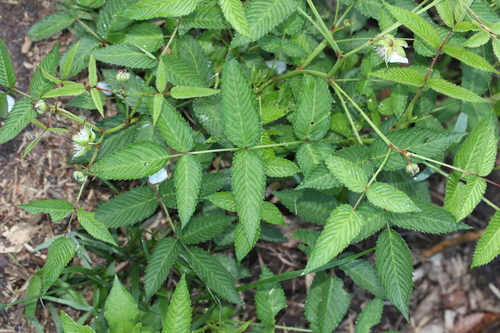
(c) Alpsdake, some rights reserved (CC BY-SA)
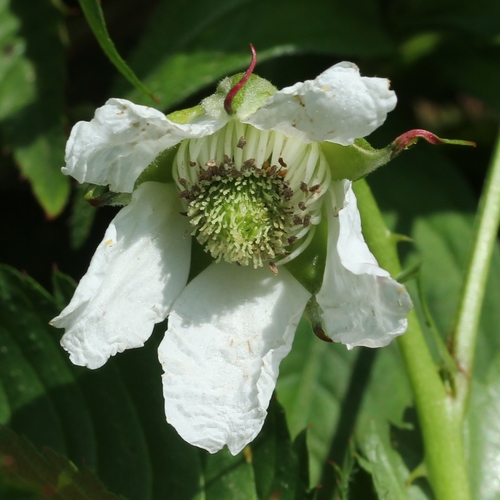
(c) Alpsdake, some rights reserved (CC BY-SA)
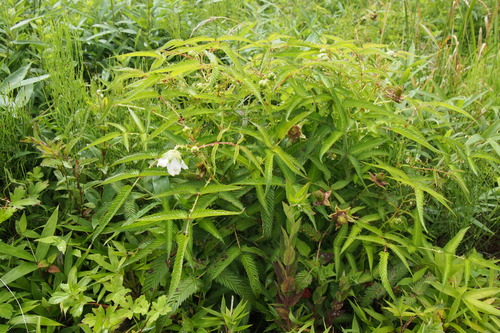
(c) harum.koh, some rights reserved (CC BY-SA), uploaded by harum.koh
What to Eat
Edible parts: Fruit
The fruit, about 30mm in diameter, can be eaten raw or cooked. Raw, it is fairly large and sweet but can be insipid, and one account describes it as sour, bitter, and unpalatable when raw. It is generally agreed to develop more flavour when cooked.
Dangerous Lookalikes
This plant can be confused with the following toxic species. Always verify identification carefully before consuming any wild plant.


Red Baneberry: Short herbaceous plant (no thorns), berries on thick red stems, each berry has a single seed, compound sharply-toothed leaves.
Japanese strawberry-raspberry: Thorny woody canes (brambles), aggregate berry made of many drupelets, berries pull easily from receptacle.
Where to Find It
It is a temperate plant. It can be used as a ground cover near banks and streams. It suits hardiness zone 6.
Africa, Asia, China, Cuba, East Africa, Japan, Malawi, North America, USA, West Indies,
How to Identify
A deciduous shrub growing 0.6m tall by 1m wide, hardy to UK zone 5 and not frost tender. Flowers in July with seed ripening in August. Hermaphroditic and insect-pollinated. Tolerates light sandy, medium loamy, and heavy clay soils with good drainage. Grows in mildly acidic to basic soil pH, semi-shade or full sun, with moist soil preference. Effective groundcover that dies back over winter.
How to Grow
Easily grown in a good well-drained loamy soil in sun or semi-shade. Sometimes cultivated for its edible fruit and occasionally naturalized in Europe. Plants spread freely when in a suitable site and are apt to become invasive. The plant adopts an almost herbaceous habit and is botanically a sub-shrub, only a small amount of woody stem persists overwinter. Plants in this genus are notably susceptible to honey fungus. An evergreen.
Propagation: Seed requires stratification and is best sown in early autumn in a cold frame. Stored seed needs one month stratification at about 3°C and should be sown as early as possible in the year. Prick out seedlings when large enough to handle and grow on in a cold frame, then plant out into permanent positions in late spring of the following year. Cuttings of half-ripe wood can be taken in July/August in a frame. Tip layer in July and plant out in autumn. Divide in early spring or just before leaf-fall in autumn.
Medicinal Uses
None known.
Other Uses
A purple to dull blue dye is obtained from the fruit. The plant makes good ground cover for a sunny position or light shade, spreading freely once established, though it dies back over winter and can allow other species to invade during that period.
Wikipedia
Source ↗Rubus illecebrosus is a red-fruited species of Rubus that originally came from Japan (where it is called バライチゴ, literally "roseberry"), but is also very popular in some European countries like Lithuania. Common names include balloon berry and strawberry raspberry. It has become sparingly naturalized in scattered locations in Canada, the United States, and South America. Rubus illecebrosus is a thorny shrub up to 150 cm (5 ft) tall. Leaves are pinnately compound. Flowers are produced either one at a time or in clumps of 2–3, each with 5 petals up to 18 mm (23⁄32 in) long (longer than those of most related species). Fruits are also unusually large for the genus, each oblong, red, up to 2 cm (3⁄4 in) long with 50–100 drupelets.
Other Information
It is a cultivated food plant.
Notes
There are about 250 Rubus species.
Names & Synonyms
Strawberry-raspberry, Balloonberry, Zarzamora
References (10)
- Abh. Naturwiss. Vereine Bremen 16:278. 1899
- Facciola, S., 1998, Cornucopia 2: a Source Book of Edible Plants. Kampong Publications, p 209
- Jackes, D. A., 2007, Edible Forest Gardens
- John, L., & Stevenson, V., 1979, The Complete Book of Fruit. Angus & Robertson p 292
- Kiple, K.F. & Ornelas, K.C., (eds), 2000, The Cambridge World History of Food. CUP p 1859
- Miguel, E., et al, 1989, A checklist of the cultivated plants of Cuba. Kulturpflanze 37. 1989, 211-357
- Plants for a Future database, The Field, Penpol, Lostwithiel, Cornwall, PL22 0NG, UK. http://www.scs.leeds.ac.uk/pfaf/
- van Wyk, B., 2005, Food Plants of the World. An illustrated guide. Timber press. p 330
- Williamson, J., 2005, Useful Plants of Malawi. 3rd. Edition. Mdadzi Book Trust. p 218
- Zeven, A. C. & de West, J. M. J., 1982, Dictionary of cultivated plants and their regions of diversity. Wageningen. p 41
More from Rosaceae


