Rubus lineatus
Reinw. ex Blume
Gempe aselu
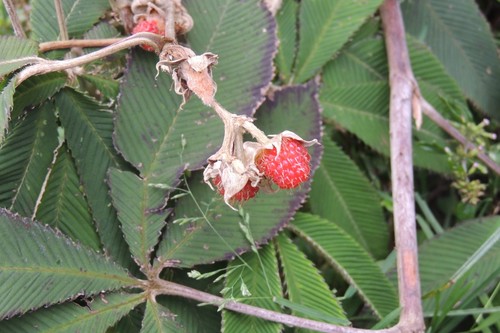
(c) Alexander Harman, Ph. D., some rights reserved (CC BY-NC), uploaded by Alexander Harman, Ph. D.

(c) Matt Berger, some rights reserved (CC BY)

(c) Matt Berger, some rights reserved (CC BY)
What to Eat
Edible parts: Fruit
The fruit can be eaten raw or cooked. It is orange to red in colour and measures 7–10mm in diameter.
Dangerous Lookalikes
This plant can be confused with the following toxic species. Always verify identification carefully before consuming any wild plant.


Red Baneberry: Short herbaceous plant (no thorns), berries on thick red stems, each berry has a single seed, compound sharply-toothed leaves.
Gempe aselu: Thorny woody canes (brambles), aggregate berry made of many drupelets, berries pull easily from receptacle.
Where to Find It
It is a tropical plant. In the Himalayas it grows between 2,100-3,000 m altitude. In Yunnan.
Asia, Australia, Bhutan, China, Himalayas, India, Indonesia, Malaysia, Myanmar, Nepal, Northeastern India, SE Asia, Sikkim, Vietnam,
How to Identify
An evergreen shrub. The canes are 3 m long and arch over. Plants develop sucker. The stems are 5-8 cm across. The leaves are large and pleated and divided into five leaflets. The leaves are satiny underneath on top and silvery underneath. The fruit are red.
How to Grow
Easily grown in a good well-drained loamy soil in sun or semi-shade. This species requires a sunny sheltered position. A very ornamental plant, it only succeeds outdoors in the milder areas of Britain. Stems have just a few minute prickles on them. Plants in this genus are notably susceptible to honey fungus.
Propagation: Seed requires stratification and is best sown in early autumn in a cold frame. Stored seed requires one month stratification at about 3°c and should be sown as early in the year as possible. Prick out seedlings when large enough to handle and grow on in a cold frame, then plant out into permanent positions in late spring of the following year. Cuttings of half-ripe wood can be taken in July/August in a frame. Tip layering in July, planting out in autumn. Division can be done in early spring or just before leaf-fall in autumn.
Medicinal Uses
None known
Other Uses
A purple to dull blue dye is obtained from the fruit. The stems are used to make fences.
Wikipedia
Source ↗Rubus lineatus (syn. R. pulcherrimus) is a semi-evergreen shrub belonging to the raspberry and blackberry genus Rubus. It is native to eastern and southern Asia, in China (Xizang, Yunnan), Bhutan, north east India (Sikkim), Indonesia, Malaysia, Myanmar, Nepal and north Vietnam. It is also cultivated as an ornamental for temperate climates. It spreads by suckering stems. Growing to a maximum height and spread of 4 m (13 feet), it has large, handsome palmate leaves with a contrasting white underside. Small white flowers in spring and summer are followed by red or yellow ornamental fruits in autumn. Full sun is required for the fruits to ripen. The Latin specific epithet lineatus ("lined" or "striped") refers to the deep veining of the leaves.
Notes
There are about 250 Rubus species.
Names & Synonyms
Achin barin, Arbei daun sutera, Chichi nintch, Dum soc, Gyampay aeiselu, Kada aphal, Na bong
References (13)
- Ambasta S.P. (Ed.), 2000, The Useful Plants of India. CSIR India. p 533
- Angami, A., et al, 2006, Status and potential of wild edible plants of Arunachal Pradesh. Indian Journal of Traditional Knowledge 5(4) October 2006, pp 541-550
- Bijdr. 17:1103, 1108. 1826
- Cheng, Z., et al, 2022, Ethnobotanical study on wild edible plants used by Dulong people in northwestern Yunnan, China. Journal of Ethnobiology and Ethnomedicine (2022) 18:3
- Flora of China @ efloras.org Volume 9
- Hibbert, M., 2002, The Aussie Plant Finder 2002, Florilegium. p 282
- Mukhia, P.K., et al, 2013, Wild plants as Non Wood Forest Products used by the rural community of Dagana, a southern foothill district of Bhutan, SAARC Journal, 27 pages
- Plants for a Future database, The Field, Penpol, Lostwithiel, Cornwall, PL22 0NG, UK. http://www.scs.leeds.ac.uk/pfaf/
- Ryan, S., 2008, Dicksonia. Rare Plants Manual. Hyland House. p 50
- Singh, H.B., Arora R.K.,1978, Wild edible Plants of India. Indian Council of Agricultural Research, New Delhi. p 70
- Singh, V. B., et al, (Ed.) Horticulture for Sustainable Income and Environmental Protection. Vol. 1 p 219
- Sukarya, D. G., (Ed.) 2013, 3,500 Plant Species of the Botanic Gardens of Indonesia. LIPI p 964
- www.Efloras.org Annotated checklist of the Flowering Plants of Nepal.
More from Rosaceae


