Rubus moluccanus
L.; Hook.f. in part
Molucca bramble

(c) Dr. Alexey Yakovlev, some rights reserved (CC BY), uploaded by Dr. Alexey Yakovlev
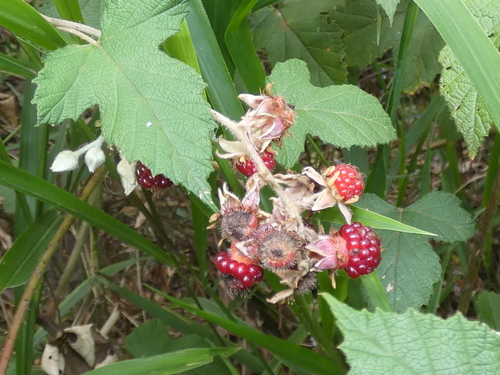
(c) Nick Lambert, some rights reserved (CC BY-NC-SA), uploaded by Nick Lambert

(c) Craig Robbins, some rights reserved (CC BY-NC), uploaded by Craig Robbins
What to Eat
Edible parts: Fruit
The fruit can be eaten raw or cooked and works well in pies and preserves. It has a sour, astringent flavour.
Dangerous Lookalikes
This plant can be confused with the following toxic species. Always verify identification carefully before consuming any wild plant.


Red Baneberry: Short herbaceous plant (no thorns), berries on thick red stems, each berry has a single seed, compound sharply-toothed leaves.
Molucca bramble: Thorny woody canes (brambles), aggregate berry made of many drupelets, berries pull easily from receptacle.
Where to Find It
A tropical plant. They occur in mountains from Bontoc, Mountain province in the Philippines to the northern limits of the islands. They are common in the highlands of Papua New Guinea from sea level to 2,200 m. In tropical Queensland they grow between 265-1200 m altitude.
Andamans, Asia, Australia, Himalayas, India, Indochina, Indonesia, Laos, Malaysia, Myanmar, New Caledonia, Northeastern India, Pacific, Papua New Guinea, PNG, Philippines, SE Asia, Solomon Islands, Sri Lanka, Vietnam,
How to Identify
A scrambling shrub reaching 2 to 3 m high. They can be 10-15 m long. The stems and leaves are armed with medium sized spines. The leaves are large and lobed and the upper surface hairy. The leaves can be 25 cm long and 25 cm wide. They are broadly heart shaped with 5 indistinct lobes. The flowers are white and borne in clusters. The berries are about 1-3 cm across. They are red and with little flavour.
How to Grow
Rubus moluccanus has a wide native range from the Himalayas through tropical southeast Asia to eastern Australia, where it can be found as far south as the warm temperate zone of Victoria. In the temperate zone, it can only be grown in regions with mild winters. Easily grown in a good well-drained, loamy soil in sun or semi-shade. The plant spreads by means of bird-sown seeds and vegetatively to form thickets. It has escaped from cultivation and become a weed in several areas, including the Mascarene Islands and southeastern N. America. There is at least one named variety occasionally cultivated for its edible fruit. 'Keri' (or Keriberry) is a very vigorous plant with mild-flavoured large black fruits that lack the distinctive flavour of blackberries. Plants in this genus are notably susceptible to honey fungus.
Propagation: Seed requires stratification and is best sown in early autumn in a cold frame. Stored seed needs one month of stratification at around 3°c and should be sown as early in the year as possible. Prick out seedlings once large enough to handle and grow on in a cold frame, then plant out into permanent positions in late spring of the following year. Cuttings of half-ripe wood can be taken in July or August in a frame. Tip layer in July and plant out in autumn. Divide in early spring or just before leaf-fall in autumn.
Medicinal Uses
The leaves are abortifacient, astringent, and emmenagogue. The leaves, or the sap they contain, can be used to treat dysentery. Sap from young shoots is drunk in a single dose to induce labour. A decoction of tender leaves combined with leaves of Psidium guajava, Perilla ocimoides, and Vernonia volkameriaefolia, plus the root of Urena lobota, is used to treat abdominal pain. The leaves are chewed with salt and then spat onto sores to promote healing. Sap from the leaves or stems is used to treat eye diseases. The fruit is considered a useful remedy for nocturnal micturition in children. The roots are astringent and act as a blood tonic; a decoction of the roots is used to treat dysentery and other internal complaints. The bark contains around 10% tannins and is an effective astringent.
Other Uses
A purple to dull blue dye can be obtained from the fruit.
Wikipedia
Source ↗Rubus moluccanus, the Molucca bramble or broad-leaf bramble, is a scrambling shrub or climber, native to moist eucalyptus forest and rainforest of eastern Australia, distributed from Queensland to Victoria, and to the Indian Subcontinent, Southeast Asia, Malesia, Papuasia, New Caledonia, Vanuatu and the Caroline Islands. Molucca bramble leaves are simple with 3–5 lobes, 2–15 cm long, and 3–10 cm wide, and the lower surface is tomentose. Flowers are pinkish red or white. Its red fruit are 1.2 cm wide.
Other Information
The plants are common in Papua New Guinea. The fruit is mainly eaten by children.
Notes
There are about 250 Rubus species. An unresolved name in The Plant List.
Names & Synonyms
Akar kupur, Arbei maluku, Berete, Bipen kanta, Brembet, Bunut, Ceylon blackberry, Dagamit, Dum dao Moluc, Duri berumbet, Fa lep, Farakau, Gadaw, Hareueus, Hezaembul, Kakaruka, Karembang ne langkow, Katsoi, Kinubot, Kwalo faraka'u, Kwalo totora, Milgankilgan gol, Ndang-chyaga, Ndangshaga, Nyia, Pfhupo, Pringga'en, Sapinit, Shanzi, Soh-nybbah, Som kung, Sosopi, Sufokji, Tampu rengat, Tempu ranak
References (44)
- Altschul, S.V.R., 1973, Drugs and Foods from Little-known Plants. Notes in Harvard University Herbaria. Harvard Univ. Press. Massachusetts. no. 1427 (Also as Rubus dendrocharis)
- Ambasta S.P. (Ed.), 2000, The Useful Plants of India. CSIR India. p 533
- Arora, K., Indigenous Forest Management in the Andaman and Nicobar Islands, India.
- Balkrishna, A., et al, 2022, Indigenous Uses of Plants among Forest-dependent Communities of Seijosa, Arunachal Pradesh. International Journal of Economic Plants 2022, 9(1):064-080
- Bourke, R. M., Altitudinal limits of 230 economic crop species in Papua New Guinea. Terra australis 32.
- Bourret, D., 1981, Bonnes-Plantes de Nouvelle-Caledonie et des Loyaute. ORSTOM. p 40
- Brown, W.H., 1920, Wild Food Plants of the Philippines. Bureau of Forestry Bulletin No. 21 Manila. p 63
- Burkill, I.H., 1966, A Dictionary of the Economic Products of the Malay Peninsula. Ministry of Agriculture and Cooperatives, Kuala Lumpur, Malaysia. Vol 2 (I-Z) p 1952
- Chakraborty, S. & Chaturbedi, H. P., 2014, Some Wild Edible Fruits of Tripura- A Survey. Indian Journal of Applied research. (4) 9
- Chase, P. & Singh, O. P., 2016, Bioresources of Nagaland: A Case of Wild 4 Edible Fruits in Khonoma Village Forest. in J. Purkayastha (ed.), Bioprospecting of Indigenous Bioresources of North-East India. p 51
- Cooper, W. and Cooper, W., 2004, Fruits of the Australian Tropical Rainforest. Nokomis Editions, Victoria, Australia. p 431
- Coronel, R.E., 1982, Fruit Collections in the Philippines. IBPGR Newsletter p 10
- Dobriyal, M. J. R. & Dobriyal, R., 2014, Non Wood Forest Produce an Option for Ethnic Food and Nutritional Security in India. Int. J. of Usuf. Mngt. 15(1):17-37
- Facciola, S., 1998, Cornucopia 2: a Source Book of Edible Plants. Kampong Publications, p 209
- French, B.R., 1986, Food Plants of Papua New Guinea, A Compendium. Asia Pacific Science Foundation p 249
- French, B.R., 2010, Food Plants of Solomon Islands. A Compendium. Food Plants International Inc. p 245
- Hardwick, R.J., 2000, Nature's Larder. A Field Guide to the Native Food Plants of the NSW South Coast. Homosapien Books. p 99
- Hariyadi, B., 2008, The Entwined Tree: Traditional Natural Resource Management of Serampas, Jambi, Indonesia. Ph. D thesis. Univ. or Hawaii. p 402
- Haslam, S., 2004, Noosa's Native Plants. Noosa Integrated Catchment Assn. Inc. p 357
- Henderson, C.P. and I.R.Hancock, 1988, A Guide to the Useful Plants of the Solomon Islands. Res. Dept. Min of Ag. & Lands. Honiara, Solomon Islands. p 133
- Hibbert, M., 2002, The Aussie Plant Finder 2002, Florilegium. p 282
- Hide, R., et al, 1979, A checklist of some plants in the territory of the Sinasina Nimai (Simbai Province, Papua New Guinea), with notes on their uses. Department Anthropology, University of Aukland
- Jackes, B.R., 2001, Plants of the Tropics. Rainforest to Heath. An Identification Guide. James Cook University. p 76
- Jones, D.L. & Gray, B., 1977, Australian Climbing Plants. Reed. p 25, 140
- Low, T., 1991, Wild Food Plants of Australia. Australian Nature FieldGuide, Angus & Robertson. p 67
- McClatchey, W. C., 2012, Wild food plants of Remote Oceania. Acta Societatis Botanicorum Poloniae 81(4) 371-380
- Melzer, R. & Plumb, J., 2011, Plants of Capricornia. Belgamba, Rockhampton. p 291 (As var. trilobus)
- Monsalud, M.R., Tongacan, A.L., Lopez, F.R., & Lagrimas, M.Q., 1966, Edible Wild Plants in Philippine Forests. Philippine Journal of Science. p 534
- Murtem, G. & Chaudhrey, P., 2016, An ethnobotanical note on wild edible plants of Upper Eastern Himalaya, India. Brazilian Journal of Biological Sciences, 2016, v. 3, no. 5, p. 63-81
- Pearson, S. & A., 1992, Rainforest Plants of Eastern Australia. Kangaroo Press p 183
- Peekel, P.G., 1984, (Translation E.E.Henty), Flora of the Bismarck Archipelago for Naturalists, Division of Botany, Lae, PNG. p 202, 201
- Pham-Hoang Ho, 1999, An Illustrated Flora of Vietnam. Nha Xuat Ban Tre. p 789
- Powell, J.M., Ethnobotany. In Paijmans, K., 1976, New Guinea Vegetation. Australian National University Press. p 111
- Plants for a Future database, The Field, Penpol, Lostwithiel, Cornwall, PL22 0NG, UK. http://www.scs.leeds.ac.uk/pfaf/
- Priyadi, H., et al, 2010, Five hundred plant species in Gunung Halimun Salak National Park, West Java. A checklist including Sundanese names, distribution and use. CIFOR, FFPRI, SLU p41
- Recher, P, 2001, Fruit Spirit Botanical Gardens Plant Index. www.nrg.com.au/~recher/ seedlist.html p 3
- Ryan, S., 2008, Dicksonia. Rare Plants Manual. Hyland House. p 78
- Sawian, J. T., et al, 2007, Wild edible plants of Meghalaya, North-east India. Natural Product Radiance Vol. 6(5): p 421
- Sillitoe, P. 1995, An Ethnobotanical Account of the Plant Resources of the Wola Region, Southern Highlands Province, Papua New Guinea. J. Ethnobiol. 15(2): 201-235
- Singh, H.B., Arora R.K.,1978, Wild edible Plants of India. Indian Council of Agricultural Research, New Delhi. p 71
- Singh, V. B., et al, (Ed.) Horticulture for Sustainable Income and Environmental Protection. Vol. 1 p 219
- Sp. pl. 2:1197. 1753
- Sukarya, D. G., (Ed.) 2013, 3,500 Plant Species of the Botanic Gardens of Indonesia. LIPI p 964
- World Checklist of Useful Plant Species 2020. Royal Botanic Gardens, Kew
More from Rosaceae


