Rubus nepalensis
(Hook. f.) Kuntze
Nepalese raspberry, Nhyalang
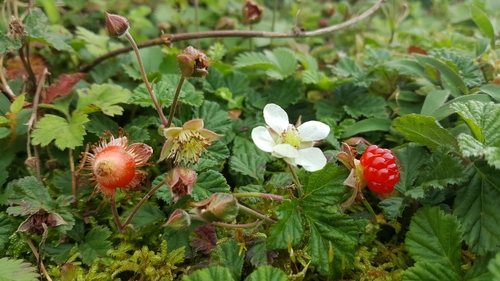
(c) T. Abe Lloyd, some rights reserved (CC BY-NC), uploaded by T. Abe Lloyd
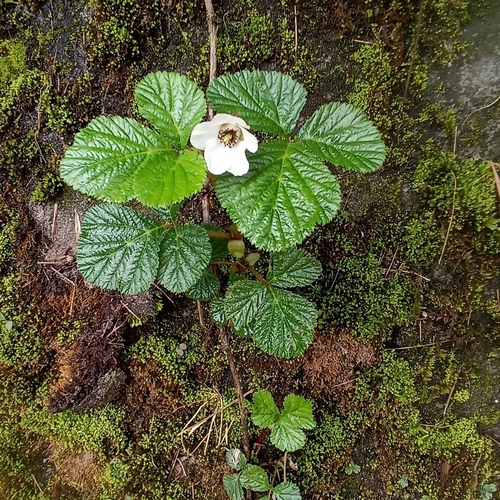
(c) Rajendra Koranga, some rights reserved (CC BY-NC), uploaded by Rajendra Koranga

(c) Ramnarayan K, some rights reserved (CC BY), uploaded by Ramnarayan K
What to Eat
Edible parts: Fruit
The fruit can be eaten raw or cooked. It is a well-flavoured, reasonably sized raspberry with just a slight sourness. Plants generally fruit well in the garden, though some forms produce very little fruit or poorly shaped fruits.
Dangerous Lookalikes
This plant can be confused with the following toxic species. Always verify identification carefully before consuming any wild plant.


Red Baneberry: Short herbaceous plant (no thorns), berries on thick red stems, each berry has a single seed, compound sharply-toothed leaves.
Nepalese raspberry: Thorny woody canes (brambles), aggregate berry made of many drupelets, berries pull easily from receptacle.
Where to Find It
It is a temperate plant. In Nepal it grows from 2,100-3,200 m altitude. It grows on rocky ground along river banks.
Asia, Himalayas, India, Nepal, Northeastern India, Sikkim,
How to Identify
A herb. It has creeping stems. The leaves are stalked. The leaves have 3 leaflets. These are broadly oval. They have a long point and double teeth. They are hairy on both surfaces. The flowers are white and nodding. The fruit are scarlet.
How to Grow
Plants are grown from root offshoots or seeds.
Propagation: Seed requires stratification and is best sown in early autumn in a cold frame. Stored seed should be sown as early as possible in the year; if sowing later than February, stratify for one month at 3°c. Prick out seedlings once large enough to handle and grow on in a cold frame, then plant out into permanent positions in late spring of the following year. Tip layer in July and plant out in autumn. Divide in early spring — this species is very easy to divide and can be split successfully at almost any time of year. Larger divisions can go straight into permanent positions; smaller ones are best potted up and grown on in a lightly shaded cold frame until well established, then planted out in summer.
Medicinal Uses
None known
Other Uses
A purple to dull blue dye can be obtained from the fruit. The plant also makes an excellent ground cover, forming a reasonably effective weed-suppressing mat.
Wikipedia
Source ↗Rubus nepalensis, the Himalayan creeping bramble or Nepalese raspberry, is a species of evergreen raspberry endemic to Nepal and Himalayan India. It grows to about 1m in diameter, with height up to 20 cm. The fruit is small, edible, and slightly sour.
Notes
There are about 250 Rubus species.
Names & Synonyms
Bhui ainselu, Gangoor, Sa palaha
References (6)
- Khakurel, D., et al, 2021, Foods from the wild: Local knowledge, use pattern and distribution in Western Nepal. PLOS ONE.
- Manandhar, N.P., 2002, Plants and People of Nepal. Timber Press. Portland, Oregon. p 404
- Meth. Sp.-Beschr. Rubus 125. 1879
- Plants for a Future database, The Field, Penpol, Lostwithiel, Cornwall, PL22 0NG, UK. http://www.scs.leeds.ac.uk/pfaf/
- Upreti, K., et al, 2010, Diversity and Distribution of Wild Edible Fruit Plants of Uttarakhand. Bioversity Potentials of the Himalaya. p 185
- www.Efloras.org Annotated checklist of the Flowering Plants of Nepal.
More from Rosaceae


