Rubus nubigenus
Kunth
Giant Colombian blackberry

(c) Pancho Sornoza, some rights reserved (CC BY-NC), uploaded by Pancho Sornoza
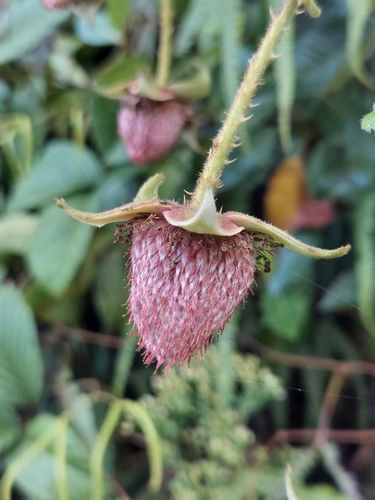
(c) Daniel Mesa, some rights reserved (CC BY), uploaded by Daniel Mesa
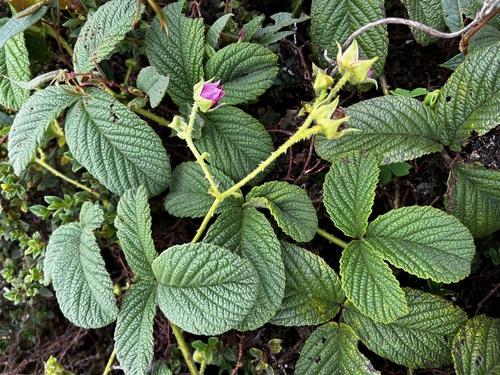
(c) Nelson Espinosa-Ortega, some rights reserved (CC BY-NC), uploaded by Nelson Espinosa-Ortega
What to Eat
Edible parts: Fruit
The fruit can be eaten raw or cooked and has a loganberry-like flavour. This species likely produces the largest fruit in the genus, reaching up to 5cm long and 2.5cm wide; fruits as large as a hen's egg have been recorded.
Dangerous Lookalikes
This plant can be confused with the following toxic species. Always verify identification carefully before consuming any wild plant.


Red Baneberry: Short herbaceous plant (no thorns), berries on thick red stems, each berry has a single seed, compound sharply-toothed leaves.
Giant Colombian blackberry: Thorny woody canes (brambles), aggregate berry made of many drupelets, berries pull easily from receptacle.
Where to Find It
A tropical plant. It grows at high elevations. It grows between 2,600-3,400 m above sea level. It needs a well-drained loamy soil. It can grow in sun or light shade.
Bolivia, Colombia, Ecuador, Peru, South America*,
How to Identify
A scrambling shrub. It loses its leaves during the year. It grows stems that last for 2 years and then fruit. They are 2 m long. The fruit are large. They are 5 cm long by 2.5 cm wide.
How to Grow
We have very little information on this species and do not know if it will be hardy in Britain. It is often sold in local markets in Colombia and is occasionally cultivated. Attempts to grow it outside its natural range have met with failure. The following notes are based on the general needs of the genus. Easily grown in a good well-drained loamy soil in sun or semi-shade. Plants in this genus are notably susceptible to honey fungus.
Propagation: Seed requires stratification and is best sown in early autumn in a cold frame. Stored seed needs one month of stratification at around 3°c and should be sown as early in the year as possible. Prick out seedlings once large enough to handle and grow on in a cold frame, then plant out into permanent positions in late spring of the following year. Cuttings of half-ripe wood can be taken in July or August in a frame. Tip layer in July and plant out in autumn. Divide in early spring or just before leaf-fall in autumn.
Medicinal Uses
None known
Other Uses
A purple to dull blue dye can be obtained from the fruit.
Wikipedia
Rubus nubigenus is a deciduous shrub reaching 2 m in height with hermaphroditic flowers. The plant reproduces through apomixis (seed formation without sexual fusion) and is self-fertile. It adapts to light sandy, medium loamy, and heavy clay soils with good drainage across mildly acid to mildly alkaline pH ranges, growing in semi-shade or full sun and preferring moist conditions.
Notes
There are about 250 Rubus species.
Names & Synonyms
Castilla mora, Chacaucho, Mishma mora, Mora de pina, Sactia mora
References (12)
- Fern, K., 2012, Tropical Species Database http://theferns.info/tropical/
- Kermath, B. M., et al, 2014, Food Plants in the Americas: A survey of the domesticated, cultivated and wild plants used for Human food in North, Central and South America and the Caribbean. On line draft. p 763
- Kew Plants of the World Online
- Lopez-Diago, D. & Garcia, N., 2021, Wild edible fruits of Colombia. Biota ColomBiana 22 (2) p 49
- Plants for a Future database, The Field, Penpol, Lostwithiel, Cornwall, PL22 0NG, UK. http://www.scs.leeds.ac.uk/pfaf/
- Roa, J. A. G. & Boada, D. S. G., 2018, Fundación para el Fortalecimiento de la Fruticultura y Plantas Alimenticias no Convencionales en Colombia.
- Torre, de la, L., et al, 2008, Enciclopedia de las Plantas Útiles del Ecuador. Herbario QCA. Pontificia Universidad Católica del Ecuador. p 538
- USDA, ARS, National Genetic Resources Program. Germplasm Resources Information Network - (GRIN). [Online Database] National Germplasm Resources Laboratory, Beltsville, Maryland. Available: www.ars-grin.gov/cgi-bin/npgs/html/econ.pl (10 April 2000)
- F. W. H. A. von Humboldt et al., Nov. gen. sp. 6:174[folio]. 1823; 6:220[quarto]. 1824 "nubigena"
- Van den Eynden, V., et al, 2003, Wild Foods from South Ecuador. Economic Botany 57(4): 576-603
- Van den Eynden, V., 2004, Use and management of edible non-crop plants in southern Ecuador, Ph D dissertation. p 108
- Wiersema, J. H. & Leon, B., 2013, World Economic Plants. A Standard Reference CRC Press. 2nd Ed. p 599
More from Rosaceae


