Rubus occidentalis
L.
Blackcap, Black raspberry, Black dewberry

(c) Joshua Mayer, some rights reserved (CC BY-SA)
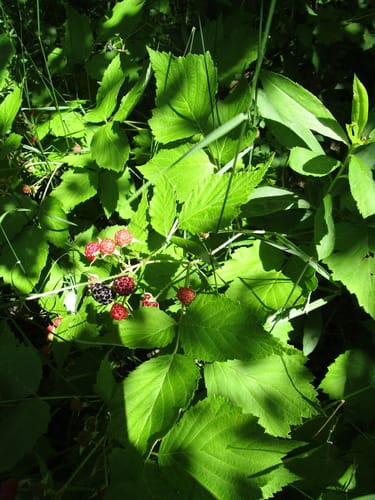
(c) mahpin, some rights reserved (CC BY-NC)
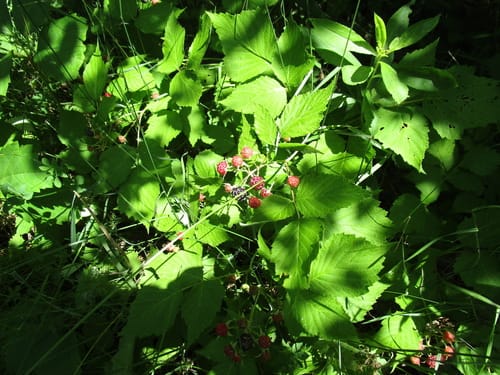
(c) mahpin, some rights reserved (CC BY-NC)
What to Eat
Edible parts: Fruit, Shoots, Leaves - tea
The fruit can be eaten raw or cooked in pies and preserves. Quality varies, but the best forms have a rich, acidic flavour; the hemispherical berries are about 15mm in diameter. Young shoots are edible raw or cooked like rhubarb — harvest them as they push through the soil in spring while still tender, then peel before eating. The leaves and the bark of the root can each be used separately to make tea.
Dangerous Lookalikes
This plant can be confused with the following toxic species. Always verify identification carefully before consuming any wild plant.


Red Baneberry: Short herbaceous plant (no thorns), berries on thick red stems, each berry has a single seed, compound sharply-toothed leaves.
Blackcap: Thorny woody canes (brambles), aggregate berry made of many drupelets, berries pull easily from receptacle.
Where to Find It
It is a temperate plant. It suits hardiness zones 3-9.
Australia, Canada, Europe, North America*, USA,
How to Identify
A shrub. It grows 3 m high and spreads 3 m wide. It loses its leaves during the year. The stems are curved and prickly. The leaves are dark green and have 5 leaflets on non flowering stems and 3 leaflets on flowering stems. The leaves are white and like felt underneath. The flowers are white. The fruit are dark purple. They are edible. Some named varieties occur.
How to Grow
Easily grown in a good well-drained loamy soil in sun or semi-shade. Sometimes cultivated, especially in N. America, for its edible fruit, it is a parent of many named varieties. This species is a raspberry with biennial stems, it produces a number of new stems each year from the perennial rootstock, these stems fruit in their second year and then die. Plants in this genus are notably susceptible to honey fungus. Berries are typically harvested in summer, from late spring to early autumn, depending on the species and local climate. Rubus species generally flower in late spring to early summer, usually from May to June (Northern Hemisphere), depending on the specific species and environmental conditions. Rubus species are known for their vigorous growth and can establish quickly, often spreading through both seeds and vegetative propagation. They can reach maturity in 1 to 2 years, with some species growing rapidly within a single growing season. Many Rubus species are self-fertile, meaning that a single plant can produce fruit on its own. However, some varieties may benefit from cross-pollination to increase yield.
Propagation: Seed requires stratification and is best sown in early autumn in a cold frame. Stored seed needs one month of stratification at about 3°C and should be sown as early as possible in the year. Prick out seedlings when large enough to handle, grow on in a cold frame, and plant out into permanent positions in late spring of the following year. Cuttings of half-ripe wood can be taken in July/August in a frame. Tip layer in July and plant out in autumn. Division can be done in early spring or just before leaf-fall in autumn.
Medicinal Uses
The roots are cathartic. A decoction of the roots has been used to treat gonorrhoea, and the root has been chewed for coughs and toothache. An infusion of the roots serves as a wash for sore eyes, and the root has been combined with Hypericum spp to treat the early stages of consumption. An infusion of the astringent root bark is used for diarrhoea and dysentery. The leaves are highly astringent; a decoction treats bowel complaints, and a tea made from the leaves is applied as a wash for old, foul sores, ulcers, and boils. A decoction of roots, stems, and leaves together has been used for whooping cough.
Other Uses
A purple to dull blue dye is obtained from the fruit. Rubus species can serve as ground cover to help prevent soil erosion and provide habitat and food for wildlife including birds and beneficial insects; their thorns also act as a natural barrier. The flowers are rich in nectar and pollen, attracting bees, butterflies, and other pollinators. The abundant berries are a significant food source for birds, mammals, and insects, while dense thickets offer shelter and nesting sites for small animals. The sprawling growth habit also provides cover and overwintering sites for invertebrates within stems and leaf litter.
Wikipedia
Source ↗Rubus occidentalis is a species of Rubus native to eastern North America. Its common name black raspberry is shared with other closely related species. Other names occasionally used include bear's eye blackberry, black cap, black cap raspberry, and scotch cap.
Other Information
It is cultivated.
Notes
There are about 250 Rubus species.
Names & Synonyms
Thimbleberry
References (24)
- Beckstrom-Sternberg, Stephen M., and James A. Duke. "The Foodplant Database." http://probe.nalusda.gov:8300/cgi-bin/browse/foodplantdb.(ACEDB version 4.0 - data version July 1994)
- Cundall, P., (ed.), 2004, Gardening Australia: flora: the gardener's bible. ABC Books. p 1284
- Elias, T.S. & Dykeman P.A., 1990, Edible Wild Plants. A North American Field guide. Sterling, New York p 183
- Esperanca, M. J., 1988. Surviving in the wild. A glance at the wild plants and their uses. Vol. 1. p 108
- Facciola, S., 1998, Cornucopia 2: a Source Book of Edible Plants. Kampong Publications, p 209
- Fisk, J. R. & Hoover, E., 2015, Wild Fruits of Minnesota. A Field Guide. University of Minnesota p 18
- Hedrick, U.P., 1919, (Ed.), Sturtevant's edible plants of the world. p 579
- http://en.hortipedia.com
- Jackes, D. A., 2007, Edible Forest Gardens
- John, L., & Stevenson, V., 1979, The Complete Book of Fruit. Angus & Robertson p 247
- Jennings, D.L., 1979, Raspberries and blackberries, in Simmonds, N.W., (ed), Crop Plant Evolution. Longmans. London. p 251
- Kermath, B. M., et al, 2014, Food Plants in the Americas: A survey of the domesticated, cultivated and wild plants used for Human food in North, Central and South America and the Caribbean. On line draft. p 763
- MacKinnon, A., et al, 2009, Edible & Medicinal Plants of Canada. Lone Pine. p 94
- Mansfield's Encyclopedia of Agricultural and Horticultural Crops p 423
- Medsger, O. P., 1939, Edible Wild Plants. Macmillan Company. p 25
- Moerman, D. F., 2010, Native American Ethnobotany. Timber Press. p 490
- Plants for a Future database, The Field, Penpol, Lostwithiel, Cornwall, PL22 0NG, UK. http://www.scs.leeds.ac.uk/pfaf/
- Sp. pl. 1:493. 1753
- Toupal, R. S. & Hollenback, K., 2009, An Ethnobotany of Indiana Dunes National Lakeshore: Plant Uses of the Ojibwa People. Bureau of Applied Research in Anthropology. University of Arizona
- USDA, ARS, National Genetic Resources Program. Germplasm Resources Information Network - (GRIN). [Online Database] National Germplasm Resources Laboratory, Beltsville, Maryland. Available: www.ars-grin.gov/cgi-bin/npgs/html/econ.pl (10 April 2000)
- van Wyk, B., 2005, Food Plants of the World. An illustrated guide. Timber press. p 329
- Wiersema, J. H. & Leon, B., 2013, World Economic Plants. A Standard Reference CRC Press. 2nd Ed. p 599
- Wild Edible Plants of the Whitmire Wildflower Garden. Missouri Botanical Gardens.
- World Checklist of Useful Plant Species 2020. Royal Botanic Gardens, Kew
More from Rosaceae


