Rubus parviflorus
Nutt.
Thimbleberry, Salmon berry
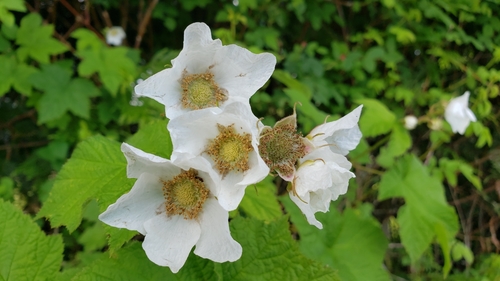
(c) Gavin Slater, some rights reserved (CC BY), uploaded by Gavin Slater

(c) Robert M. Mutch Jr., some rights reserved (CC BY-NC), uploaded by Robert M. Mutch Jr.

(c) urij777, some rights reserved (CC BY-NC), uploaded by urij777
What to Eat
Edible parts: Fruit, Leaves, Shoots
The fruit can be eaten raw or cooked and makes excellent jams and preserves; it can also be dried for later use. The flavour is sweet and pleasant, though it is not always fully developed in Britain's cooler summers. The fruit is very seedy and rich in vitamin C; the hemispherical berries are about 20mm in diameter. Young shoots should be peeled and can be eaten raw or cooked — harvest them in spring while still young and tender; they can be prepared like asparagus and are rich in vitamin C. Flowers are edible raw.
Dangerous Lookalikes
This plant can be confused with the following toxic species. Always verify identification carefully before consuming any wild plant.


Red Baneberry: Short herbaceous plant (no thorns), berries on thick red stems, each berry has a single seed, compound sharply-toothed leaves.
Thimbleberry: Thorny woody canes (brambles), aggregate berry made of many drupelets, berries pull easily from receptacle.
Where to Find It
It is a temperate plant. It grows in wooded subalpine streambeds in the Rocky Mountains in Canada. It suits damp shaded places. It suits hardiness zones 3-9.
Alaska, Australia, Canada, Mexico, Nepal, North America, USA,
How to Identify
A shrub. It grows 4.5 m high and spreads 3 m wide. It loses its leaves during the year. The stems are upright. The bark peels off. There are no prickles. The new growth is furry. The leaves mostly have 5 lobes. There are uneven teeth along the edge. The flowers are white. The fruit are red.
Nutrition Score: 38/100
| Part | Moisture | kJ | kcal | Protein | Vit A | Vit C | Iron | Zinc |
|---|---|---|---|---|---|---|---|---|
| Fruit | 74 | 460 | 110 | 1.7 | — | 63.6 | 0.7 | 0.4 |
| Leaves | 93 | 92 | 22 | 0.6 | — | — | — | — |
How to Grow
Easily grown in a good well-drained loamy soil in sun or semi-shade. Can be grown in a woodland garden though it is less likely to fruit well in such a position. This plant has perennial stems without prickles and is less invasive than the related R. odoratus. Plants in this genus are notably susceptible to honey fungus.
Propagation: Seed requires stratification and is best sown in early autumn in a cold frame. Stored seed should be sown as early as possible in the year, stratified for one month at 3°C if sowing later than February. Prick out seedlings when large enough to handle, grow on in a cold frame, and plant out into permanent positions in late spring of the following year. Tip layer in July and plant out in autumn. Divide in early spring.
Medicinal Uses
The leaves are antiemetic, astringent, a blood tonic, and stomachic. An infusion is taken internally for stomach complaints, diarrhoea, dysentery, anaemia, spitting up of blood, and vomiting, and has been taken by women experiencing unusually long periods. A poultice of dried powdered leaves treats wounds and burns. Crushed leaves rubbed on the skin address pimples and blackheads, and a poultice of leaf ashes mixed with oil has been used for swellings. The young shoots are alterative and antiscorbutic. The roots are appetizing, astringent, stomachic, and tonic; an infusion has been used by thin people to gain weight and to treat stomach disorders, diarrhoea, and dysentery. A decoction of the roots has been taken for pimples and blackheads.
Other Uses
The leaves are used to line baskets for carrying soft fruit or other delicate items. Plants are very vigorous and can be grown as tall ground cover for large areas. A soap can be obtained from the boiled bark. A purple to dull blue dye is obtained from the fruit.
Wikipedia
Source ↗Rubus parviflorus, the fruit of which is commonly called the thimbleberry or redcap, is a species of Rubus with large hairy leaves and no thorns. The species is native to northern temperate regions of North America. It produces red aggregate fruit similar in appearance to a raspberry; although edible, it is too soft for major commerce. It is cultivated as an ornamental.
Notes
There are about 250 Rubus species. They are good sources of Vitamin C.
Names & Synonyms
Rato ainselu, White-flowering raspberry
References (38)
- Beckstrom-Sternberg, Stephen M., and James A. Duke. "The Foodplant Database." http://probe.nalusda.gov:8300/cgi-bin/browse/foodplantdb.(ACEDB version 4.0 - data version July 1994)
- Bonney, N., 1997, Economic Native Trees and Shrubs for South Australia. Greening Australia (SA) inc. Campbelltown SA 5074 p 168
- Cheifetz, A., (ed), 1999, 500 popular vegetables, herbs, fruits and nuts for Australian Gardeners. Random House p 250
- Cormack, R. G. H., 1967, Wild Flowers of Alberta. Commercial Printers Edmonton, Canada. p 163
- Cundall, P., (ed.), 2004, Gardening Australia: flora: the gardener's bible. ABC Books. p 1285
- Elias, T.S. & Dykeman P.A., 1990, Edible Wild Plants. A North American Field guide. Sterling, New York p 180
- Esperanca, M. J., 1988. Surviving in the wild. A glance at the wild plants and their uses. Vol. 2. p 285
- Facciola, S., 1998, Cornucopia 2: a Source Book of Edible Plants. Kampong Publications, p 209
- Fisk, J. R. & Hoover, E., 2015, Wild Fruits of Minnesota. A Field Guide. University of Minnesota p 29
- Flora of China @ efloras.org Volume 9
- Gen. N. Amer. pl. 1:308. 1818
- Guil-Guerrero, J. L., et al, 2001, Edible Wild Plants. in Recent Progress in Medicinal Plants Vol. 8 Sci. Tech publishing, Texas
- Hedrick, U.P., 1919, (Ed.), Sturtevant's edible plants of the world. p 578 (As Rubus nutkanus)
- Heller, C. A., 1962, Wild Edible and Poisonous Plants of Alaska. Univ. of Alaska Extension Service. p 47
- Hibbert, M., 2002, The Aussie Plant Finder 2002, Florilegium. p 282
- Isaacs, J., 1987, Bush Food, Aboriginal Food and Herbal Medicine. Weldons. p 76
- Jackes, D. A., 2007, Edible Forest Gardens
- Jones, D.L. & Gray, B., 1977, Australian Climbing Plants. Reed. p 1
- Kermath, B. M., et al, 2014, Food Plants in the Americas: A survey of the domesticated, cultivated and wild plants used for Human food in North, Central and South America and the Caribbean. On line draft. p 763
- Kuhnlein, H. V., et al, 2009, Indigenous Peoples' food systems. FAO Rome p 33 (As Ribes)
- MacKinnon, A., et al, 2009, Edible & Medicinal Plants of Canada. Lone Pine. p 94
- Mansfield's Encyclopedia of Agricultural and Horticultural Crops
- Medsger, O. P., 1939, Edible Wild Plants. Macmillan Company. p 24
- Miya, M. S. & Gautum, D., 2021, Checklist of floral species at the Institute of Forestry, Pokhara Campus, Pokhara, Nepal. Journal of Institute of Forestry, Nepal 18 (2021) 133-177
- Moerman, D. F., 2010, Native American Ethnobotany. Timber Press. p 491
- NYBG herbarium "edible"
- Paczkowska, G . & Chapman, A.R., 2000, The Western Australian Flora. A Descriptive Calatogue. Western Australian Herbarium. p 513
- Plants for a Future database, The Field, Penpol, Lostwithiel, Cornwall, PL22 0NG, UK. http://www.scs.leeds.ac.uk/pfaf/
- Porsild, A.E., 1974, Rocky Mountain Wild Flowers. Natural History Series No. 2 National Museums of Canada. p 250
- Reis, S. V. and Lipp, F. L., 1982, New Plant Sources for Drugs and Foods from the New York Botanical Garden herbarium. Harvard. p 103
- Scotter, G. W., & Flygare, H., 1993, Wildflowers of the Canadian Rockies. Hurtig. p 38
- Segura, S., et al, 2018, The edible fruit species in Mexico. Genet Resour Crop Evol (2018) 65:1767–1793
- Stubbs, R. D., 1966, An investigation of the Edible and Medicinal Plants used by the Flathead Indians. MA thesis University of Montana. p 64
- Turner, N., 1995, Food Plants of Coastal First Peoples. Royal BC Museum Handbook p 124
- Turner, N., 1997, Food Plants of Interior First Peoples. Royal BC Museum Handbook p 154
- Turner, N., et al, 2011, "Up on the Mountain": Ethnobotanical Important of Montane Sites in Pacific Coastal North America. Journal of Ethnobiology 31(1): 4-43
- World Checklist of Useful Plant Species 2020. Royal Botanic Gardens, Kew (As Rubus nutkanus)
- www.wildediblefood.com
More from Rosaceae


