Rubus rigidus
J. E. Sm.
African bramble
no rights reserved, uploaded by Peter Warren

(c) Charles Stirton, some rights reserved (CC BY-SA), uploaded by Charles Stirton

(c) Reuben Heydenrych, some rights reserved (CC BY-NC)
What to Eat
Edible parts: Fruit
The orange fruit are eaten raw or used for jams, jellies, and drinks. The leaves are used for tea drinks.
Dangerous Lookalikes
This plant can be confused with the following toxic species. Always verify identification carefully before consuming any wild plant.


Red Baneberry: Short herbaceous plant (no thorns), berries on thick red stems, each berry has a single seed, compound sharply-toothed leaves.
African bramble: Thorny woody canes (brambles), aggregate berry made of many drupelets, berries pull easily from receptacle.
Where to Find It
A tropical plant. It grows on the edges of swamp forest in West Africa. It grows between 1,040-2,100 m altitude. It grows on clay loams and sandy soils. It is often along creeks and rivers.
Africa, Angola, Australia, Botswana, Cameroon, Central Africa, Congo, East Africa, Eswatini, Ethiopia, Kenya, Lesotho, Malawi, Mediterranean, Mozambique, North Africa, Nigeria, South Africa, Southern Africa, Swaziland, Tunisia, Uganda, West Africa, Zambia, Zimbabwe,
How to Identify
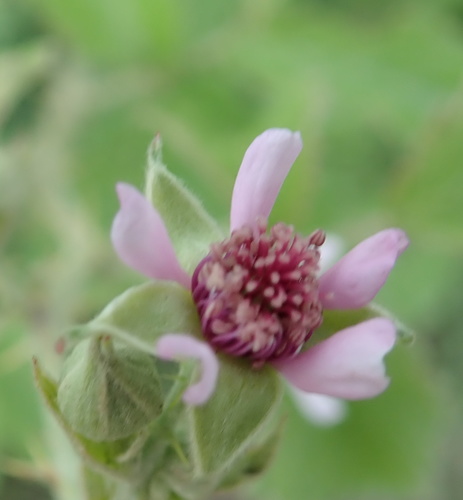
A straggling herb or shrub. It can be erect. It grows 1-3.5 m high. It keeps growing from year to year. The flowering branches have a grey covering and prickles. The leaves are 6-14 cm long by 6-11 cm wide. The flowers are pink or red. The fruit are orange.
How to Grow
Species in this genus are generally easily grown in a good well-drained loamy soil in sun or semi-shade.
Propagation: Seed - germinates best if given a period of cold stratification prior to sowing in containers. Stored seed requires one month stratification at about 3°c and is best sown as early as possible in the growing season. Prick out the seedlings when they are large enough to handle and grow on until large enough to plant out. Cuttings of half-ripe wood in a frame. Tip layering towards the end of the growing season Division just before the plant comes into new growth or as it enters dormancy.
Notes
There are about 250 Rubus species.
Names & Synonyms
Achdirt, Akhlij, Allaiq, Amarha, Amodar, Annejil, Areq ahmar, Caulachombe, Chedremmou, Chouq, Ijingijolo, Inidjeb, Landj, Monokotsoai-oa-banna, Nkaakut, Tizoual, Ukato, Ulucumence, Wildebraam
References (27)
- BOUQUET, (As Rubus discolor)
- Burkill, H. M., 1985, The useful plants of west tropical Africa, Vol. 4. Kew.
- Flora Zambesiaca. http://apps.kew.org/efloras
- Fox, F. W. & Young, M. E. N., 1982, Food from the Veld. Delta Books. p 317
- Guillarmod, J. 1966, 1971,
- Hussey, B.M.J., Keighery, G.J., Cousens, R.D., Dodd, J., Lloyd, S.G., 1997, Western Weeds. A guide to the weeds of Western Australia. Plant Protection Society of Western Australia. p 210 (As Rubus discolor)
- Ichikawa, M., 1980, The Utilization of Wild Food Plants by the Suiei Dorobo in Northern Kenya. J. Anthrop. Soc. Nippon. 88(1): 25-48
- Jardin, C., 1970, List of Foods Used In Africa, FAO Nutrition Information Document Series No 2.p 159
- JSTOR Global Plants edible
- Lazarides, M. & Hince, B., 1993, Handbook of Economic Plants of Australia, CSIRO. p 207 (As Rubus discolor)
- Long, C., 2005, Swaziland's Flora - siSwati names and Uses http://www.sntc.org.sz/flora/
- Magwede, K., van Wyk, B.-E., & van Wyk, A. E., 2019, An inventory of Vhavenḓa useful plants. South African Journal of Botany 122 (2019) 57–89
- Moerman, D. F., 2010, Native American Ethnobotany. Timber Press. p 488 (As Rubus discolor)
- Mutie, F. M., et al, 2023, Important Medicinal and Food Taxa (Orders and Families) in Kenya, Based on Three Quantitative Approaches. Plants 2023, 12, 1145
- Paczkowska, G . & Chapman, A.R., 2000, The Western Australian Flora. A Descriptive Calatogue. Western Australian Herbarium. p 512 (As Rubus discolor)
- Peters, C. R., O'Brien, E. M., and Drummond, R.B., 1992, Edible Wild plants of Sub-saharan Africa. Kew. p 167
- A. Rees, Cycl. 30: Rubus no. 5. 1815 (Ser. in A. P. de Candolle, Prodr. 2:556. 1825)
- Rubi germanici 30. 1824 (Deut. Brombeerstr.) (As Rubus discolor)
- Ruiters-Welcome, A. K., 2019, Food plants of southern Africa. Ph.D. thesis. Univ. of Johannesburg p 95
- Swaziland's Flora Database http://www.sntc.org.sz/flora
- Tredgold, M.H., 1986, Food Plants of Zimbabwe. Mambo Press. p 78
- van Wyk, Be., & Gericke, N., 2007, People's plants. A Guide to Useful Plants of Southern Africa. Briza. p 54
- van Wyk, B-E., 2011, The potential of South African plants in the development of new food and beverage products. South African Journal of Botany 77 (2011) 857–868
- Vinnicombe, 1976,
- Welcome, A. K. & Van Wyk, B.-E., 2019, An inventory and analysis of the food plants of southern Africa. South African Journal of Botany 122 (2019) 136–179
- White, F., Dowsett-Lemaire, F. and Chapman, J. D., 2001, Evergreen Forest Flora of Malawi. Kew. p 457
- Wild, 1975,
More from Rosaceae


