Rubus rolfei
S. Vidal
Dutung
no rights reserved, uploaded by 葉子

(c) cmacca, some rights reserved (CC BY-NC)

(c) Yaling Lin, some rights reserved (CC BY-NC)
What to Eat
Edible parts: Fruit
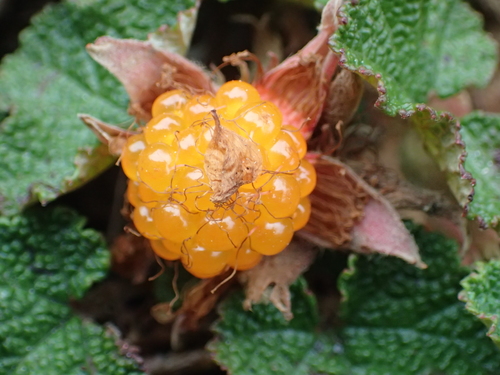
The fruit can be eaten raw or cooked. It is yellow to orange-reddish in colour and up to 14mm in diameter.
Dangerous Lookalikes
This plant can be confused with the following toxic species. Always verify identification carefully before consuming any wild plant.


Red Baneberry: Short herbaceous plant (no thorns), berries on thick red stems, each berry has a single seed, compound sharply-toothed leaves.
Dutung: Thorny woody canes (brambles), aggregate berry made of many drupelets, berries pull easily from receptacle.
Where to Find It
A tropical plant. They are common in mossy forests throughout the Philippines. In Taiwan it grows between 1,600-3,800 m altitude. It suits hardiness zones 7-9.
Asia, Australia, Canada, North America, Pacific, Philippines, SE Asia, Taiwan, USA,
How to Identify
A scrambling shrub 2 to 3 m high. It is a ground cover plant. The stems and lower surfaces of leaves and covered with fine soft hairs while the stem and larger veins of the leaves are armed with small spines. The leaves are rough and 3 to 5 lobed and dark green above and brownish underneath. They have a toothed edge. The leaves are crinkled. They turn reddish-brown with frost. The flowers are small and white. The fruit are yellow, fleshy and well flavoured.
How to Grow
Easily grown in a good well-drained loamy soil in sun or semi-shade. Succeeds in deep shade. Plants are evergreen in most climates but they can lose their leaves in severe winters. Occasionally cultivated for its edible fruit, there are some named varieties. 'Emerald Carpet' is an ornamental thornless form with orange berries that resemble small raspberries. Plants in this genus are notably susceptible to honey fungus. Rubus pentalobus Hayata is a synonym of Rubus rolfei J.E.Vidal An evergreen. A clumping mat former. Forming a dense prostrate carpet with a limited spread.
Propagation: Seed requires stratification and is best sown in early autumn in a cold frame. Stored seed needs one month of stratification at about 3°c and should be sown as early as possible in the year. Prick out seedlings when large enough to handle and grow on in a cold frame, then plant out into permanent positions in late spring of the following year. Cuttings of half-ripe wood can be taken in July or August in a frame. Division is possible in early spring or just before leaf-fall in autumn.
Medicinal Uses
None known.
Other Uses
A purple to dull blue dye is obtained from the fruit. This plant also makes a good ground cover for a sunny position or deep shade, forming a firmly matted cover, though it requires weeding for the first year or so. Plants are best spaced about 60cm apart each way.
Wikipedia
Source ↗Rubus rolfei, known as creeping raspberry, crinkle-leaf creeper, or Taiwanese creeping bramble, is a low-growing member of the genus Rubus and is related to the blackberry and raspberry. It is common in the horticultural trade. The species is originally from Taiwan where it grows at high elevations.
Notes
There are about 250 Rubus species.
Names & Synonyms
References (8)
- Brown, W.H., 1920, Wild Food Plants of the Philippines. Bureau of Forestry Bulletin No. 21 Manila. p 60
- Flora of China @ efloras.org Volume 9
- Jackes, D. A., 2007, Edible Forest Gardens
- Lyle, S., 2006, Discovering fruit and nuts. Land Links. p 391
- Monsalud, M.R., Tongacan, A.L., Lopez, F.R., & Lagrimas, M.Q., 1966, Edible Wild Plants in Philippine Forests. Philippine Journal of Science. p 533
- Phan. Cuming. philipp. 171. 1885
- Ryan, S., 2008, Dicksonia. Rare Plants Manual. Hyland House. p 110 (As Rubus pentalobus)
- World Checklist of Useful Plant Species 2020. Royal Botanic Gardens, Kew
More from Rosaceae


