Rubus rosifolius
Smith
Rose-leaf bramble

daniablr (via Wikimedia Commons)

Jean Van Jean (via Wikimedia Commons)

John Moss (via Wikimedia Commons)
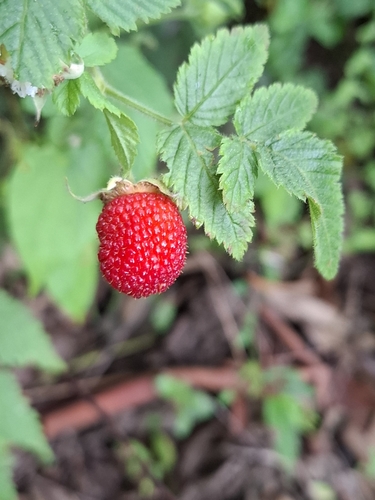
(c) dsouza, some rights reserved (CC BY-NC)

(c) Gavin Goodyear, some rights reserved (CC BY-NC)

(c) blueberrybird, some rights reserved (CC BY-NC)
What to Eat
Edible parts: Fruit, Leaves
The red fruit, up to 15mm in diameter, can be eaten raw or cooked in pies, preserves, and similar preparations. It is a type of raspberry but lacks any particularly pleasant flavour, being rather insipid when raw. It is usually better cooked, making good tarts and jams. The leaves are also edible, though no further details are given.
Dangerous Lookalikes
This plant can be confused with the following toxic species. Always verify identification carefully before consuming any wild plant.


Red Baneberry: Short herbaceous plant (no thorns), berries on thick red stems, each berry has a single seed, compound sharply-toothed leaves.
Rose-leaf bramble: Thorny woody canes (brambles), aggregate berry made of many drupelets, berries pull easily from receptacle.
Where to Find It
It is a tropical plant. It can grow in the lowlands and highlands. Plants are resistant to drought and frost. They are common in forests of Luzon, Visayas and Mindanao in the Philippines at low and medium altitudes. They are common in the highlands. In Papua New Guinea, Rubus rosifolius grows from 750-2800 m altitude. It suits hardiness zones 9-11.
Africa, Argentina, Asia, Australia, Brazil*, Cambodia, Cameroon, Central Africa, Central America, China, Colombia, Dominican Republic, East Africa, East Timor, Eswatini, Ethiopia, Hawaii, Himalayas, India, Indochina, Indonesia, Japan, Laos, Madagascar, Malawi, Malaysia, Marquesas, Mauritius, Myanmar, Nepal, New Caledonia, Northeastern India, Pacific, Papua, Papua New Guinea, PNG, Philippines, Polynesia, Puerto Rico, SE Asia, Sikkim, Solomon Islands, South Africa, Southern Africa, South America, St Helena, St Lucia, Swaziland, Taiwan, Thailand, Timor-Leste, USA, Vanuatu, Vietnam, West Africa, West Indies, West Papua, Zambia, Zimbabwe,
How to Identify
A spiny evergreen creeping shrub. It grows to 3 m high and spreads to 3 m across. The stem is trailing and forms suckers. The leaves have 3 to 7 leaflets on opposite sides of the stalk. These are either smooth or hairy with lobed edges. The leaflets are 1-9 cm long. The flowers are white and 3 cm across. The fruit are red and about 1.5 to 2 cm across. They occur on their own or in clusters. They are juicy and tasteless. They have several seeds inside which are very tiny.
Nutrition Score: 10/100
| Part | Moisture | kJ | kcal | Protein | Vit A | Vit C | Iron | Zinc |
|---|---|---|---|---|---|---|---|---|
| Fruit | 82.9 | — | — | 1.3 | — | 1 | — | 0.3 |
How to Grow
Plants are grown from seed. They both grow wild. The fruit are crushed in water and the seeds float free. These are left overnight when the seeds sink and the flesh floats. Seeds can take 3 months to germinate. They could be grown by division of the root or from cuttings. Cuttings grown easily.
Propagation: Seed requires stratification and is best sown in early autumn in a cold frame. Stored seed needs one month of stratification at about 3°c and should be sown as early as possible in the year. Prick out seedlings when large enough to handle and grow on in a cold frame, then plant out into permanent positions in late spring of the following year. Cuttings of half-ripe wood can be taken in July or August in a frame. Tip layering can be done in July, with plants set out in autumn. Division is possible in early spring or just before leaf-fall in autumn.
Medicinal Uses
The leaves and roots are anodyne, astringent, and depurative. A decoction of the leafy stems is used in the treatment of fevers.
Other Uses
A purple to dull blue dye is obtained from the fruit.
Wikipedia
Source ↗Rubus rosifolius, (sometimes spelled Rubus rosaefolius), also known as roseleaf bramble, Mauritius raspberry, thimbleberry, Vanuatu raspberry and bramble of the Cape is a species of prickly subshrub. Its double-flowered variety is named Rubus rosifolius var. coronarius (synonym: Rubus coronarius).
Other Information
The plants are common in Papua New Guinea. The fruit is eaten especially by children. It is cultivated.
Notes
There are about 250 Rubus species.
Names & Synonyms
Arbei tropis merah, Beberetean, Bramble-of-the-Cape, Cape bramble, Dum la-huong, Fongwez, Framboesa-silvestre, Frambuesa, Frutilla del monte, Gahkyeng, Gampe aselu, Gempe aselu, Gharunggung, Gucen, Init, Kashempong-pot, Katigaro, Kobabol kul, Kongxinpao, Malief, Mantum, Maranguinho-do-mato, Mauritius raspberry, Mon barang, Sagmit, Sapinit, Sepfulicu, Sumugisim, Thimbleberry, Tropical Red raspberry, Ujen-ujen, Voaroy, Zarza
References (83)
- Alimenticias - FloraSBS
- Ambasta S.P. (Ed.), 2000, The Useful Plants of India. CSIR India. p 533
- Arora, R. K., 2014, Diversity in Underutilized Plant Species - An Asia-Pacific Perspective. Bioversity International. p 85
- Asfaw, Z. and Tadesse, M., 2001, Prospects for Sustainable Use and Development of Wild Food Plants in Ethiopia. Economic Botany, Vol. 55, No. 1, pp. 47-62
- Bodkin, F., 1991, Encyclopedia Botanica. Cornstalk publishing, p 893
- Bodner, C. C. and Gereau, R. E., 1988, A Contribution to Bontoc Ethnobotany. Economic Botany, 43(2): 307-369
- Bourke, R. M., Altitudinal limits of 230 economic crop species in Papua New Guinea. Terra australis 32.
- Bourret, D., 1981, Bonnes-Plantes de Nouvelle-Caledonie et des Loyaute. ORSTOM. p 40
- Brack, P., et al, 2020, Frutas nativas do Rio Grande do Sul, Brasil: riqueza e potencial alimentício. Native fruits of Rio Grande do Sul, Brazil: richness and potential as food. Rodriguésia 71: e03102018
- Brown, W.H., 1920, Wild Food Plants of the Philippines. Bureau of Forestry Bulletin No. 21 Manila. p 66
- Burkill, H. M., 1985, The useful plants of west tropical Africa, Vol. 4. Kew.
- Call, C. A., et al, 2004, Participatory Rural Appraisal in the Upland Ecosystem of Mt Malindang, Misamis Occidental, Philippines. Biodiversity Research Programme for Development in Mindanao. p 59
- Caton, J.M. & Hardwick, R. J., 2016, Field Guide to Useful Native Plants from Temperate Australia. Harbour Publishing House. p 232
- Chakraborty, S. & Chaturbedi, H. P., 2014, Some Wild Edible Fruits of Tripura- A Survey. Indian Journal of Applied research. (4) 9
- Chase, P. & Singh, O. P., 2016, Bioresources of Nagaland: A Case of Wild 4 Edible Fruits in Khonoma Village Forest. in J. Purkayastha (ed.), Bioprospecting of Indigenous Bioresources of North-East India. p 51
- Cherikoff V. & Isaacs, J., The Bush Food Handbook. How to gather, grow, process and cook Australian Wild Foods. Ti Tree Press, Australia p 41
- Cooper W & Cooper W T, 1994, Fruits of the Rain Forest. RD Press p 248
- Cribb, A.B. & J.W., 1976, Wild Food in Australia, Fontana. p 53
- Cundall, P., (ed.), 2004, Gardening Australia: flora: the gardener's bible. ABC Books. p 1285
- Facciola, S., 1998, Cornucopia 2: a Source Book of Edible Plants. Kampong Publications, p 210
- Flora of China. Vol. 9 p 91
- French, B.R., 1986, Food Plants of Papua New Guinea, A Compendium. Asia Pacific Science Foundation p 249
- French, B.R., 2010, Food Plants of Solomon Islands. A Compendium. Food Plants International Inc. p 246
- Gott, B & Conran, J., 1991, Victorian Koorie Plants. PO Box 666 Hamilton, Victoria 3300, Australia. p 35
- Hardwick, R.J., 2000, Nature's Larder. A Field Guide to the Native Food Plants of the NSW South Coast. Homosapien Books. p 99
- Haslam, S., 2004, Noosa's Native Plants. Noosa Integrated Catchment Assn. Inc. p 358
- Hedrick, U.P., 1919, (Ed.), Sturtevant's edible plants of the world. p 580
- Hibbert, M., 2002, The Aussie Plant Finder 2002, Florilegium. p 282
- Hiddins, L., 1999, Explore Wild Australia with the Bush Tucker Man. Penguin Books/ABC Books. p 168
- Hide, R., et al, 1979, A checklist of some plants in the territory of the Sinasina Nimai (Simbai Province, Papua New Guinea), with notes on their uses. Department Anthropology, University of Aukland
- Hu, Shiu-ying, 2005, Food Plants of China. The Chinese University Press. p 461
- Hunter, D., et al, 2019, The potential of neglected and underutilized species for improving diets and nutrition. Planta (2019) 250:709-729
- Jardin, C., 1970, List of Foods Used In Africa, FAO Nutrition Information Document Series No 2.p 159
- JSTOR Global Plants edible
- Kinupp, V. F., 2007, Plantas alimenticias nao-convencionais da regiao metropolitana de Porto Alegre, RS, Brazil p 96
- Kinupp, V. F. & Bergman, I., 2008, Protein and minerals of native species, potential vegetables and fruits. Cienc.Tecnol. Aliment. Vol. 28 No. 4 Campinas Oct/Dec.
- Kujawska, M. & Luczaj, L., 2015, Wild Edible Plants Used by the Polish Community in Misiones, Argentina. Human Ecology 43:855-869
- Lamoureux, C.H., 1976, Trailside Plants of Hawaii's National Parks. Hawaii Natural History Association. p 31
- Leal, M. L. et al, 2018, Knowledge, use, and disuse of unconventional food plants. Journal of Ethnobiology and Ethnomedicine (2018) 14:6
- Long, C., 2005, Swaziland's Flora - siSwati names and Uses http://www.sntc.org.sz/flora/
- Lorenzi, H., Bacher, L., Lacerda, M. & Sartori, S., 2006, Brazilian Fruits & Cultivated Exotics. Sao Paulo, Instituto Plantarum de Estuados da Flora Ltda. p 281
- Low, T., 1991, Wild Food Plants of Australia. Australian Nature FieldGuide, Angus & Robertson. p 66
- Macmillan, H.F. (Revised Barlow, H.S., et al) 1991, Tropical Planting and Gardening. Sixth edition. Malayan Nature Society. Kuala Lumpur. p 319
- Martin, F.W. & Ruberte, R.M., 1979, Edible Leaves of the Tropics. Antillian College Press, Mayaguez, Puerto Rico. p 57, 216
- Martin, F. W., et al, 1987, Perennial Edible Fruits of the Tropics. USDA Handbook 642 p 55
- Medhi, P. & Borthakur, S. K., 2012, Phytoresources from North Cachur Hills of Assam -3: Edible plants sold at Hflong market. Indian Journal of Natural Products and Resources. 3(1) pp 84-109
- Medhi, P., Sarma, A and Borthakur, S. K., 2014, Wild edible plants from the Dima Hasao district of Assam, India. Pleione 8(1): 133-148
- Menisa, A. A., et al, 2012, Survey and characterization of Indigenous Food Plants in Ilocos Norte, Philippines. SEARCA Discussion Paper series No. 2011-2
- Milliken, W., 2000, Ethnobotany of the Yali of West Papua. Royal Botanical Garden, Edinburgh. p 10 (near Baliem)
- Monsalud, M.R., Tongacan, A.L., Lopez, F.R., & Lagrimas, M.Q., 1966, Edible Wild Plants in Philippine Forests. Philippine Journal of Science. p 533
- NYBG Herbarium "edible"
- Peekel, P.G., 1984, (Translation E.E.Henty), Flora of the Bismarck Archipelago for Naturalists, Division of Botany, Lae, PNG. p 202, 201
- Pham-Hoang Ho, 1999, An Illustrated Flora of Vietnam. Nha Xuat Ban Tre. p 784
- Phon, P., 2000, Plants used in Cambodia. © Pauline Dy Phon, Phnom Penh, Cambodia. p 539
- Plants for a Future database, The Field, Penpol, Lostwithiel, Cornwall, PL22 0NG, UK. http://www.scs.leeds.ac.uk/pfaf/
- Pl. icon. ined. 3: t. 60. 1791 "rosaefolius"
- Porcher, V., et al, 2022, Growing up in the Betsileo landscape: Children’s wild edible plants knowledge in Madagascar. PLoS ONE 17(2): e0264147.
- Powell, J.M., Ethnobotany. In Paijmans, K., 1976, New Guinea Vegetation. Australian National University Press. p 111
- Priyadi, H., et al, 2010, Five hundred plant species in Gunung Halimun Salak National Park, West Java. A checklist including Sundanese names, distribution and use. CIFOR, FFPRI, SLU p 12
- Ruiters-Welcome, A. K., 2019, Food plants of southern Africa. Ph.D. thesis. Univ. of Johannesburg p 95
- Savita, et al, 2006, Studies on wild edible plants of ethnic people in east Sikkim. Asian J. of Bio Sci. (2006) Vol. 1 No. 2 : 117-125
- Senbeta, F., et al, 2013, Diversity of Useful Plants in the Coffee Forests of Ethiopia. Ethnobotany Research & Applications 11:049-069
- Sillitoe, P. 1995, An Ethnobotanical Account of the Plant Resources of the Wola Region, Southern Highlands Province, Papua New Guinea. J. Ethnobiol. 15(2): 201-235
- Singh, H.B., Arora R.K.,1978, Wild edible Plants of India. Indian Council of Agricultural Research, New Delhi. p 71
- Singh, V. B., et al, (Ed.) Horticulture for Sustainable Income and Environmental Protection. Vol. 1 p 219
- Srivastava, R. C., 2009, Traditional knowledge of Adi tribe of Arunachal Pradesh on plants. Indian Journal of Traditional Knowledge. 8(2): 146-153
- Styger, E., et al, 1999, Indigenous fruit trees of Madagascar: potential components of agroforestry systems to improve human nutrition and restore biological diversity. Agroforestry Systems 46: 289-310
- Sukarya, D. G., (Ed.) 2013, 3,500 Plant Species of the Botanic Gardens of Indonesia. LIPI p 966
- Swaziland's Flora Database http://www.sntc.org.sz/flora
- Tanaka,
- Ulian, T., et al, 2020, Unlocking plant resources to support food security and promote sustainable agriculture. Plants, People, Planet. 2020;2:421–445.
- USDA, ARS, National Genetic Resources Program. Germplasm Resources Information Network - (GRIN). [Online Database] National Germplasm Resources Laboratory, Beltsville, Maryland. Available: www.ars-grin.gov/cgi-bin/npgs/html/econ.pl (10 April 2000)
- Valder, P., 1999, The Garden Plants of China. Florilegium. p 326
- Vivien, J., & Faure, J.J., 1996, Fruitiers Sauvages d'Afrique. Especes du Cameroun. CTA p 279
- Welcome, A. K. & Van Wyk, B.-E., 2019, An inventory and analysis of the food plants of southern Africa. South African Journal of Botany 122 (2019) 136–179
- White, F., Dowsett-Lemaire, F. and Chapman, J. D., 2001, Evergreen Forest Flora of Malawi. Kew. p 457
- Wiersema, J. H. & Leon, B., 2013, World Economic Plants. A Standard Reference CRC Press. 2nd Ed. p 599
- Wiriadinata, H., 1995, Ethnobotany of Economic Plants in the Baliem Valley, Jayawijaya, Irian Jaya, Indonesian Institute of Science, Bogor, Indonesia
- World Checklist of Useful Plant Species 2020. Royal Botanic Gardens, Kew
- www.colecionandofrutas.org
- www.Efloras.org Annotated checklist of the Flowering Plants of Nepal.
- Yallakool Reserve Plant List July 1, 2009 Off internet
- Zeven, A. C. & de West, J. M. J., 1982, Dictionary of cultivated plants and their regions of diversity. Wageningen. p 62
More from Rosaceae


