Rubus spectabilis
Pursh
Salmonberry, Thimbleberry

(c) Harry Hill, some rights reserved (CC BY-NC), uploaded by Harry Hill
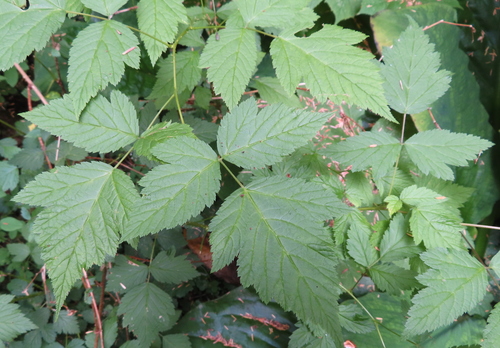
(c) Andy Goerdel - Texas Master Naturalist, Good Water Chapter, some rights reserved (CC BY-NC), uploaded by Andy Goerdel - Texas Master Naturalist, Good Water Chapter

(c) Lynette Schimming, some rights reserved (CC BY-NC)
What to Eat
Edible parts: Flowers, Fruit, Stem, Leaves - tea
The fruit can be eaten raw, cooked, or dried for later use. It is juicy with a very good flavour and can be made into jams and jellies. The fruit ranges in colour from yellow through orange to red and is roughly the size of a cultivated raspberry, though it can be somewhat inferior in flavour and often carries a distinctive bitterness, especially during cooler summers. One account notes that this species is not of great value in Britain, as it does not fruit freely in cooler summers and the fruits do not always develop their full flavour, though another report contradicts this, stating it fruits freely in Britain. Young shoots can be peeled and eaten raw or cooked like asparagus; they are harvested in spring as they emerge from the soil while still tender. The flowers can be eaten raw. The leaves make a useful tea substitute.
Known Hazards
Dangerous Lookalikes
This plant can be confused with the following toxic species. Always verify identification carefully before consuming any wild plant.


Red Baneberry: Short herbaceous plant (no thorns), berries on thick red stems, each berry has a single seed, compound sharply-toothed leaves.
Salmonberry: Thorny woody canes (brambles), aggregate berry made of many drupelets, berries pull easily from receptacle.
Where to Find It
It is a temperate plant. It grows in shaded swamps and damp woods. It suits hardiness zones 5-9.
Alaska, Australia, Canada, North America, USA,
How to Identify
A prickly shrub. It grows 1.8 m tall and spreads 1.8 m wide. It loses its leaves during the year. The stems are upright. It has small thorns. The leaves have 3 egg shaped leaflets. The flowers occur singly and are pink or purple. The fruit is a berry which is edible. It is a yellow-pink colour.
Nutrition Score: 24/100
| Part | Moisture | kJ | kcal | Protein | Vit A | Vit C | Iron | Zinc |
|---|---|---|---|---|---|---|---|---|
| Fruit | 88 | 217 | 52 | 1.4 | — | 14.4 | 0.6 | 0.2 |
| Leaves | 93 | 109 | 27 | 0.5 | — | — | — | — |
How to Grow
Easily grown in a good well-drained loamy soil in sun or semi-shade. Grows well in the shade of trees though it is less likely to fruit well in such a position. Hardy to about -25°c. A very ornamental plant, but it is invasive. It does not fruit well in Britain, but has become naturalized in Surrey and Cumbria in cool acid woodland soils. This species is a raspberry with biennial stems, it produces a number of new stems each year from the perennial rootstock, these stems fruit in their second year and then die. Plants in this genus are notably susceptible to honey fungus. A clumping plant, forming a colony from shoots away from the crown but with a limited spread.
Propagation: Seed requires stratification and is best sown in early autumn in a cold frame. Stored seed requires one month stratification at about 3°c and should be sown as early in the year as possible. Prick out seedlings when large enough to handle and grow on in a cold frame, then plant into permanent positions in late spring of the following year. Cuttings of half-ripe wood can be taken in July/August in a frame. Tip layer in July and plant out in autumn. Division can be done in early spring or just before leaf-fall in autumn.
Medicinal Uses
The leaves and root are astringent. A poultice of chewed leaves has been used as a dressing on burns. The root bark is analgesic, astringent, disinfectant, and stomachic. A decoction of the root bark is used to treat stomach complaints and has also been used to lessen the pains of labour. The powdered bark has been applied as a dusting powder on burns and sores. A poultice of the bark has been applied to wounds and aching teeth to ease pain, and a poultice of chewed bark has been used to relieve pain and clean burns and wounds.
Other Uses
Salmonberry's deep root system helps prevent soil erosion on steep slopes. It is a pioneer or early seral species that spreads aggressively on disturbed sites, with seedlings appearing in abundance after fire, timber harvest, or similar disturbances. A certain amount of soil disturbance is essential for good seedling establishment. Rhizomes allow the plant to spread vigorously, and dense stands can form within 2 to 3 years after disturbance. These stands often diminish as tree species establish a canopy, though the plant can persist almost indefinitely, particularly under hardwood canopies such as alder. The plant is used in raspberry (Rubus idaeus) breeding programmes in North America. A purple to dull blue dye is obtained from the fruit. The hollowed stems are used as pipes.
Wikipedia
Source ↗Rubus spectabilis, the salmonberry, is a species of bramble in the rose family Rosaceae, native to the west coast of North America from west-central Alaska to California, inland as far as Idaho. Like many other species in the genus Rubus, the salmonberry plant bears edible fruit, typically yellow-orange or red in color, resembling raspberries in appearance.
Other Information
It is also cultivated.
Notes
There are about 250 Rubus species.
Names & Synonyms
Qaax.
References (21)
- Beckstrom-Sternberg, Stephen M., and James A. Duke. "The Foodplant Database." http://probe.nalusda.gov:8300/cgi-bin/browse/foodplantdb.(ACEDB version 4.0 - data version July 1994)
- Bowser, M., 2017, Handout on Edible Plants of the Kenai Peninsula. USFWS Kenai National Wildlife Refuge p 18
- Cundall, P., (ed.), 2004, Gardening Australia: flora: the gardener's bible. ABC Books. p 1285
- Facciola, S., 1998, Cornucopia 2: a Source Book of Edible Plants. Kampong Publications, p 210
- Fl. Amer. sept. 1:348, t. 16. 1813-1814
- Guil-Guerrero, J. L., et al, 2001, Edible Wild Plants. in Recent Progress in Medicinal Plants Vol. 8 Sci. Tech publishing, Texas
- Hedrick, U.P., 1919, (Ed.), Sturtevant's edible plants of the world. p 580
- Heller, C. A., 1962, Wild Edible and Poisonous Plants of Alaska. Univ. of Alaska Extension Service. p 48
- Hibbert, M., 2002, The Aussie Plant Finder 2002, Florilegium. p 282
- Jackes, D. A., 2007, Edible Forest Gardens
- Kermath, B. M., et al, 2014, Food Plants in the Americas: A survey of the domesticated, cultivated and wild plants used for Human food in North, Central and South America and the Caribbean. On line draft. p 765
- Kiple, K.F. & Ornelas, K.C., (eds), 2000, The Cambridge World History of Food. CUP p 1847
- Kuhnlein, H. V., et al, 2009, Indigenous Peoples' food systems. FAO Rome p 33
- MacKinnon, A., et al, 2009, Edible & Medicinal Plants of Canada. Lone Pine. p 94
- Moerman, D. F., 2010, Native American Ethnobotany. Timber Press. p 493
- Plants for a Future database, The Field, Penpol, Lostwithiel, Cornwall, PL22 0NG, UK. http://www.scs.leeds.ac.uk/pfaf/
- Ryan, S., 2008, Dicksonia. Rare Plants Manual. Hyland House. p 50
- Turner, N., 1995, Food Plants of Coastal First Peoples. Royal BC Museum Handbook p 126
- USDA, ARS, National Genetic Resources Program. Germplasm Resources Information Network - (GRIN). [Online Database] National Germplasm Resources Laboratory, Beltsville, Maryland. Available: www.ars-grin.gov/cgi-bin/npgs/html/econ.pl (10 April 2000)
- Wiersema, J. H. & Leon, B., 2013, World Economic Plants. A Standard Reference CRC Press. 2nd Ed. p 599
- World Checklist of Useful Plant Species 2020. Royal Botanic Gardens, Kew
More from Rosaceae


