Rubus strigosus
Michx.
American red raspberry
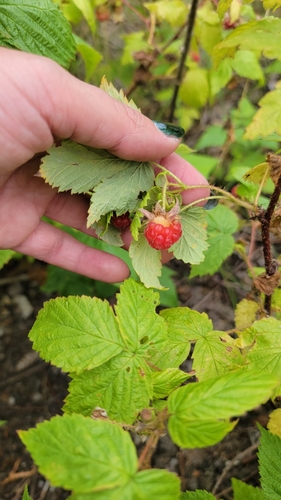
(c) Lauren Markewicz, some rights reserved (CC BY)

(c) eknuth, some rights reserved (CC BY-NC)

(c) eknuth, some rights reserved (CC BY-NC)
What to Eat
Edible parts: Fruit, Leaves - tea
The fruit can be eaten raw or cooked in pies, preserves, and similar preparations. Young shoots, harvested as they emerge from the ground in spring, can be peeled and eaten raw or cooked like asparagus. The leaves and twigs make a useful tea substitute.
Dangerous Lookalikes
This plant can be confused with the following toxic species. Always verify identification carefully before consuming any wild plant.


Red Baneberry: Short herbaceous plant (no thorns), berries on thick red stems, each berry has a single seed, compound sharply-toothed leaves.
American red raspberry: Thorny woody canes (brambles), aggregate berry made of many drupelets, berries pull easily from receptacle.
Where to Find It
It is a temperate plant. It grows in clearings and on sunny slopes in the Rocky Mountains.
Asia, Australia, Canada, Japan, Mexico, North America, USA,
How to Identify
A raspberry. It has prickly canes up to 2 m tall. The leaves are alternate and compound with 3-5 oval leaflets. They are dark green above and white and woolly underneath. The flowers are white and showy. They are 1.2 cm across. There are several flowers in small clusters. The fruit are large, red juicy berries.
How to Grow
Plants can be grown from seeds or cuttings.
Propagation: Seed requires stratification and is best sown in early autumn in a cold frame. Stored seed requires one month stratification at about 3°c and should be sown as early as possible in the year. Prick out seedlings when large enough to handle and grow on in a cold frame, then plant out into permanent positions in late spring of the following year. Cuttings of half-ripe wood can be taken in July or August and rooted in a frame. Tip layer in July and plant out in autumn. Division can be done in early spring or just before leaf-fall in autumn.
Medicinal Uses
The leaves and roots are anti-inflammatory, astringent, decongestant, ophthalmic, oxytocic, and stimulant. A tea made from them treats diarrhoea, acts as a uterine tonic to strengthen pregnant women, and aids in childbirth. This tea has also been shown effective at relieving painful menstrual cramps. The active ingredients both stimulate and relax the uterus; they may be used during the last three months of pregnancy and during childbirth, but should not be used earlier. Externally, leaves and roots are used as a gargle for tonsillitis and mouth inflammations, and as a poultice or wash for sores, conjunctivitis, minor wounds, burns, and varicose ulcers. Leaves are harvested in summer and dried for later use. The fruit is antiscorbutic and diuretic. Fresh raspberry juice mixed with a little honey makes an effective cooling drink during fever, and prepared as a syrup it is said to benefit the heart.
Other Uses
A purple to dull blue dye can be obtained from the fruit.
Wikipedia
Source ↗Rubus strigosus, the American red raspberry or American raspberry, is a species of Rubus native to much of North America. It was often treated as a variety or subspecies of the closely related Eurasian Rubus idaeus (red raspberry or European red raspberry), but is now more commonly treated as a distinct species. Many of the commercial raspberry cultivars grown for their fruit derive from hybrids between R. strigosus and R. idaeus; see Raspberry for more details.
Other Information
It is also cultivated.
Notes
There are about 250 Rubus species.
Names & Synonyms
Frambuesa Frambuesa roja
References (17)
- Beckstrom-Sternberg, Stephen M., and James A. Duke. "The Foodplant Database." http://probe.nalusda.gov:8300/cgi-bin/browse/foodplantdb.(ACEDB version 4.0 - data version July 1994)
- Bodkin, F., 1991, Encyclopedia Botanica. Cornstalk publishing, p 893
- Cormack, R. G. H., 1967, Wild Flowers of Alberta. Commercial Printers Edmonton, Canada. p 162
- Esperanca, M. J., 1988. Surviving in the wild. A glance at the wild plants and their uses. Vol. 2. p 173
- Facciola, S., 1998, Cornucopia 2: a Source Book of Edible Plants. Kampong Publications, p 210
- Fl. bor.-amer. 1:297. 1803
- Hedrick, U.P., 1919, (Ed.), Sturtevant's edible plants of the world. p 580
- INFOODS:FAO/INFOODS Databases
- Jennings, D.L., 1979, Raspberries and blackberries, in Simmonds, N.W., (ed), Crop Plant Evolution. Longmans. London. p 251
- Kiple, K.F. & Ornelas, K.C., (eds), 2000, The Cambridge World History of Food. CUP p 1843
- Mansfield's Encyclopedia of Agricultural and Horticultural Crops p 425
- Medsger, O. P., 1939, Edible Wild Plants. Macmillan Company. p 24
- Plants for a Future database, The Field, Penpol, Lostwithiel, Cornwall, PL22 0NG, UK. http://www.scs.leeds.ac.uk/pfaf/
- Porsild, A.E., 1974, Rocky Mountain Wild Flowers. Natural History Series No. 2 National Museums of Canada. p 250
- Segura, S., et al, 2018, The edible fruit species in Mexico. Genet Resour Crop Evol (2018) 65:1767–1793
- USDA, ARS, National Genetic Resources Program. Germplasm Resources Information Network - (GRIN). [Online Database] National Germplasm Resources Laboratory, Beltsville, Maryland. Available: www.ars-grin.gov/cgi-bin/npgs/html/econ.pl (10 April 2000)
- Wiersema, J. H. & Leon, B., 2013, World Economic Plants. A Standard Reference CRC Press. 2nd Ed. p 599
More from Rosaceae


