Ruscus aculeatus
Linn.
Box Holly, Butcher’s broom, Jew's myrtle, Sicilian asparagus

(c) rudyclaeys, some rights reserved (CC BY-NC)
(c) Eleftherios Katsillis, some rights reserved (CC BY)
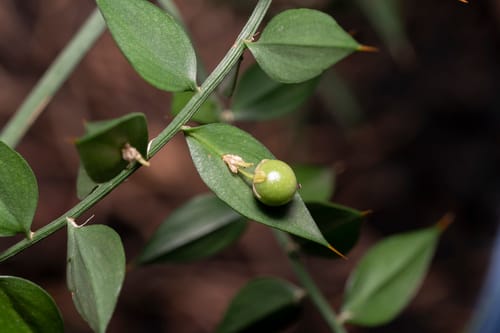
(c) Eleftherios Katsillis, some rights reserved (CC BY)
What to Eat
Edible parts: Shoots, Stems, Seeds - coffee
Young shoots are harvested in spring as they emerge through the soil and cooked as an asparagus substitute, though the taste is pungent and rather bitter. The roasted seed can be used as a coffee substitute.
Known Hazards
Where to Find It
It is a warm temperate plant. It grows in woods, scrub and usually in shade. It suits hardiness zones 6-10. Melbourne Botanical Gardens. Hobart Botanical Gardens.
Australia, Balkans, Bosnia, Britain, Croatia, Europe, France, Greece, Italy, Mediterranean, North Africa, North America, Portugal, San Marino, Sicily, Slovakia, Slovenia, Spain, Tasmania, Tunisia, Turkey, Türkiye, USA,
How to Identify
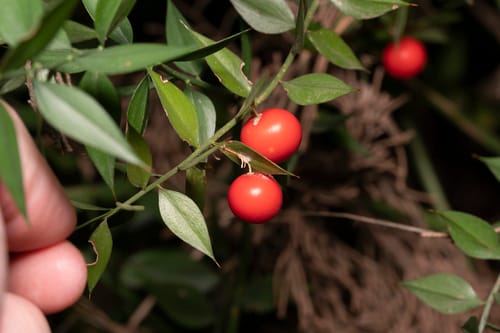
A shrub. It grows 75-100 cm high and spreads 100 cm wide. It forms clumps. The stems are erect. It spreads by underground stems or rhizomes. The leaves are reduced. The stems are flattened and like leaves. These are 18-30 mm long and have prickly tips. The flowers are on the surface of these leaf like structures. The flowers are greenish-white and 3 mm long. They can occur singly or in pairs. Male and female flowers are on separate plants. The fruit are bright red berries. They are 7 mm across.
How to Grow
Tolerant of most soils, including chalky and heavy clay soils. Prefers a shady position, tolerating dense dry shade and bad growing conditions, including the drip-line of trees. Dislikes much wetness at the roots. Established plants are drought resistant. A very hardy plant, when fully dormant it can tolerate temperatures down to about -25°c. Plants have a slowly creeping tough rootstock and eventually form large clumps. Plants in this genus are notably resistant to honey fungus. Plants are unusual in that the flowers are produced from the middle of the leaf. Although normally dioecious, some hermaphrodite forms are known. One of these is called 'Sparkler'. Male and female plants must usually be grown if seed is required.
Propagation: Sow seed thinly in early spring in a cold frame in light shade; a period of cold stratification improves germination, which can be slow and sometimes takes 12 months or more. Grow seedlings on in pots in light shade in the greenhouse through their first growing season, giving occasional liquid feeds to prevent nutrient deficiencies. Prick out into individual pots the following spring and grow on for at least another year before planting out in early summer. Protect seedlings carefully from slugs. Alternatively, divide plants as growth begins in early spring. Larger divisions can go straight into permanent positions; smaller ones are best potted up and grown on in a lightly shaded cold frame until well established, then planted out in summer.
Medicinal Uses
Butcher's broom is little used in modern herbalism, but its positive effects on varicose veins and haemorrhoids suggest potential for wider use. The root is aperient, deobstruent, depurative, diaphoretic, diuretic, and vasoconstrictor. Historically taken internally for jaundice, gout, and kidney and bladder stones, it is currently used to treat venous insufficiency and haemorrhoids, including external application for the latter. It should not be prescribed for patients with hypertension. The root is harvested in autumn and dried for later use; the whole plant is sometimes used as well. The plant contains saponin glycosides, including ruscogenin and neoruscogenin, which are anti-inflammatory and cause contraction of blood vessels, particularly veins. The German Commission E Monographs approve Ruscus aculeatus for haemorrhoids and venous conditions.
Other Uses
Mature shoots can be bound into bunches and used as scourers or besoms.
Wikipedia
Source ↗Ruscus aculeatus, known as butcher's-broom, is a low evergreen dioecious Eurasian shrub, with flat shoots known as cladodes that give the appearance of stiff, spine-tipped leaves. Small greenish flowers appear in spring, and are borne singly in the centre of the cladodes. The female flowers are followed by a red berry, and the seeds are bird-distributed, but the plant also spreads vegetatively by means of rhizomes. It is native to Eurasia and some northern parts of Africa. Ruscus aculeatus occurs in woodlands and hedgerows, where it is tolerant of deep shade, and also on coastal cliffs. Likely due to its attractive winter/spring color, Ruscus aculeatus has become a fairly common landscape plant. It is also widely planted in gardens, and has spread as a garden escapee in many areas outside its native range. The plant grows well in zones 7 to 9 on the USDA hardiness zone map. The Latin specific epithet aculeatus means "prickly".
Notes
There are 5-6 Ruscus species. Also put in the family Ruscaceae.
Names & Synonyms
Albricias, Bodeča lobodika, Değirmen boncuğu, Deve çöküren, Deve tomurcuğu, Kostrava, Kostrika, Pungitopo, Puntaroli, Rusco, Scopa pungente, Scupa pungicosa, Scuparini, Spinasurci
References (37)
- Bianchini, F., Corbetta, F., and Pistoia, M., 1975, Fruits of the Earth. Cassell. p 88
- Biscotti, N. & Pieroni, A., 2015, The hidden Mediterranean diet: wild vegetables traditionally gathered and consumed in the Gargano area, Apulia, SE Italy. Acta Societatis Botanicorum Poloniae 84 (3): 327-338
- Biscotti, N. et al, 2018, The traditional food use of wild vegetables in Apulia (Italy) in the light of Italian ethnobotanical literature. Italian Botanist 5:1-24
- Blamey, M and Grey-Wilson, C., 2005, Wild flowers of the Mediterranean. A & C Black London. p 484
- Blanco-Salas, J., et al, 2019, Wild Plants Potentially Used in Human Food in the Protected Area “Sierra Grande de Hornachos” of Extremadura (Spain). Sustainability 2019, 11, 456
- Bodkin, F., 1991, Encyclopedia Botanica. Cornstalk publishing, p 896
- Bremness, L., 1994, Herbs. Collins Eyewitness Handbooks. Harper Collins. p 123
- Brickell, C. (Ed.), 1999, The Royal Horticultural Society A-Z Encyclopedia of Garden Plants. Convent Garden Books. p 919
- Cundall, P., (ed.), 2004, Gardening Australia: flora: the gardener's bible. ABC Books. p 1288
- Dolina, K. & Luczaj, L., 2014, Wild food plants used on the Dubrovnik coast (south-eastern Croatia) Acta Soc Bot Pol 83(3):175–181
- Ertug, F, Yenen Bitkiler. Resimli Türkiye Florası -I- Flora of Turkey - Ethnobotany supplement
- Geraci, A., et al, 2018, The wild taxa utilized as vegetables in Sicily (Italy): a traditional component of the Mediterranean diet. Journal of Ethnobiology and Ethnomedicine (2018) 14:14
- Hedrick, U.P., 1919, (Ed.), Sturtevant's edible plants of the world. p 585
- Heywood, V.H., Brummitt, R.K., Culham, A., and Seberg, O., 2007, Flowering Plant Families of the World. Royal Botanical Gardens, Kew. p 400 (Family)
- Hibbert, M., 2002, The Aussie Plant Finder 2002, Florilegium. p 282
- http://www.botanic-gardens-ljubljana.com/en/plants
- Kremer, B.P., 1995, Shrubs in the Wild and in Gardens. Barrons. p 127
- Lentini, F. and Venza, F., 2007, Wild food plants of popular use in Sicily. J Ethnobiol Ethnomedicine. 3: 15
- Licata, M., et al, 2016, A survey of wild plant species for food use in Sicily (Italy) – results of a 3-year study in four Regional Parks. Journal of Ethnobiology and Ethnomedicine 12:12
- Luczaj, L. et al, 2014, Wild Food Plants of Dalmatia (Croatia). in A. Pieroni, C. L. Quave (eds.), Ethnobotany and Biocultural Diversities in the Balkans, p 138
- Lord, E.E., & Willis, J.H., 1999, Shrubs and Trees for Australian gardens. Lothian. p 260
- Mabey, R., 1973, Food for Free. A Guide to the edible wild plants of Britain, Collins. p 115
- Morley, B. & Everard, B., 1970, Wild Flowers of the World. Ebury press. Plate 41
- Nimis, P. L., et al, 2015, A guide to the vascular plants of the temporary ponds of Sardinia (Italy) p 172
- Özdemir, E. and Kültür, S., 2017, Wild Edible Plants of Savaştepe District (Balıkesir, Turkey), Marmara Pharm J 21/3: 578-589
- Paoletti, M.G., Dreon, A.L., and Lorenzoni, G.G., 1995, Pistic, Traditional Food from Western Friuli, NE Italy. Economic Botany 49(1) pp 26-30
- Pasta, S., et al, 2020, An Updated Checklist of the Sicilian Native Edible Plants: Preserving the Traditional Ecological Knowledge of Century-Old Agro-Pastoral Landscapes. Frontiers in Plant Science. Volume 11|Article 388
- Pieroni A, Nebel S, Santoro RF, Heinrich M., 2005, Food for two seasons: culinary uses of non-cultivated local vegetables and mushrooms in a south Italian village. Int J Food Sci Nutr. 56(4):245-72
- Redzic, S. J., 2006, Wild Edible Plants and their Traditional Use in the Human Nutrition in Bosnia-Herzegovina. Ecology of Food and Nutrition, 45:189-232
- Rivera, C., et al, 2005, The Ethnobotanical Study of Local Mediterranean Food Plants as Medicinal Resources in Southern Spain. Journal of Physiologyand Pharmacology. 56, Suppl. 1, 97-114
- Ryan, S., 2008, Dicksonia. Rare Plants Manual. Hyland House. p 50
- Sansanelli, S., et al, 2014, Wild food plants traditionall consumed in the area of Bologna (Emilia Romagna region, Italy). Journal of Ethnobiology and Ethnomedicine 10:69
- Sansanelli, S., et al, 2017, Ethnobotanical survey of wild food plants traditionally collected and consumed in the Middle Agri Valley (Basilicata region, southern Italy). Journal of Ethnobiology and Ethnomedicine (2017) 13:50
- Sp. pl. 2:1041. 1753
- Tardio, J., et al, Ethnobotanical review of wild edible plants in Spain. Botanical J. Linnean Soc. 152 (2006), 27-71
- Turner, N. J. et al, 2011, Edible and Tended Wild Plants, Traditional Ecological Knowledge and Agroecology. Critical Reviews in Plant Sciences, 30:198-225
- World Checklist of Useful Plant Species 2020. Royal Botanic Gardens, Kew