Sagittaria graminea
Michaux
Chinese arrowhead

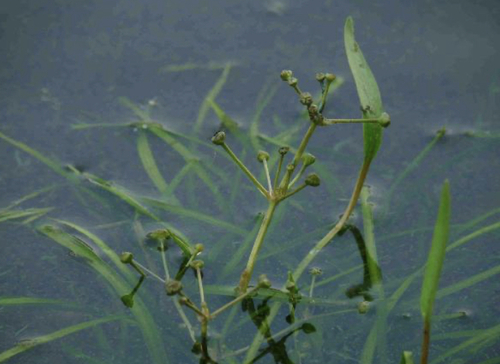
(c) Andrea Avers, some rights reserved (CC BY-NC), uploaded by Andrea Avers

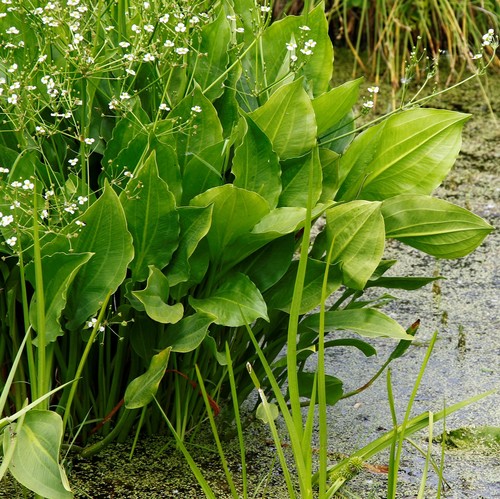
(c) Andrea Avers, some rights reserved (CC BY-NC), uploaded by Andrea Avers

(c) Erin Haase, some rights reserved (CC BY-NC), uploaded by Erin Haase
What to Eat
Edible parts: Leaves - tea, Root
The root is edible when cooked and contains 4–7% protein. Young shoots can also be cooked and eaten.
Where to Find It
A temperate plant. It grows in shallow water up to 50 cm deep. It suits hardiness zones 6-12. Uni of Calicut BG.
Asia, Australia, China, India, Japan, Mexico, North America, USA,
How to Identify
A plant that grows in shallow water. It has underground stems or rhizomes. It keeps growing from year to year. The leaves can be narrow, or oval or heart shaped. They are 25 cm long and 10 cm wide. The leaves under the water are often very long. The flowers are white and in groups of 5-7. They are held in a cluster above the water.
How to Grow
A pond or bog garden plant, it requires a moist or wet loamy soil in a sunny position. Prefers shallow, still or slowly flowing water up to 30 - 60cm deep. The edible roots are commonly found in Chinese markets. There is some confusion over this name. The report that this plant is edible gives the name as S. sinensis and its range as Asia. However, the RHS Dictionary of Gardening says that S. sinensis is a synonym of S. graminea and that its range is Eastern N. America, whilst other reports say that it is a synonym of S. sagittifolia or S. trifolia. The Flora of N. America says that S. graminea does not produce corms but has coarse rhizomes, which suggests that the report of edibility does not really belong here.
Propagation: Sow seed as soon as it is ripe in a pot standing in about 5cm of water. Prick seedlings into individual pots when large enough to handle, gradually increasing the water depth as plants grow until it reaches about 5cm above the top of the pot. Plant out in late spring or early summer of the following year. Tubers can be divided in spring or autumn — a straightforward process. Runners can be potted up at any point during the growing season.
Medicinal Uses
None known
Other Uses
None known Special Uses
Wikipedia
Source ↗Sagittaria graminea, the grassy arrowhead or grass-leaved arrowhead, is an aquatic plant species native to eastern North America.
Other Information
The tubers are sold in markets.
Names & Synonyms
References (10)
- Crawford, M., 2012, How to grow Perennial Vegetables. Green Books. p 68
- Cundall, P., (ed.), 2004, Gardening Australia: flora: the gardener's bible. ABC Books. p 1293
- Fl. bor.-amer. 2:190. 1803
- Hedrick, U.P., 1919, (Ed.), Sturtevant's edible plants of the world. p 588 (As Sagittaria chinensis)
- Hibbert, M., 2002, The Aussie Plant Finder 2002, Florilegium. p 283
- Lazarides, M. & Hince, B., 1993, Handbook of Economic Plants of Australia, CSIRO. p 209
- Plants for a Future database, The Field, Penpol, Lostwithiel, Cornwall, PL22 0NG, UK. http://www.scs.leeds.ac.uk/pfaf/
- Sainty, G.R. & Jacobs, S.W.L., 1981, Waterplants of New South Wales. Water Resources Commission. NSW p 51
- Slocum, P.D. & Robinson, P., 1999, Water Gardening. Water Lilies and Lotuses. Timber Press. p 86
- Stephens, K.M., & Dowling, R.M., 2002, Wetland Plants of Queensland. A field guide. CSIRO p 3