Salacia erecta
(G. Don.) Walp.
Thicket lemon-rope
(c) Carel Jongkind, some rights reserved (CC BY-NC), uploaded by Carel Jongkind

(c) Carel Jongkind, some rights reserved (CC BY-NC), uploaded by Carel Jongkind
What to Eat
Edible parts: Fruit
The orange fruits are eaten.
Where to Find It
A tropical plant. It grows from 50-1,700 m above sea level. It is an understorey tree in the forest.
Africa, Angola, Benin, Burundi, Cameroon, Central Africa, Central African Republic, CAR, Congo DR, Côte d'Ivoire, East Africa, Ghana, Guinea, Guinée, Guinea-Bissau, Ivory Coast, Kenya, Madagascar, Nigeria, Rwanda, Sierra Leone, Tanzania, Togo, Tropical Africa, Uganda, West Africa, Zambia, Zimbabwe,
How to Identify
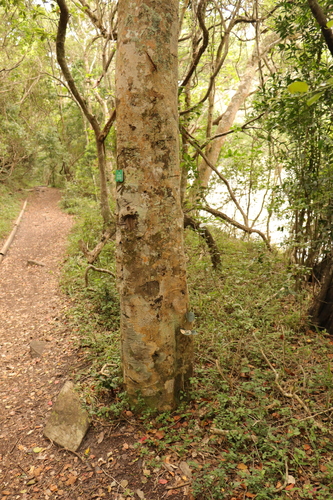
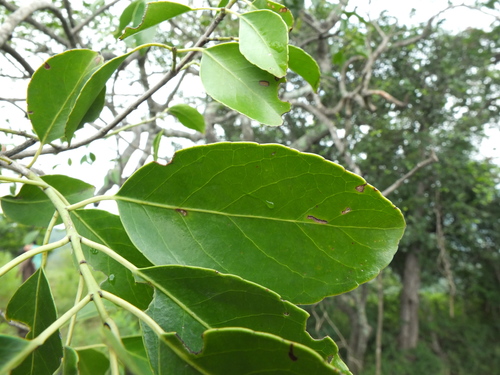
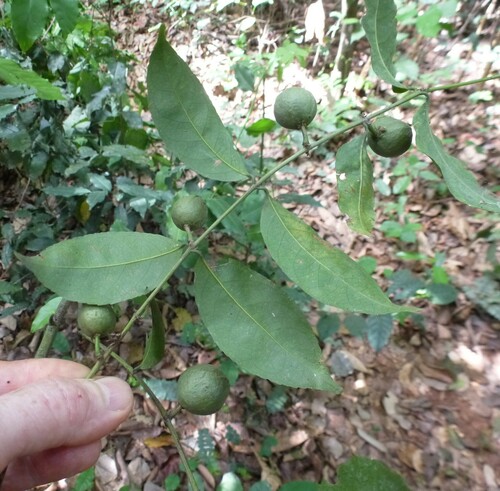
A shrub. The branches can be climbing. It grows to 5-8 m tall. The stems are angular. The leaves are opposite or alternate on climbing branches. The leaves are green but more pale underneath. They are 5-11 cm long by 2-5 cm wide. They are oval and taper at the tip. There are 1-5 flowers in a group in the axils of leaves. The fruit are orange and are 3 lobed but become round with age. They are 2-3 cm across. There are 1-3 seeds.
Names & Synonyms
References (10)
- Busson, 1965, (As Salacia cornifolia)
- Codjia, J. T. C., et al, 2003, Diversity and local valorisation of vegetal edible products in Benin. Cahiers Agricultures 12:1-12
- Dalziel, J. M., 1937, The Useful plants of west tropical Africa. Crown Agents for the Colonies London.
- Jardin, C., 1970, List of Foods Used In Africa, FAO Nutrition Information Document Series No 2.p 160
- Maundu, P. et al, 1999, Traditional Food Plants of Kenya. National Museum of Kenya. 288p
- Mutie, F. M., et al, 2023, Important Medicinal and Food Taxa (Orders and Families) in Kenya, Based on Three Quantitative Approaches. Plants 2023, 12, 1145
- Nzigidahera, B., 2006, Assessment of Socio-cultural, Economic Characteristics and Livelihood of Riparian Population of the Kibira National Park. (Rukoma-Mutana locality). UNDP p 30
- Peters, C. R., O'Brien, E. M., and Drummond, R.B., 1992, Edible Wild plants of Sub-saharan Africa. Kew. p 81
- Vivien, J., & Faure, J.J., 1996, Fruitiers Sauvages d'Afrique. Especes du Cameroun. CTA p 165
- World Checklist of Useful Plant Species 2020. Royal Botanic Gardens, Kew