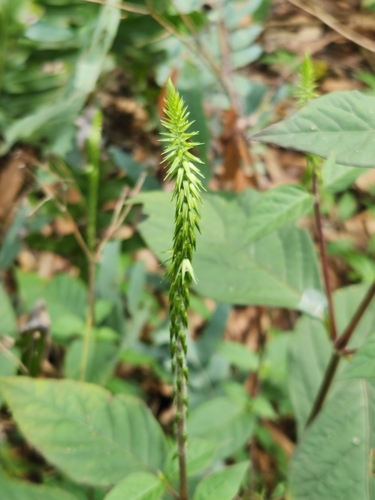
Salsola collina
Pall.
Tumbleweed, Slender Russian Thistle

no rights reserved, uploaded by Craig Martin

(c) Pat Deacon, some rights reserved (CC BY-NC), uploaded by Pat Deacon
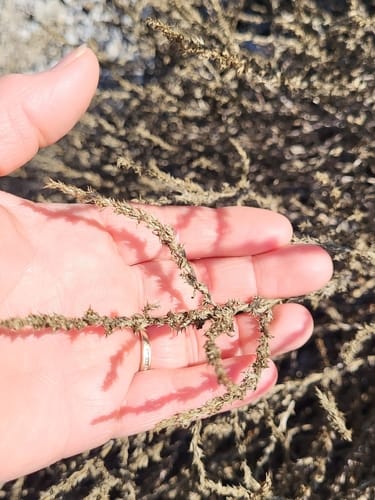
(c) Anita Byrne, some rights reserved (CC BY-NC)
What to Eat
Edible parts: Leaves
Young leaves and stems can be cooked and eaten, though this is strictly an emergency food used only when nothing else is available.
Where to Find It
It is a temperate plant. In Pakistan it is mostly between 1,500-3,000 m altitude.
Asia, China, Europe, Korea, Manchuria, Mongolia, North America, Pakistan, Russia, Siberia,
How to Identify
An annual herb. It grows 20-100 cm high. The stem branches from the base. The branches are alternate. The leaves are spreading and slightly curved. They are narrow. They are 2-5 cm long by 1 mm wide.
How to Grow
We have very little information on this species and do not know if it will be hardy in Britain, though judging by its native range it should succeed outdoors in many parts of this country. The following notes are based on the general needs of the genus. Requires a very sunny position in a light or medium well-drained soil, it tolerates salty soils, occasional inundation by salt water and maritime exposure. Succeeds in poor soils and grows more vigorously on alkaline soils.
Propagation: Sow seed in spring directly in situ. Seed has short viability and should be stored in cool conditions over winter.
Medicinal Uses
A tea decocted from the whole plant is drunk twice daily for 6 months as a treatment for high blood pressure.
Other Uses
None known Special Uses
Wikipedia
Source ↗Salsola collina, commonly known as the slender Russian thistle, tumbleweed, or Russian thistle, is a species of flowering plant in the genus Salsola.
Notes
Plants are used in medicine to reduce blood pressure. Also put in the family Chenopodiaceae.
Names & Synonyms
Hamhuul, Zhu mao cai
References (9)
- BARANOV,
- "Chinese Nutrition Journal", 2002, Vol 23(8) p 298
- Ill. pl. 34, t. 26. 1803-1806
- Khasbagan, Hu-Yin Huai, and Sheng-Ji pei, 2000, Wild Plants in the Diet of Athorchin Mongol Herdsmen in Inner Mongolia. Economic Botany 54(4): 528-536
- Plants for a Future database, The Field, Penpol, Lostwithiel, Cornwall, PL22 0NG, UK. http://www.scs.leeds.ac.uk/pfaf/
- Sachula, et al, 2020, Wild edible plants collected and consumed by the locals in Daqinggou, Inner Mongolia, China. Journal of Ethnobiology and Ethnomedicine (2020) 16:60
- Wujisguleng, W., & Khasbagen. K., 2010, An integrated assessment of wild vegetable resources in Inner Mongolian Autonomous Region, China. Journal of Ethnobiology and Ethnomedicine 6:34
- www.eFloras.org Flora of China
- Zhu Gelin (Chu Ge-ling); Steven E. Clemants, CHENOPODIACEAE [Draft], Flora of China