Samanea saman
(Jacq.) Merr.
Raintree
no rights reserved, uploaded by 葉子

(c) Claudia Mejía Morales, some rights reserved (CC BY-NC), uploaded by Claudia Mejía Morales
(c) James Bailey, some rights reserved (CC BY-NC), uploaded by James Bailey
What to Eat
Edible parts: Pod pulp, Leaves, Fruit, Seeds - spice
Children eat the pods, which contain a brownish, sticky, liquorice-like sweet pulp. The pulp is also made into a lemon-like fruit drink. The pods are more or less straight with conspicuously thickened edges, measuring 12–20cm long, 1–2cm wide, and 1.2cm thick. The tree also yields a gum of inferior quality that can serve as a poor substitute for gum arabic. It is noted as a staple crop for balanced carbohydrates in carbon farming contexts.
Known Hazards
Where to Find It
A tropical plant. It is native to tropical America. Common and widely planted as a shade tree. Trees grow almost wild in some areas and are planted as a street tree in coastal towns. It suits river-side locations in dry areas. It should grow up to about 1800 m altitude in the equatorial tropics. It grows best in the tropical lowlands from sea level to 300 m altitude and with a rainfall of 600-3000 mm per year. It can grow in arid places. It suits hardiness zones 10-12.
Africa, Andamans, Angola, Antigua-Barbuda, Asia, Australia, Bangladesh, Barbados, Belize, Benin, Bhutan, Bolivia, Brazil, British Indian Ocean Terr., BIOT, Cambodia, Cameroon, Cape Verde, Caribbean, Central Africa, Central America, China, Colombia, Congo DR, Costa Rica, Cuba, Dominica, Dominican Republic, East Africa, East Timor, Ecuador, El Salvador, Fiji, French Guiana, Gambia, Ghana, Grenada, Guadeloupe, Guam, Guatemala, Guianas, Guyana, Haiti, Hawaii, Himalayas, Honduras, India, Indochina, Indonesia, Jamaica, Kenya, Laos, Madagascar, Malaysia, Maldives, Marianas, Marquesas, Martinique, Mauritius, Mexico, Mozambique, Myanmar, Nauru, New Caledonia, Nicaragua, Nigeria, Northeastern India, North America, Pacific, Panama, Papua New Guinea, PNG, Paraguay, Peru, Philippines, Puerto Rico, Reunion, Rotuma, Samoa, Sao Tome and Principe, SE Asia, Seychelles, Sierra Leone, Sikkim, Singapore, Solomon Islands, Somalia, South America*, Sri Lanka, St Lucia, Sudan, Suriname, Taiwan, Tanzania, Thailand, Timor-Leste, Tobago, Togo, Tonga, Trinidad-Tobago, Tuvalu, Uganda, USA, Vanuatu, Venezuela*, Vietnam, West Africa, West Indies, Yap, Zambia,
How to Identify
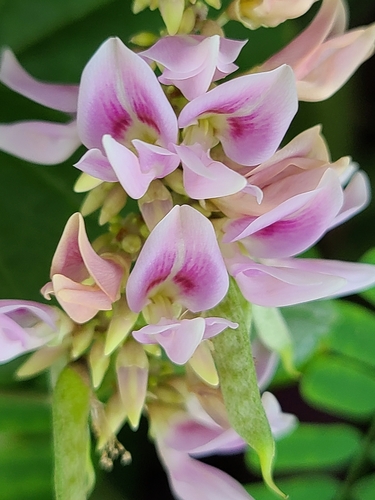
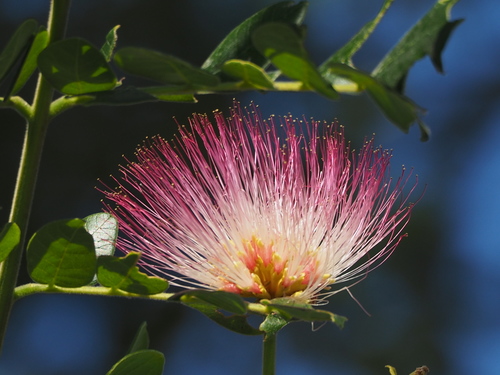
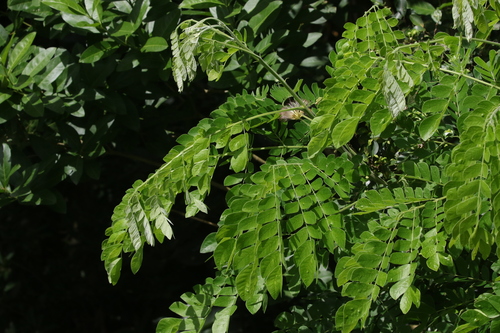
A large tree with a widely spreading crown. It grows up to 25 m tall. It can grow to 60 m high. It has a short thick trunk. The branches spread out horizontally and can be 30 m long. The bark is a distinctive yellow. It loses its leaves during the year. The leaves have leaflets which are evenly in two rows. They are feather like. There are 8 to 12 leaflets in a row. There are 12 to 16 in the upper row. The leaves fold inwards at night and during rain. The leaves can be 35 cm long. The secondary division of the leaf can be 20 cm long and the leaflets 3 cm by 2 cm. The flowers are at the ends of branches and pink. They occur in round heads about 5 cm across. They are on long stalks 10-12 cm long. The fruit are pods. The pods are straight and somewhat fleshy. The pods can be 20 cm long by 2 cm across. The pods are slightly flattened.
How to Grow
Trees are grown from seeds. They can also be grown from cuttings. Seeds need to put into hot water for 3 minutes then cooled and allowed to soak for 24 hours before sowing. Seed can be stored for 6 months.
Propagation: Seed stores well at ambient temperatures. Fresh, still-moist seed usually germinates without pre-treatment. Once the seedcoat has dried and hardened, it must be nicked carefully (without damaging the seed) or larger batches soaked in hot water for 3 minutes, followed by soaking in warm water for 12–24 hours before sowing. Treated seed typically germinates in 6–8 days under optimal conditions. Cuttings can also be used.
Medicinal Uses
A decoction of the inner bark and fresh leaves is used to treat diarrhoea. Small sections of bark are brewed to relieve stomach-ache. A crude aqueous or alcoholic leaf extract has shown an inhibiting effect on Mycobacterium tuberculosis. The alkaloid fraction of the leaves acts on both the central and peripheral nervous systems. An infusion of the leaves is used as a laxative. A decoction of the fruit is used as a CNS sedative. The seeds are chewed to treat a sore throat.
Other Uses
The bark is an abundant source of gums and resins, including a low-grade gum usable as a substitute for gum arabic. Ground and fermented pods can be converted to alcohol as an energy source, with yields of up to 1,150 litres of absolute alcohol per hectare per year. The tree is widely used as a street tree and in public open spaces, and is suited to xerophytic conditions. In agroforestry, it provides shade for crops including cocoa, coffee, tea, and peppers; its dome-shaped crown gives dense shade even at low sun angles, and the leaves fold up during rain to allow more moisture to reach plants below. The heartwood is brown when freshly cut, turning golden-brown on exposure; the sapwood is cream-coloured. The wood is light, soft but strong, and very durable, taking a high polish though often cross-grained, making it easier to work green. It shrinks so little that carvings can be made from green wood without risk of splitting or warping as it dries. Highly prized for carvings, furniture, and panelling — demand in Hawaii is high enough that local supply is supplemented by imports from Indonesia and the Philippines. It is also used in boat building, interior trim, boxes, veneer, plywood, and general construction. The wood produces 5,200–5,600 kcal/kg when burned and the tree regrows vigorously after lopping or pollarding, making it a valuable firewood and charcoal source, though where a strong carving market exists it is considered too valuable for fuel.
Wikipedia
Source ↗Samanea saman is a semi-deciduous species of flowering tree in the pea family, Fabaceae, now in the Mimosoid clade and is native to Central and South America. It is often placed in the genus Samanea, which by yet other authors is subsumed in Albizia entirely. Its range extends from Mexico south to Peru and Brazil, but it has been widely introduced to South and Southeast Asia, as well as the Pacific Islands, including Hawaii. It is a well-known tree, rivaled perhaps only by lebbeck and pink siris among its genus. It is well represented in many languages and has numerous local names in its native range; common English names include saman, rain tree and monkeypod (see also § Names below). In Cambodia it is colloquially known as the Chankiri Tree (can be written ចន្ទគិរី or ចន្ទ៍គីរី).
Production
It is a quick growing tree.
Other Information
The pod pulp is especially enjoyed by children. It is cultivated.
Notes
There is only one Samanea species. Also as Mimosaceae. It is the flower emblem of Venezuela. Possibly now Albizia saman. Also as Mimosaceae.
Names & Synonyms
Akasya, Akasya, Belati siris, Bhalimora, Bodu gas, Campano, Carabeli, Cenizaro, Chaam-churii, Cong, Cow tamarind, Filiganga, French tamarind, Genixaro, Gouannegoul, Gumorni spanis, Hujan-hujan, Jahmjuree, Kasia kula, Kayu hujan, Khirish, Marmar, Mohemohe, Monkey Pod, 'ohai, Pukul lima, Reethigas, Saman, Sirsa, Tamaligi, Tamalini, Thinbaw-kokko, Tikpikung, Trong-kon-mames, Vaivai ni vavalangi
References (62)
- Abbiw, D.K., 1990, Useful Plants of Ghana. West African uses of wild and cultivated plants. Intermediate Technology Publications and the Royal Botanic Gardens, Kew. p 46 (As Samanea saman)
- Ambasta, S.P. (Ed.), 2000, The Useful Plants of India. CSIR India. p 544 (As Samanea saman)
- Barwick, M., 2004, Tropical and Subtropical Trees. A Worldwide Encyclopedic Guide. Thames and Hudson p 359 (As Samanea saman)
- Bodkin, F., 1991, Encyclopedia Botanica. Cornstalk publishing, p 905 (As Samanea saman)
- Bole, P.V., & Yaghani, Y., 1985, Field Guide to the Common Trees of India. OUP p 93 (As Enterolobium saman).
- Borrell, O.W., 1989, An Annotated Checklist of the Flora of Kairiru Island, New Guinea. Marcellin College, Victoria Australia. p 95 (As Samanea saman)
- Burkill, H. M., 1985, The useful plants of west tropical Africa, Vol. 3. Kew. (As Albizia saman)
- Burkill, I.H., 1966, A Dictionary of the Economic Products of the Malay Peninsula. Ministry of Agriculture and Cooperatives, Kuala Lumpur, Malaysia. Vol 1 (A-H) p 942 (As Enterolobium saman)
- Condit, R., et al, 2011, Trees of Panama and Costa Rica. Princeton Field Guides. p 212 (As Samanea saman)
- Cooper, W. and Cooper, W., 2004, Fruits of the Australian Tropical Rainforest. Nokomis Editions, Victoria, Australia. p 315 (As Samanea saman)
- Cundall, P., (ed.), 2004, Gardening Australia: flora: the gardener's bible. ABC Books. p 122 (As Albizia saman)
- Duarte, M. C., et al, 2022, Diversity of Useful Plants in Cabo Verde Islands: A Biogeographic and Conservation Perspective. Plants 2022, 11, 1313 p 12
- Ekman Herbarium records Haiti (As Enterolobium saman)
- Elevitch, C.R.(ed.), 2006, Traditional Trees of the Pacific Islands: Their Culture, Environment and Use. Permanent Agriculture Resources, Holualoa, Hawaii. p 661 (As Samanea saman)
- Engel, D.H., & Phummai, S., 2000, A Field Guide to Tropical Plants of Asia. Timber Press. p 43, 90 (As Samanea saman)
- Etherington, K., & Imwold, D., (Eds), 2001, Botanica's Trees & Shrubs. The illustrated A-Z of over 8500 trees and shrubs. Random House, Australia. p 84 (As Albizia saman)
- Flora of Australia Volume 12, Mimosaceae (excl. Acacia) Caesalpiniaceae. Melbourne: CSIRO Australia (1998) p 32 (As Samanea saman)
- Franklin, J., Keppel, G., & Whistler, W., 2008, The vegetation and flora of Lakeba, Nayau and Aiwa Islands, Central Lau Group, Fiji. Micronesica 40(1/2): 169–225, 2008
- French, B.R., 1986, Food Plants of Papua New Guinea, A Compendium. Asia Pacific Science Foundation p 383 (As Samanea saman)
- Ghosh, C. & Das A. P., 2011, Some useful and poisonous tea garden weeds from the Darjiling District of West Bengal, India. Pleione 5(1): 91 - 114 (As Samanea saman)
- Global Plants JSTOR
- Grandtner, M. M., 2008, World Dictionary of Trees. Wood and Forest Science Department. Laval University, Quebec, Qc Canada. (Internet database http://www.wdt.qc.ca) (As Samanea saman)
- Grandtner, M. M. & Chevrette, J., 2013, Dictionary of Trees, Volume 2: South America: Nomenclature, Taxonomy and Ecology. Academic Press p 580 (As Samanea saman)
- Hearne, D.A., & Rance, S.J., 1975, Trees for Darwin and Northern Australia. AGPS, Canberra p 103, Pl 31 (As Samanea saman)
- Hedrick, U.P., 1919, (Ed.), Sturtevant's edible plants of the world. p 506 (As Pithocellobium saman)
- J. Wash. Acad. Sci. 6:47. 1916 (As Samanea saman)
- Katende, A.B., Birnie, A & Tengnas B., 1995, Useful Trees and Shrubs for Uganda. Identification, Propagation and Management for Agricultural and Pastoral Communities. Technical handbook No 10. Regional Soil Conservation Unit, Nairobi, Kenya. p 84 (As Albizia saman)
- Kew Plants of the World Online
- Kiple, K.F. & Ornelas, K.C., (eds), 2000, The Cambridge World History of Food. CUP p 1842 (As Samanea saman)
- Latham, P. & Mbuta, A. K., 2014, Useful Plants of Bas-Congo Province, Democratic Republic of Congo. Volume 1. p 32
- Latham, P. & Mbuta, A. K., 2017, Plants of Kongo Central Province, Democratic Republic of Congo. Volume 1. 3rd ed p 36
- Lugod, G.C. and de Padua L.S., 1979, Wild Food Plants in the Philippines. Vol. 1. Univ. of Philippines Los Banos. p 43 (As Samanea saman)
- Martin, F. W., et al, 1987, Perennial Edible Fruits of the Tropics. USDA Handbook 642 p 99
- Massal, E. and Barrau, J., 1973, Food Plants of the South Sea Islands. SPC Technical Paper No 94. Noumea, New Caledonia. p 42 (As Samanea saman)
- Mbuya, L.P., Msanga, H.P., Ruffo, C.K., Birnie, A & Tengnas, B., 1994, Useful Trees and Shrubs for Tanzania. Regional Soil Conservation Unit. Technical Handbook No 6. p 92 (As Albizia saman)
- Miguel, E., et al, 1989, A checklist of the cultivated plants of Cuba. Kulturpflanze 37. 1989, 211-357 (As Pithecellobium saman)
- Monsalud, M.R., Tongacan, A.L., Lopez, F.R., & Lagrimas, M.Q., 1966, Edible Wild Plants in Philippine Forests. Philippine Journal of Science. p 490 (As Samanea saman)
- Omawale, 1973, Guyana's edible plants. Guyana University, Georgetown p 16 (As Samanea saman)
- Parham, B. E. V., 1972, Plants of Samoa. New Zealand Department of Scientific and Industrial Research. Information Series. No. 85 p 71
- Peekel, P.G., 1984, (Translation E.E.Henty), Flora of the Bismarck Archipelago for Naturalists, Division of Botany, Lae, PNG. p 205, 204 (As Samanea saman)
- Pham-Hoang Ho, 1999, An Illustrated Flora of Vietnam. Nha Xuat Ban Tre. p 827 (As Samanea saman)
- Phon, P., 2000, Plants used in Cambodia. © Pauline Dy Phon, Phnom Penh, Cambodia. p 21 (As Albizia saman)
- Roa, J. A. G. & Boada, D. S. G., 2018, Fundación para el Fortalecimiento de la Fruticultura y Plantas Alimenticias no Convencionales en Colombia. (As Samanea saman)
- Royal Botanic Gardens, Kew (1999). Survey of Economic Plants for Arid and Semi-Arid Lands (SEPASAL) database. Published on the Internet; http://www.rbgkew.org.uk/ceb/sepasal/internet [Accessed 28th April 2011] (As Albizia saman)
- Savita, et al, 2006, Studies on wild edible plants of ethnic people in east Sikkim. Asian J. of Bio Sci. (2006) Vol. 1 No. 2 : 117-125 (As Samanea saman)
- Sawian, J. T., et al, 2007, Wild edible plants of Meghalaya, North-east India. Natural Product Radiance Vol. 6(5): p 421 (As Samanea saman)
- Segura, S., et al, 2018, The edible fruit species in Mexico. Genet Resour Crop Evol (2018) 65:1767–1793 (As Samanea saman)
- Selvam, V., 2007, Trees and shrubs of the Maldives. RAP Publication No. 2007/12
- Smith, N., Mori, S.A., et al, 2004, Flowering Plants of the Neotropics. Princeton. Plate 18 (Photo) (As Pithecellobium saman)
- Staples, G.W. and Herbst, D.R., 2005, A tropical Garden Flora. Bishop Museum Press, Honolulu, Hawaii. p 324 (Drawing) (As Samanea saman)
- Sujanapal, P., & Sankaran, K. V., 2016, Common Plants of Maldives. FAO & Kerala FRI, p 24
- Sukarya, D. G., (Ed.) 2013, 3,500 Plant Species of the Botanic Gardens of Indonesia. LIPI p 118
- Swaminathan, M.S., and Kochnar, S.L., 2007, An Atlas of Major Flowering Trees in India. Macmillan. p 134 (As Samanea saman)
- Reitveld, S., 2013, The Animals and Plants of the Zazamalala Forest in Western Madagascar. p 60
- Thaman, R. R, 2016, The flora of Tuvalu. Atoll Research Bulletin No. 611. Smithsonian Institute p 91 (As Samanea saman)
- Topp, J. M. W., 1988, An Annotated Check List of the Flora of Diego Garcia, British Ocean Territory. Atoll Research Bulletin No. 313 (As Pithecellobium saman - introduced and possibly rare)
- Torre, de la, L., et al, 2008, Enciclopedia de las Plantas Útiles del Ecuador. Herbario QCA. Pontificia Universidad Católica del Ecuador. p 331
- Van Sam, H. et al, 2004, Trees of Laos and Vietnam: A Field Guide to 100 Economically or Ecologically Important Species. Blumea 29 (2004) 201-349 (As Samanea saman)
- Verdcourt, B., 1979, Manual of New Guinea Legumes. Botany Bulletin No 11, Division of Botany, Lae, Papua New Guinea. p 207 (As Samanea saman)
- World Checklist of Useful Plant Species 2020. Royal Botanic Gardens, Kew (As Samania saman)
- www.worldagroforestrycentre.org/treedb/
- Zuchowski W., 2007, Tropical Plants of Costa Rica. A Zona Tropical Publication, Comstock Publishing. p 271 (As Samanea saman)