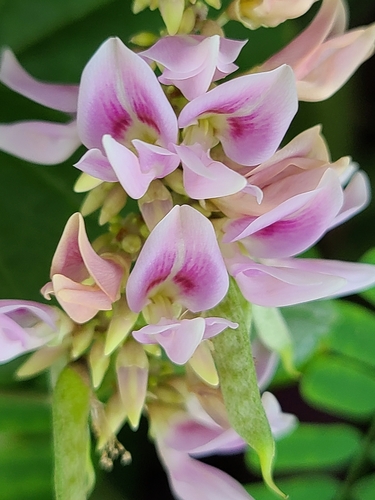
Saraca indica
L.
Sorrowless Tree

(c) Marco Mussita, some rights reserved (CC BY), uploaded by Marco Mussita

(c) 106611639464075912591, some rights reserved (CC BY-NC-SA), uploaded by 106611639464075912591

(c) Alan Kwok (King Lun), Ada Tai (Ah Heung) / 阿達蘭 AdAlan, some rights reserved (CC BY-NC), uploaded by Alan Kwok (King Lun), Ada Tai (Ah Heung) / 阿達蘭 AdAlan
What to Eat
Edible parts: Leaves, Flowers, Fruit - masticatory
S. indica is cultivated as an ornamental tree for its fragrant and showy flowers. It is considered suitable for roadsides as well as parks and gardens. The wood is sometimes used to make small utensils, pallets, veneer and plywood. In Southeast Asia, particularly Thailand, people eat the flowers and leaves of one variety of the species. The flowers are said to taste sourish.
Where to Find It
A tropical plant. It needs shade and moist well-drained soil. It is native in India, Thailand and Indonesia. It suits hardiness zones 10-12. In Yunnan.
Andamans, Asia, Australia, Bangladesh, China, Hawaii, India, Indochina, Indonesia, Laos, Malaysia, Marquesas, Myanmar, Pacific, SE Asia, Singapore, Sri Lanka, Thailand, USA, Vietnam,
How to Identify
An evergreen tree. It grows to 20 m tall. The bark can be dark brown or almost black. The leaves are divided into 3-6 pairs of leaflets. Each leaflet is oblong and 10-20 cm long by 2-3 cm wide. When young they hang down and are copper coloured. The flowers are orange and do not have petals. They often arise from branches from the wood. The fruit are on stalks 6-25 cm long. They are flat pods which are 10-20 cm long by 3-5 cm wide. They are leathery with 3-5 compressed seeds.
How to Grow
Plants are grown from seed.
Propagation: Seed - if the seed is harvested when ripe and sown immediately, preferably after soaking in water for 12 hours, it will germinate within 3 weeks and will be ready to plant out within 6 - 12 months. Air layering.
Medicinal Uses
The bark is a very popular herb in Ayurveda, where it is said to be particularly useful for treating the female reproductive system. It is strongly astringent and a uterine sedative. It is said to have a stimulating effect on uterine and ovarian tissue. It is said to be useful in the treatment of several ailments including menstrual cramps; some cases of uterine bleeding; uterine fibroids; haemorrhoids, and internal bleeding. The bark contains tannins and catechol.
Other Uses
The light reddish-brown wood is soft.
Wikipedia
Source ↗Saraca indica, commonly known as the asoka tree, ashok or simply asoca, is a species of tree in the family Fabaceae, subfamily Detarioideae. The species is native to most of Mainland Southeast Asia and Western Indonesia. It grows to a height of 20 metres (66 feet) and is known for its clusters of orange-yellow to red flowers. The original plant specimen from which Carl Linnaeus described the species came from Java, but the name S. indica has been generally incorrectly applied to S. asoca since 1869.
Notes
The tree is sacred to Buddhists and Hindus. Also as Caesalpinaceae.
Names & Synonyms
Ashoka tree, Asogam, Asoka, Diya rat mal, Gapis, Sok, Thawka, Thawka-po, Vang-anh
References (15)
- Ambasta S.P. (Ed.), 2000, The Useful Plants of India. CSIR India. p 550
- Barwick, M., 2004, Tropical and Subtropical Trees. A Worldwide Encyclopedic Guide. Thames and Hudson p 364
- Bodkin, F., 1991, Encyclopedia Botanica. Cornstalk publishing, p 909
- Bole, P.V., & Yaghani, Y., 1985, Field Guide to the Common Trees of India. OUP p 7 (As Saraca asoca)
- Engel, D.H., & Phummai, S., 2000, A Field Guide to Tropical Plants of Asia. Timber Press. p 34
- Krishen P., 2006, Trees of Delhi, A Field Guide. DK Books. p 227 (As Saraca asoca)
- Llamas, K.A., 2003, Tropical Flowering Plants. Timber Press. p 206
- Mant. pl. 1:98. 1767
- Martin, F.W. & Ruberte, R.M., 1979, Edible Leaves of the Tropics. Antillian College Press, Mayaguez, Puerto Rico. p 200
- Pham-Hoang Ho, 1999, An Illustrated Flora of Vietnam. Nha Xuat Ban Tre. p 865
- Recher, P, 2001, Fruit Spirit Botanical Gardens Plant Index. www.nrg.com.au/~recher/ seedlist.html p 7
- Staples, G.W. and Herbst, D.R., 2005, A tropical Garden Flora. Bishop Museum Press, Honolulu, Hawaii. p 334
- Thitiprasert, W., et al, 2007, Country report on the State of Plant Genetic Resources for Food and Agriculture in Thailand (1997-2004). FAO p 95
- World Checklist of Useful Plant Species 2020. Royal Botanic Gardens, Kew
- Xu, You-Kai, et al, 2004, Wild Vegetable Resources and Market Survey in Xishuangbanna, Southwest China. Economic Botany. 58(4): 647-667.