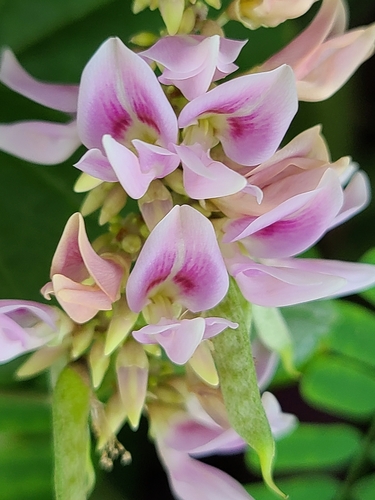
Sarothamnus scoparius
(L.) Wimmer ex Koch
Broom, English broom, Scotch broom
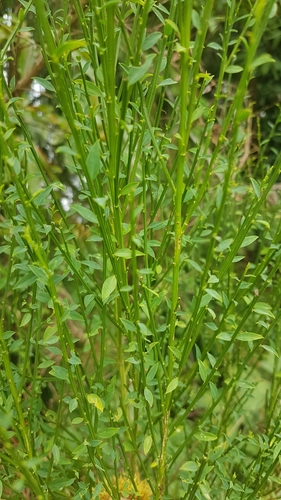
(c) nina-houssais, some rights reserved (CC BY-NC)
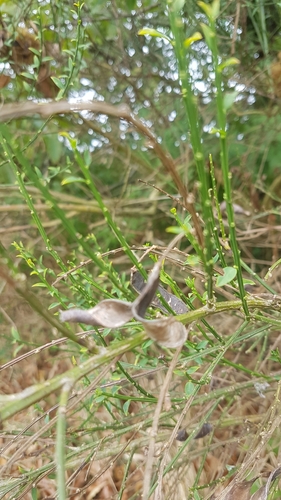
(c) nina-houssais, some rights reserved (CC BY-NC)
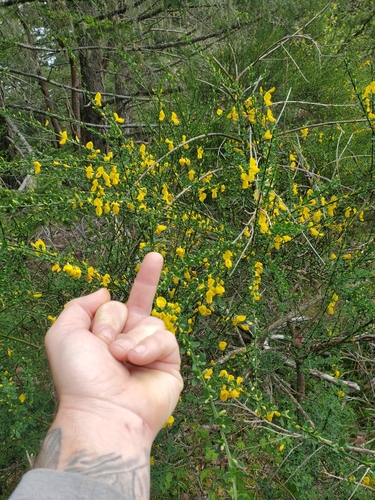
no rights reserved
What to Eat
Edible parts: Flowers, Seeds-coffee, Flower buds-flavouring, Shoots
The flower buds are pickled and used as a substitute for capers, added to salads and wines. The seeds are roasted and used as a coffee substitute. The plant tops have been used to flavor beer in place of hops.
Known Hazards
Where to Find It
It grows very easily in Mediterranean climates. It suits hardiness zones 5-9. Tasmania Herbarium.
Australia, Britain, Denmark, Europe, France, Greece, Hungary, Italy, Mediterranean, Poland, Portugal, Scandinavia, Slovenia, Spain, Sweden, Tasmania,
How to Identify
A medium sized shrub with many branches. It grows 2 m high and spreads 2 m wide. The stems are green and slender. These are green and photosynthesise. The leaves are small and scale like. It does not have spines. The lower leaves have 3 leaflets. The flowers occur singly. The flower standard is yellow and the keel yellow or red-brown. The fruit is a black pod. It has brown hairs along its edge. The seeds are hard and yellow-brown. The pods explode scattering seed.
How to Grow
Plants are grown from seed. Seeds can live for 80 years.
Medicinal Uses
Broom contains scoparin, which is a diuretic. The plant also is used as a cathartic and as a cardiac stimulant, which is credited to the presence of sparteine. A decoction or infusion of broom can be used to treat dropsy due to its diuretic action. An ointment can be made from the flowers to treat gout. Oxysparteine, produced from the action of acid on the sparteine, is useful as a cardiac stimulant and has the advantage over digoxin that it does not accumulate in the body. A medicinal beer was brewed from this herb, called broom ale, as a remedy for dropsy.
Names & Synonyms
Ginesta, Ginestell, Navadna metla
References (16)
- Blamey, M and Grey-Wilson, C., 2005, Wild flowers of the Mediterranean. A & C Black London. p 81 (As Cytisus scoparius)
- Bonet, M. A. & Valles, J., 2002, Use of non-crop food vascular plants in Montseny biosphere reserve (Catalonia, Iberian Peninsula). International Journal of Food Sciences and Nutrition (2002) 53, 225–248
- Curtis, W.M., 1956, The Students Flora of Tasmania Vol 1 p 146
- Cundall, P., (ed.), 2004, Gardening Australia: flora: the gardener's bible. ABC Books. p 461 (As Cytisus scoparius)
- Etherington, K., & Imwold, D., (Eds), 2001, Botanica's Trees & Shrubs. The illustrated A-Z of over 8500 trees and shrubs. Random House, Australia. p 249 (As Cytisus scoparius)
- Facciola, S., 1998, Cornucopia 2: a Source Book of Edible Plants. Kampong Publications, p 104, 111
- Hedrick, U.P., 1919, (Ed.), Sturtevant's edible plants of the world. p 263 (As Cytisus scoparius)
- Hibbert, M., 2002, The Aussie Plant Finder 2002, Florilegium. p 80 (As Cytisus scoparius)
- http://www.botanic-gardens-ljubljana.com/en/plants
- Lamp, C & Collet F., 1989, Field Guide to Weeds in Australia. Inkata Press. p 255
- Mabey, R., 1973, Food for Free. A Guide to the edible wild plants of Britain, Collins. p 151
- Marinelli, J. (Ed), 2004, Plant. DK. p 452 (As Cytisus scoparius)
- Morley, B. & Everard, B., 1970, Wild Flowers of the World. Ebury press. Plate 10
- Syn. fl. germ. helv. 154. 1836 ("1835")
- Tasmanian Herbarium Vascular Plants list p 29 (As Cytisus scoparius)
- Whiting, J. et al, 2004, Tasmania's Natural Flora. Tasmania's Natural Flora Editorial Committee PO Box 194, Ulverstone, Tasmania, Australia 7315 p 363 (As Cytisus scoparius)