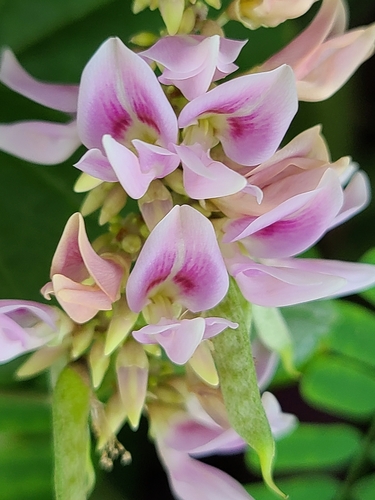
Archidendron globosum
(Blume) Nielsen
Pokok bongak, Coastal dog fruit
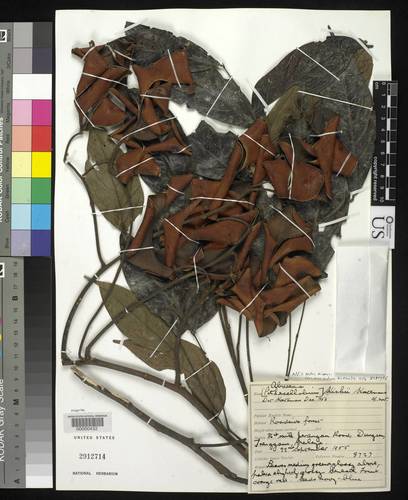
(c) Smithsonian Institution, National Museum of Natural History, Department of Botany, some rights reserved (CC BY-NC-SA)

President and Fellows of Harvard College

President and Fellows of Harvard College
What to Eat
Edible parts: Pods, Fruit
The acidic fruit are used in curries and chutneys.
Known Hazards
Where to Find It
A tropical plant. Trees grow in dense lowland and hill rainforest. They grow from sea level to 1,000 m altitude.
Asia, Indochina, Indonesia, Malaysia, Myanmar, SE Asia, Singapore,
How to Identify
A tree. It grows up to 30 m high and can have a trunk 90 cm across. The small branches are round and red-brown. Near the end they have short rusty hairs. The leaves can be 6-20 cm long divided into a compound leaf. There can be 1-3 pairs of first level leaflets 5-20 cm long with secondary leaflets in 4-7 pairs and 5-17 cm long by 2-7 cm wide. (The leaves vary in size and number of leaflets.) The flower clusters are at the ends of branches or in the axils of leaves towards the ends of branches. The flower heads can be 40 cm by 40 cm made up of 25-30 flowers with very short stalks. Flowers have 5 parts and are of both sexes. The fruit are pods which are reddish brown both outside and inside. They are curved almost into a circle which is 6-7 cm across. The pod splits open along one side. The seeds are bluish-black and oval. They are 25 mm by 10-15 mm. They remain attached to the pod.
How to Grow
It is grown from seed.
Medicinal Uses
The roots are used as a poultice on boils.
Other Uses
The heartwood is dark yellow, the sapwood white. The wood is soft, when freshly cut it has a somewhat disagreeable turnip smell. It is used locally for beams etc.
Production
Flowers occur from January to April and then June and December. Pods occur in January and September.
Notes
There are 90 Archidendron species. Also as Mimosaceae.
Names & Synonyms
Lulai bongak, Lulai merah, Pohon kerdas, Pokok lempong
References (6)
- Ambasta, S.P. (Ed.), 2000, The Useful Plants of India. CSIR India. p 464 (As Pithecellobium globosum)
- Burkill, I.H., 1966, A Dictionary of the Economic Products of the Malay Peninsula. Ministry of Agriculture and Cooperatives, Kuala Lumpur, Malaysia. Vol 2 (I-Z) p 1789 (As Pithecellobium affine)
- Nielsen, 1992, Mimosaceae, Flora Malesiana ser 1, 11(1) p 104
- Slik, F., www.asianplant.net
- Sukarya, D. G., (Ed.) 2013, 3,500 Plant Species of the Botanic Gardens of Indonesia. LIPI p 135
- World Checklist of Useful Plant Species 2020. Royal Botanic Gardens, Kew