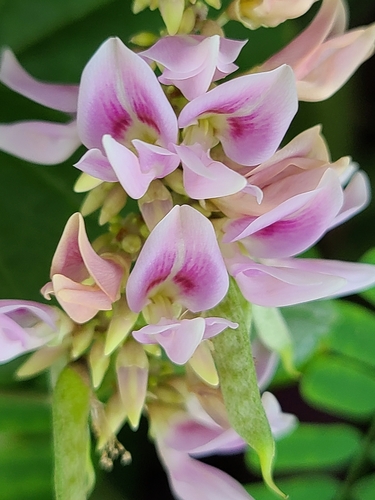
Archidendron jiringa
(Jack) I.C.Nielsen
Jengkol, Jiringa
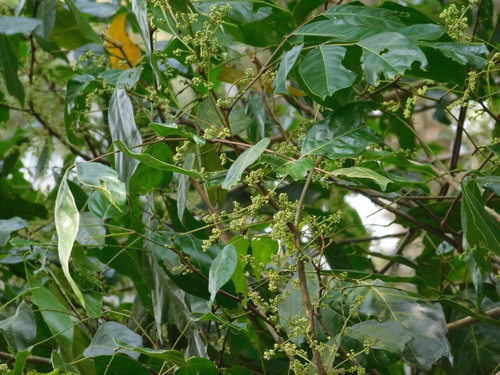
(c) Ganjar Cahyadi, some rights reserved (CC BY-NC)
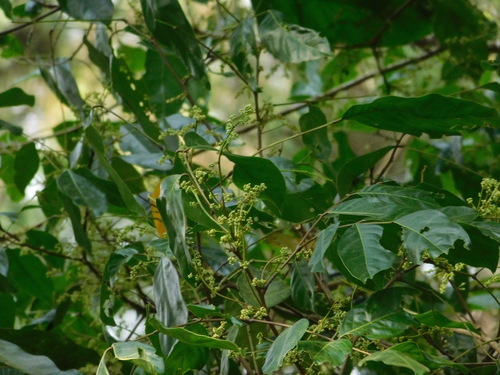
(c) Ganjar Cahyadi, some rights reserved (CC BY-NC)
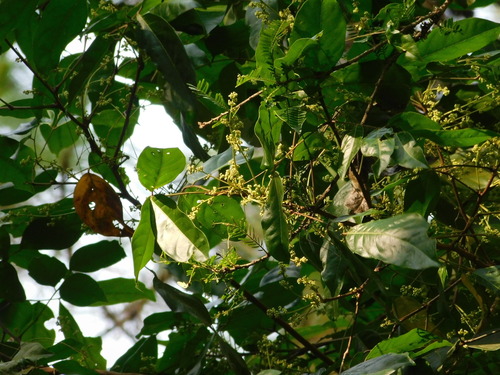
(c) Ganjar Cahyadi, some rights reserved (CC BY-NC)
What to Eat
Edible parts: Pods - flavouring, Shoots, Seeds, Spice, Leaves, Vegetable
Edible Parts: Flowers Fruit Leaves Seed Seedpod Shoots Edible Uses: Edible portion: Pods - flavouring, Shoots, Seeds, Spice, Leaves. Seed - raw or cooked. The seed has a powerful odour that many people find objectionable. Young seeds are often eaten raw. Generally the young seeds are believed to have a better flavour than older ones, though some people prefer to eat germinating mature seeds. The seedpod is 20 - 25cm long and 3 - 4cm wide, twisted in a wide spiral. Mature seeds contain djenkolic acid and need careful preparation to neutralize it. Traditionally, they are boiled in three changes of water. Sometimes the seeds are boiled in a mixture of water, wood ash, bamboo leaves and pieces of steel or nails, discarding the cook water a number of times. The resulting beans are said to be highly nutritious. Other ways in which the seeds are prepared are:- 1). Boiled thoroughly till the offensive smell has disappeared, then consumed with salt and grated coconut. 2). Steeped for a couple of hours in salt water, before being fried in oil. This also removes most of the bad smell. 3). Made into a local delicacy, called emping. After cooking, the cotyledons are flattened by hammering them one by one into the shape of small cakes which are sun-dried, and fried in coconut oil and sprinkled with salt before consumption. 4). Buried for 14 days until they germinate, then dug up and washed clean, whilst at the same time the sprouts are cut off and thrown away. The latter way of preparation is said to minimize the danger of intoxication by jengkolic acid, crystals of which can cause kidney failure. It is recommended to drink much water when eating the seeds. A starch is also extracted from the seed. Young leaves - cooked. The very young wine-red shoots are consumed raw as a vegetable. Flowers. Eaten as a vegetable. Fruit.
Known Hazards
Where to Find It
A tropical plant. It grows in rainforest including re-growth. It can grow on sand or clay soils. It occurs from sea level up to 1,000 m altitude or sometimes 1600 m in Java.
Asia, Bangladesh, Brunei, Indochina, Indonesia, Malaysia, Myanmar, Pacific, Philippines, SE Asia, Thailand,
How to Identify
A shrub or tree. It can grow to 21 m high. The trunk can be 60 cm across. The branches are round but with ridges down the stem from the leaf scars. The leaf stalk is 2-7 cm long. The leaves are compound with one pair of primary branches and 2 or 3 pairs of leaflets along these. The leaflets are oval and 5.5-20.5 cm long by 2.4-7 cm wide. The flower clusters have 4-7 flowers on one long stalk. They are cream to white with 5 flower parts and both sexes. The fruit is a pod which is dark brown and twisted into a wide spiral or circle. This is about 11 cm across. The pod is deeply lobed between the seeds. The pod is woody and 20-25 cm long by 5 cm across. It opens along the centre. The seeds are dark brown and 3-3.5 cm across. They are 1-1.5 cm thick.
Nutrition Score: 47/100
| Part | Moisture | kJ | kcal | Protein | Vit A | Vit C | Iron | Zinc |
|---|---|---|---|---|---|---|---|---|
| Pods - flavour | 76.3 | 385 | 92 | 6.2 | — | — | 0.7 | — |
| Seeds - flavour | 93 | 92 | 22 | 3.5 | 72 | 12 | 0.7 | — |
| Shoots - flavour | — | — | — | — | — | — | — | — |
How to Grow
The trees are grown from seed planted in the location where they are to grow. A spacing of 10-15 m is suitable.
Propagation: Seed - The trees are grown from seed planted in the location where they are to grow. A spacing of 10-15 m is suitable.
Medicinal Uses
Diuretic Hypoglycaemic Skin The seed is said to be good for relieving the symptoms of diabetes. The old leaves, burnt to ashes, are used against itching. The ashes of young leaves are used as wound powder for cuts (e.g. Circumcision). They are also applied traditionally as a diuretic, but are poisonous when eaten in large amounts.
Other Uses
Dye Fuel Furniture Hair Insecticide Soap making Wood Other uses rating: Low (2/5). Other Uses The pods have been used as a source of purple dye for silk. The bark and leaves are used for dyeing matting black. To obtain this colour the mat is boiled with extract from the bark and then immersed in mud. A reddish dye is obtained from the seeds. The pods are used as a shampoo. The pulverised seeds are used, they are rich in saponins. The bark, leaves and seeds have insecticidal properties. The heartwood is white, the sapwood white or pinkish-white. The wood has a strong smell of garlic when fresh, it is soft, easy to saw and to work with. It is considered to be only suitable for cabinet work, interior joinery. The wood is used for fuel. Special Uses Nitrogen Fixer
Wikipedia
Source ↗Archidendron jiringa is a flowering plant in the family Fabaceae. It is a shrub or tree which ranges from Bangladesh through Myanmar, Thailand, Peninsular Malaysia, Borneo, and Sumatra to Java.
Production
It flowers and fruits throughout the year. It takes 40-50 days from flowering to mature fruit. A mature tree produces 1,000-4,000 seeds per year.
Other Information
It is sold in Asian stores bottled in brine. It is a cultivated food plant. It is popular in SE Asia.
Notes
The seeds can contain djenkol acid which is poisonous. There are 90 Archidendron species. Also as Mimosaceae.
Names & Synonyms
Cha niang, Chanieng, Danyin, Dhinyindi, Jaring, Jering, Jing, Jiring, Jringkol, Kanieng, Ngapi nut, Niang, Niang-nok, Nieng, Sa nae sa, Tang-yin, Tanyeng-pen, Tanyin, Tutung, Yawng
References (44)
- Adansonia ser. 2, 19:32. 1979
- Altschul, S.V.R., 1973, Drugs and Foods from Little-known Plants. Notes in Harvard University Herbaria. Harvard Univ. Press. Massachusetts. no. 1552 (As Zygia jiringa)
- Argent, G et al, nd, Manual of the Larger and More important non Dipterocarp Trees of Central Kalimantan Indonesia. Volume 2 Forest Research Institute, Samarinda, Indonesia. p 352
- Arora, R. K., 2014, Diversity in Underutilized Plant Species - An Asia-Pacific Perspective. Bioversity International. p 100, 108
- Burkill, I.H., 1966, A Dictionary of the Economic Products of the Malay Peninsula. Ministry of Agriculture and Cooperatives, Kuala Lumpur, Malaysia. Vol 2 (I-Z) p 1792 (As Pithecellobium jiringa)
- Coronel, R.E., 1982, Fruit Collections in the Philippines. IBPGR Newsletter p 8 (As Pithecellobium jiringa)
- Food Composition Tables for use in East Asia FAO http://www.fao.org/infoods/directory No. 363 (As Pithecellobium jiringa)
- Gardner, S., et al, 2000, A Field Guide to Forest Trees of Northern Thailand, Kobfai Publishing Project. p 162
- Hedrick, U.P., 1919, (Ed.), Sturtevant's edible plants of the world. p 506 (As Pithecellobium lobatum)
- G. King, J. Asiat. Soc. Bengal, Pt. 2, Nat. Hist. 66(2):267. 1897 (As Pithecellobium jiringa)
- Jacquat, C., 1990, Plants from the Markets of Thailand. D.K. Book House p 40
- Japanese International Research Centre for Agricultural Science www.jircas.affrc.go.jp/project/value_addition/Vegetables
- Kiple, K.F. & Ornelas, K.C., (eds), 2000, The Cambridge World History of Food. CUP p 1792 (As Pithecellobium jiringa)
- Lembogi Biologi Nasional, 1980, Sayur-sayuran. Balai Pustaka, Jakarta. p 34 (As Pithecellobium jiringa)
- Macmillan, H.F. (Revised Barlow, H.S., et al) 1991, Tropical Planting and Gardening. Sixth edition. Malayan Nature Society. Kuala Lumpur. p 322
- Martin, F. W., et al, 1987, Perennial Edible Fruits of the Tropics. USDA Handbook 642 p 35 (As Pithecellobium lobatum)
- Menninger, E.A., 1977, Edible Nuts of the World. Horticultural Books. Florida p 99 (As Pithecellobium jiringa)
- Menninger, E.A., 1977, Edible Nuts of the World. Horticultural Books. Florida p 99 (As Pithecellobium lobatum)
- Milow, P., et al, 2013, Malaysian species of plants with edible fruits or seeds and their evaluation. International Journal of Fruit Science. 14:1, 1-27 (Also as Pithecellobium jiringa Prain)
- Murakami, A. et al, 2014, Screening for the In Vitro Anti-tumor-promoting Activities of Edible Plants from Malaysia. Bioscience, Biotechnology, and Biochemistry, 64:1, 9-16.
- Nakahara, K. et al, 2002, Antimutagenicity of Some Edible Thai Plants, and a Biocative Carbazole Alkaloid, Mahanine, Isolated from Micromelum minutum. Journal of Agricultural and Food Chemistry. 50: 4796-4892
- Nielsen, 1992, Mimosaceae. Flora Malesiana ser 1, 11(1) p 106
- Ochse, J.J. et al, 1931, Vegetables of the Dutch East Indies. Asher reprint. p 425 (As Pithecolobium lobatum)
- Ong, H., et al, 2012, Traditional knowledge and usage of edible plants among the Semai community of Kampung Batu 16, Tapah, Perak, Malaysia. Scientific Research and Essays Vol. 7(4), pp. 441-445, 30 January, 2012
- Ong, H.C. et al, 2012, Traditional knowledge and usage of edible plants among the Temuan villagers, Malaysia. Indian Journal of Traditional Knowledge. 11(1) pp 161-165
- Pitojo, S., 1992, Jengkol. Budidaya dan pemanfaatannya. Pernerbit Kanisius. (As Pithecellobium jiringa)
- PROSEA handbook Volume 13 Spices. p 274
- Sakunpak, A. & Panichayupakaranant, P., 2012, Antibacterial activity of Thai edible plants against gastrointestinal pathogenic bacteria and isolation of a new broad spectrum antibacterial polyisoprenylated benzophenone, chamuangone. Food Chemistry 130 (2012) 826–831
- Seidemann J., 2005, World Spice Plants. Economic Usage, Botany, Taxonomy. Springer. p 49
- Shin, T., et al, 2018, Traditional knowledge of wild edible plants with special emphasis on medicinal uses in Southern Shan State, Myanmar. Journal of Ethnobiology and Ethnomedicine (2018) 14:48
- Siemonsma, J. S. and Piluek, K. (Eds), 1994, Plant Resources of South-East Asia No. 8 Vegetables. Prosea Foundation, Bogor, Indonesia, p 89
- Siong, K. H., 2003, Indigenous Fruits of Sarawak. ITTO & Sarawak Forest Department. p 80 (As Pithecellbium jiringa)
- Slik, F., www.asianplant.net
- Solomon, C., 2001, Encyclopedia of Asian Food. New Holland. p 247 (As Pithecellobium lobatum)
- Sosef, M. S. M., Hong, L. T., & Prawirohatmodjo, S., (Eds.), 1998, Timber tree: Lesser-known timbers. Plant Resources of South-East Asia, 5(3), p 84
- Sutjaritjai, N., et al, 2019, Traditional Uses of Leguminosae among the Karen in Thailand. Plants 2019, 8, 600 p 5
- Suwardi, A. B., et al, 2020, Ethnobotany and conservation of indigenous edible fruit plants in South Aceh, Indonesia. Biodiversitas Vol. 21, No. 5, pp 1850-1860
- Terra, G.J.A., 1973, Tropical Vegetables. Communication 54e Royal Tropical Institute, Amsterdam, p 67 (As Pithecellobium lobatum)
- Thitiprasert, W., et al, 2007, Country report on the State of Plant Genetic Resources for Food and Agriculture in Thailand (1997-2004). FAO p 106
- USDA, ARS, National Genetic Resources Program. Germplasm Resources Information Network - (GRIN). [Online Database] National Germplasm Resources Laboratory, Beltsville, Maryland. Available: www.ars-grin.gov/cgi-bin/npgs/html/econ.pl (10 April 2000)
- Wiersema, J. H. & Leon, B., 2013, World Economic Plants. A Standard Reference CRC Press. 2nd Ed. p 64
- World Checklist of Useful Plant Species 2020. Royal Botanic Gardens, Kew
- Zawiah, N. & Othaman, H., 2012, 99 Spesies Buah di FRIM. Institut Penyelidikan Perhutanan Malaysia. p 28
- Wickens, G.E., 1995, Edible Nuts. FAO Non-wood forest products. FAO, Rome. p 141 (As Pithecellobium jiringa)