Archidendron microcarpum
(Benth.) Nielsen
Keredas

(c) loupok, some rights reserved (CC BY-NC-ND)

(c) loupok, some rights reserved (CC BY-NC-ND)
What to Eat
Edible parts: Pods - flavouring, Spice
The strong-smelling pods are used for seasoning food in Malaysia and are added to chutneys.
Known Hazards
Where to Find It
A tropical plant. Trees grown in light secondary rainforest. Often they are in sandy soil and swampy conditions. They grow from sea level to 500 m altitude but occasionally up to 1,200 m.
Asia, Brunei, Indonesia, Malaysia, SE Asia,
How to Identify
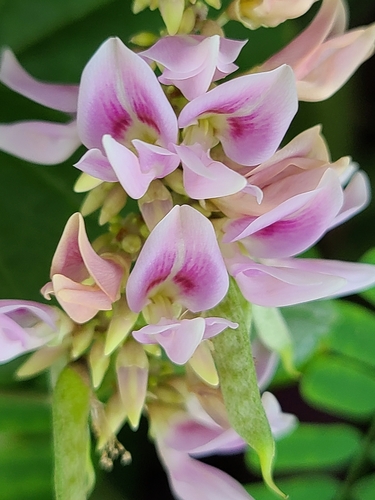
A small tree. It grows up to 15 m high and has a straight trunk. It can reach 10 m before the first branches. The trunk can be 20 cm across. There can be buttresses. The small branches are round and densely hairy. The leaf axis is 1-17 cm long and divided into a compound leaf. There are 1-3 pairs of first leaf divisions which are 15 cm long and then 1-4 pairs of leaflets 5-15 cm long by 3-7 cm wide. They are unequal in shape and oval. The flower cluster is at the ends of branches and is hairy. They are in flower heads 30 cm long by 60 cm across. The flowers have 5 flower parts and are of both sexes. The fruit are pods and two kinds of pods occur. In the outer part of the arrangement the pods are sterile, red and distorted. Fertile pods are in the centre. These are reddish-orange and curved into a circle 2-3 cm across. The seeds are black with a bluish bloom. They are 7-8 mm long by 6 mm across.
How to Grow
A plant of the moist lowland tropics, where it is usually found at elevations below 500 metres. Plants can flower and fruit all year round. This species has a symbiotic relationship with certain soil bacteria, these bacteria form nodules on the roots and fix atmospheric nitrogen. Some of this nitrogen is utilized by the growing plant but some can also be used by other plants growing nearby.
Medicinal Uses
The shoots and roots are prescribed as a treatment against itch. The pounded leaves are used for rubbing the skin of patients suffering from smallpox.
Other Uses
The heartwood is white, the sapwood white or yellowish-white, sometimes streaked with red. The wood is soft. It is used locally for construction purposes.
Wikipedia
Source ↗Archidendron microcarpum (In Indonesian: kabau or jolang-jaling) is a plant, native to the wild forests of Sumatra. It produces fruit, oval in shape and green with darker skin. The plant is notably potent. Typically, these plants live in the tropics, and includes plants that grow wild in the forests of Sumatra. This fruit smells like jering and banana. The trait makes kabau similar to them and thus it is consumed like both of the plants. According to the Indonesian dictionary, kabau is a bad smelling fruit that can be consumed. In the area of Rejang, kabau consumed as fresh vegetables and is usually consumed with rice that bergulai entry, tempoyak, or side dishes typical of other Sumatra. Based on existing experience, kabau have substances such as chalk owned Jering. This could lead to the head, which is characterized by hard fruit urine and the presence of substances such as chalk is out along with the urine.
Production
Plants flower and fruit all year round.
Notes
There are 90 Archidendron species. Also as Mimosaceae.
Names & Synonyms
Jiring tupai, Kayum, Keredas api, Keredas ayam, Keredas padi, Petai belalang, Saga
References (8)
- Burkill, I.H., 1966, A Dictionary of the Economic Products of the Malay Peninsula. Ministry of Agriculture and Cooperatives, Kuala Lumpur, Malaysia. Vol 2 (I-Z) p 1793 (As Pithecellobium microcarpum)
- Flora Malesiana 11(1) p 109
- ILDIS Legumes of the World http:www;ildis.org/Legume/Web
- Milow, P., et al, 2013, Malaysian species of plants with edible fruits or seeds and their evaluation. International Journal of Fruit Science. 14:1, 1-27
- PROSEA handbook Volume 13 Spices. p 274
- Slik, F., www.asianplant.net
- Sosef, M. S. M., Hong, L. T., & Prawirohatmodjo, S., (Eds.), 1998, Timber tree: Lesser-known timbers. Plant Resources of South-East Asia, 5(3), p 84
- World Checklist of Useful Plant Species 2020. Royal Botanic Gardens, Kew