Schinus areira
L.
Pepperina, Pepper tree
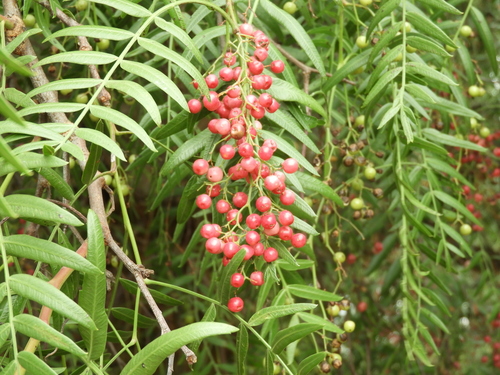
(c) Graeme Rigg, some rights reserved (CC BY-NC), uploaded by Graeme Rigg
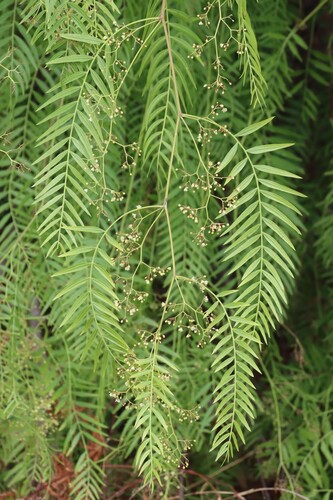
(c) Garry French, some rights reserved (CC BY-NC), uploaded by Garry French

(c) Jeremy James, some rights reserved (CC BY), uploaded by Jeremy James
What to Eat
Edible parts: Fruit as spice
Although not related to commercial pepper (Piper nigrum) the pink/red berries are sold as pink peppercorns and often blended with commercial pepper. The fruit and leaves are, however, potentially poisonous to poultry, pigs, and possibly calves. Records also exist of young children who have experienced vomiting and diarrhea after eating the fruit. Presently Schinus molle lacks generally recognized as safe (GRAS) status with the United States Food and Drug Administration. Extracts of S. molle have been used as a flavor in drinks and syrups.
Where to Find It
It grows in subtropical and warm temperate regions. It grows on red sandy loams. It is often along creek banks.
Argentina, Australia, Bolivia*, Chile, Colombia, Ecuador, Paraguay, Peru, South America, Uruguay,
How to Identify
A tree. It grows 25 m high. The leaves are compound and alternate. They are 15-30 cm long with narrow leaflets. The flowers are white and cream. The fruit is 5-9 mm across.
Medicinal Uses
In traditional medicine, S. molle was used in treating a variety of wounds and infections due to its antibacterial and antiseptic properties. It has also been used as an antidepressant and diuretic, and for toothache, rheumatism and menstrual disorders, with recent studies in mice providing possible support for its antidepressant effects. It has also been speculated that S. molle's insecticidal properties make it a good candidate for use as an alternative to synthetic chemicals in pest control. Fresh green leaves in bunches are used shamanically in Mesoamerican traditional ceremonies for cleansings and blessings.
Notes
There are about 30 Schinus species.
Names & Synonyms
Aquaribay, Molle, Molli, Pimiento
References (13)
- Bodkin, F., 1991, Encyclopedia Botanica. Cornstalk publishing, p 914
- Cordero, S. E., Abello, L. A., & Galvez, F. L., 2017, Plantas silvestres comestibles y medicinales de Chile y otras partes del mundo. CORMA p 123
- Hemphill, I, 2002, Spice Notes. Macmillan. p 292 (As Schinus molle var. ariera)
- Hibbert, M., 2002, The Aussie Plant Finder 2002, Florilegium. p 288
- Hussey, B.M.J., Keighery, G.J., Cousens, R.D., Dodd, J., Lloyd, S.G., 1997, Western Weeds. A guide to the weeds of Western Australia. Plant Protection Society of Western Australia. p 80
- Joyal, E., 1987, Ethnobotanical Field Notes from Ecuador: Camp, Prieto, Jorgensen, and Giler. Economic Botany 41(2): 163-189
- Kew Plants of the World Online
- Lazarides, M. & Hince, B., 1993, Handbook of Economic Plants of Australia, CSIRO. p 212
- Leon-Lobos, P., et al, 2022, Patterns of Traditional and Modern Uses of Wild Edible Native Plants of Chile: Challenges and Future Perspectives. Plants (Basel) v 11 (6) Table S1
- Paczkowska, G. & Chapman, A.R., 2000, The Western Australian Flora. A Descriptive Catalogue. Western Australian Herbarium. p 145
- Palmieri, V. S., et al, 2018, Aproximaciones etnobotánicas de las especies y prácticas de frutos nativos comestibles de la Actualidad. Aportes para la interpretación del pasado prehispánico de cerro colorado (Córdoba, Argentina). Bol. Soc. Argent. Bot. 53 (1): 115-133
- Palmeiri, V. S., & Geisa, M. G., 2019, Las plantas comestibles empleadas por las comunidades comechingonas de San Marcos Sierras (Córdoba, Argentina). Primeras aproximaciones. Bol. Soc. Argent. Bot. 54: 295-309.
- Prodr. 2:74. 1825