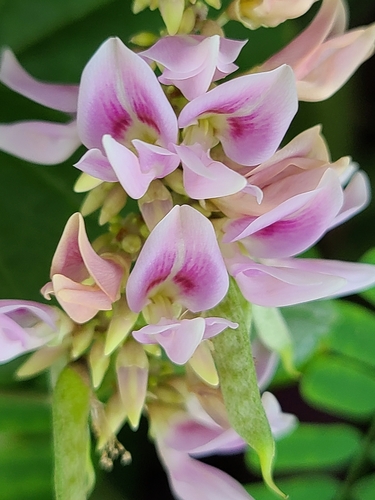
Schotia afra
(L.) Thunb.
African schotia, Karoo boer-bean
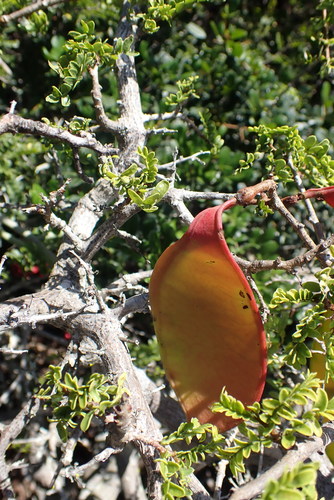
(c) David Hoare, some rights reserved (CC BY-NC-SA), uploaded by David Hoare
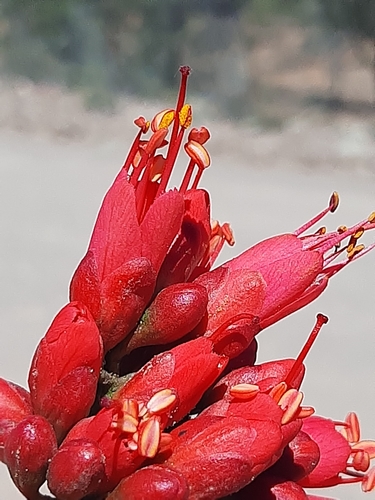
(c) Johan Eksteen, some rights reserved (CC BY-NC), uploaded by Johan Eksteen

(c) YvettevWijk, some rights reserved (CC BY-NC), uploaded by YvettevWijk
What to Eat
Edible parts: Pods, Seeds
The round brown seeds are eaten raw or cooked with the outer bitter skin removed, or ground into flour.
Where to Find It
A tropical plant. It grows in coastal districts in South Africa. It grows in dry stony soils. It grows between sea level and 1,250 m above sea level. It is tolerant to drought and frost. It can grow in arid places. Brisbane Botanical Gardens. Hobart Botanical Gardens.
Africa, Australia, Britain, Europe, Namibia, North America, South Africa, Southern Africa, Tasmania, USA,
How to Identify
A shrub or much branched small tree. It grows up to 6 m tall. It has several stout, thick, twisted stems. The leaves are usually dark green. The smooth grey twigs can be seen among the leaves. The leaves divide once. There is a pair of leaflets at the end and the leaflets tend to fold up along the midrib. The midrib is sometimes winged. There are 6-8 pairs of leaflets. They vary from 6-25 mm long. The flowers are red. They occur in bunches on short woody side twigs. The flowers have 5 petals. The pods are 5-13 cm long and 4 cm wide. They are hard and woody. There are several round brown seeds. They are edible.
Nutrition Score: 64/100
| Part | Moisture | kJ | kcal | Protein | Vit A | Vit C | Iron | Zinc |
|---|---|---|---|---|---|---|---|---|
| Seeds | 8 | 1340 | 321 | 11.6 | — | — | 15.6 | 2.2 |
How to Grow
Trees can be grown from seed. The seeds germinate irregularly. Seedlings transplant easily.
Propagation: Seed - sow in a seed tray in a semi-shady area with about 40% shade. The seeds should sown in well-drained, loamy soil and covered with around 3 - 5mm of soil. Water well once a day. Make sure the seeds are not crowded in the tray (this should prevent damping off). The seeds will swell with moisture and should germinate within 7 days. The seedlings should be allowed to develop a tap root and be in their third set of leaves before they are transplanted into planting bags.
Other Uses
The bark has been used as a source of tannins. The reddish brown wood is hard and durable. It is used for yokes and felloes. The wood is used for fuel.
Wikipedia
Source ↗Schotia afra is a flowering plant in the legume family, Fabaceae. It belongs to the subfamily Detarioideae. It occurs in Southern Africa. The genus was named for Richard van der Schot by Jacquin who was the director of the Imperial Gardens at Schönbrunn Palace, Vienna. Van der Schot was his head gardener.
Notes
There are 4-5 Schotia species. They are in southern Africa. Also as Caesalpinaceae.
Names & Synonyms
Karooboerboon, Umgonge, Umgxamu, Umngxam, Umquoqoba
References (17)
- Barwick, M., 2004, Tropical and Subtropical Trees. A Worldwide Encyclopedic Guide. Thames and Hudson p 370
- Fox, F. W. & Young, M. E. N., 1982, Food from the Veld. Delta Books. p 215
- Hedrick, U.P., 1919, (Ed.), Sturtevant's edible plants of the world. p 598 (As Schotia speciosa)
- ILDIS Legumes of the World http:www:ildis.org/Legume/Web
- Mannheimer, C. A. & Curtis. B.A. (eds), 2009, Le Roux and Muller's Field Guide to the Trees and Shrubs of Namibia. Windhoek: Macmillan Education Namibia. p 140 (var. angustifolia)
- Palgrave, K.C., 1996, Trees of Southern Africa. Struik Publishers. p 275
- Palmer, E and Pitman, N., 1972, Trees of Southern Africa. Vol. 2. A.A. Balkema, Cape Town p 851
- Peters, C. R., O'Brien, E. M., and Drummond, R.B., 1992, Edible Wild plants of Sub-saharan Africa. Kew. p 124
- Prodr. pl. cap. 79. 1794
- Royal Botanic Gardens, Kew (1999). Survey of Economic Plants for Arid and Semi-Arid Lands (SEPASAL) database. Published on the Internet; http://www.rbgkew.org.uk/ceb/sepasal/internet [Accessed 26th April 2011]
- Ruiters-Welcome, A. K., 2019, Food plants of southern Africa. Ph.D. thesis. Univ. of Johannesburg p 60
- van Wyk, B, van Wyk, P, and van Wyk B., 2000, Photographic guide to Trees of Southern Africa. Briza. p 280
- van Wyk, Be, & Gericke, N., 2007, People's plants. A Guide to Useful Plants of Southern Africa. Briza. p 24
- van Wyk, Ben-Erik, 2019, The diversity and multiple uses of southern African legumes. Australian Systematic Botany, 2019, 32, 519–546
- Wehmeyer, A. S, 1986, Edible Wild Plants of Southern Africa. Data on the Nutrient Contents of over 300 species
- Welcome, A. K. & Van Wyk, B.-E., 2019, An inventory and analysis of the food plants of southern Africa. South African Journal of Botany 122 (2019) 136–179
- World Checklist of Useful Plant Species 2020. Royal Botanic Gardens, Kew