Schotia capitata
Bolle
Dwarf boer-bean, Small schotia
(c) Noeleen du Toit, some rights reserved (CC BY-SA), uploaded by Noeleen du Toit

(c) Duncan McKenzie, some rights reserved (CC BY-NC), uploaded by Duncan McKenzie

(c) Ricky Taylor, some rights reserved (CC BY-NC), uploaded by Ricky Taylor
What to Eat
Edible parts: Flowers - nectar
This tree can be used as a shade and ornamental tree. The leaves are browsed by stock. The seeds are edible either green, or mature. They can be used as a meal if roasted and ground. Traditionally the tree's bark has been used in tanning. It is also suitable to grow as a bonsai species.
Where to Find It
A tropical plant. It grows in dry woodland and scrub. In Brisbane Botanical gardens.
Africa, Australia, Botswana, East Africa, Eswatini, Mozambique, Namibia, South Africa, Southern Africa, Swaziland, Zimbabwe,
How to Identify
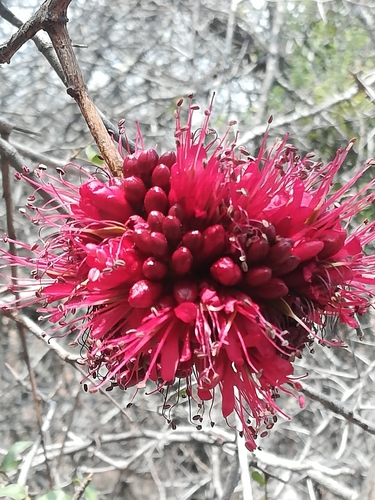
A shrub or slender tree. It grows up to 6 m tall. Mostly it has a single stem but may have several stems. The branches point upwards. The bark is grey. The leaves are divided once. The leaves are 8 cm long and they fold along the midrib. There are usually 3-5 pairs of leaflets. They are rounded and 1.3-2.5 cm long. They do not have a stalk but have a sharply pointed tip. The flowers are bight scarlet and cup shaped. They occur in dense round bunches at the ends of branches. They flowers have lots of nectar. This is edible. The pods are large and woody. The edges have a broad rim. There are several pale seeds with a yellow layer around them.
How to Grow
Although many species within the family Fabaceae have a symbiotic relationship with soil bacteria, this species is said to be devoid of such a relationship and therefore does not fix atmospheric nitrogen.
Other Uses
The wood is sometimes used for msking furniture.
Notes
Also as Caesalpinaceae.
Names & Synonyms
Dwarf boerboom
References (5)
- Palgrave, K.C., 1996, Trees of Southern Africa. Struik Publishers. p 276
- Palmer, E and Pitman, N., 1972, Trees of Southern Africa. Vol. 2. A.A. Balkema, Cape Town p 853
- Peters, C. R., O'Brien, E. M., and Drummond, R.B., 1992, Edible Wild plants of Sub-saharan Africa. Kew. p 124
- Swaziland's Flora Database http://www.sntc.org.sz/flora
- W. C. H. Peters, Naturw. Reise Mossambique 6(1):18. 1861