Scilla scilloides
(Lindl.) Druce
Chinese jacinth
(c) 红梅, some rights reserved (CC BY-NC)
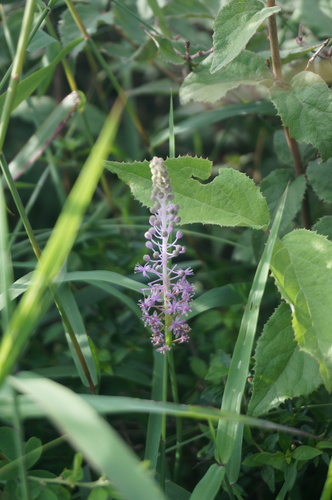
(c) 红梅, some rights reserved (CC BY-NC)
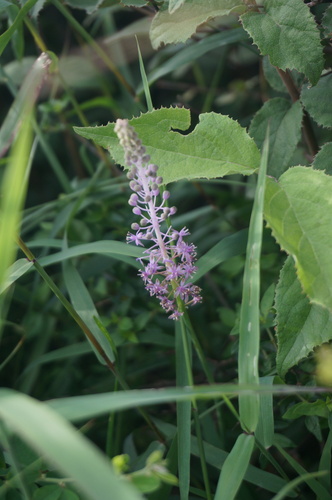
(c) 红梅, some rights reserved (CC BY-NC)
What to Eat
Edible parts: Leaves, Root, Bulb
The leaves are edible when cooked. The bulb, which grows up to 2cm in diameter, is also edible, though no further preparation details are recorded.
Where to Find It
It is a temperate plant. It grows on open hillsides with poor soil.
Asia, Australia, China, Japan, Korea, Slovenia,
How to Identify
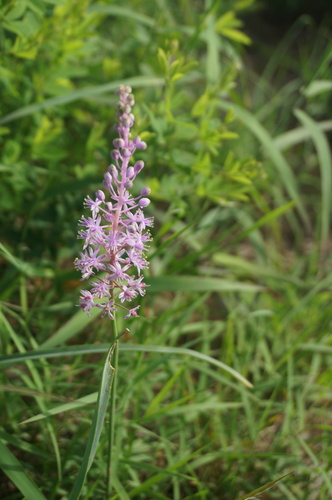
A herb that forms a bulb. It keeps growing from year to year. It grows about 1.8 m tall. The bulbs are oval and 2-4 cm long. The leaves are narrow and 10-50 cm long by 1 cm wide. The flowers are small and rose pink. They are in a dense group at the top of a stalk 20-60 cm long. The fruit is a 3 sided capsule 2-3 mm long. The seeds are black. Possibly now Barnardia japonica
How to Grow
Propagation: Seed is best sown as soon as it is ripe in a cold frame. Sow thinly and leave seedlings in the pot for their first year, providing liquid feeds if needed. When dormant, prick out young bulbs 2–3 to a pot and grow on in a frame for the following two years before planting out in their permanent positions while dormant. Established clumps can be divided when the foliage dies down in summer. Larger bulbs can go directly into permanent positions; smaller bulbs are best potted and grown on in a cold frame for a year before planting out when dormant in late summer.
Medicinal Uses
The bulbs are pounded and applied as a poultice to abscesses.
Other Uses
The plant is noted for its scent.
Wikipedia
Source ↗Bulbous perennial reaching 0.4 m tall and 0.1 m wide. Hardy to UK zone 5. Hermaphroditic flowers bloom August to September. Grows in light sandy, medium loamy, and heavy clay soils with mildly acid to basic pH. Tolerates semi-shade or full sun and prefers moist soil. Bulbs up to 2 cm diameter.
Other Information
It is a famine food.
Notes
There are about 90 Scilla species. It has anticancer properties. Also put in the family Hyacinthaceae.
Names & Synonyms
Morska čebulica, Mureut
References (12)
- Bot. Soc. Exch. Club Brit. Isles 4:646. 1917
- Brickell, C. (Ed.), 1999, The Royal Horticultural Society A-Z Encyclopedia of Garden Plants. Convent Garden Books. p 946
- Hibbert, M., 2002, The Aussie Plant Finder 2002, Florilegium. p 288
- http://www.botanic-gardens-ljubljana.com/en/plants
- Hu, Shiu-ying, 2005, Food Plants of China. The Chinese University Press. p 320
- Hwang, H., et al, 2013, A Study on the Flora of 15 Islands in the Western Sea of Jeollanamdo Province, Korea. Journal of Asia-Pacific Biodiversity Vol. 6, No. 2 281-310
- Hwang, HS, et al, 2014, Distribution characteristics of plant in the Ungseokbong Mountain, Gyeongsangnam-do, Korea. Journal of Asia-Pacific Biodiversity. 7(2014) e164-e178
- Kintzios, S. E., 2006, Terrestrial Plant-Derived Anticancer Agents and Plant Species Used in Anticancer research. Critical Reviews in Plant Sciences. 25: pp 79-113
- Lim, T. K., 2015, Edible Medicinal and Non Medicinal Plants. Volume 9, Modified Stems, Roots, Bulbs. Springer p 75
- Plants for a Future database, The Field, Penpol, Lostwithiel, Cornwall, PL22 0NG, UK. http://www.scs.leeds.ac.uk/pfaf/
- Song, M., et al, 2013, Traditional knowledge of wild edible plants in Jeju Island, Korea. Indian Journal of Traditional Knowledge. 12(2) pp 177-194
- Williams, D., 2017, Ainu Ethnobiology. Contributions in Ethnobiology. Society of Ethnobiology. p 143