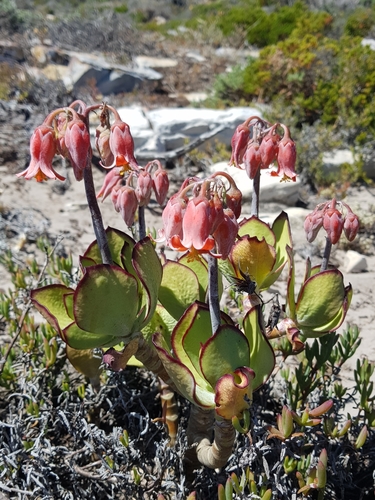
Sedum roseum
(L.) Scop. ex Sprague
Roseroot, Rosy-flowered stone crop, Golden root

(c) Boris Bolshakov, some rights reserved (CC BY-NC)

(c) Boris Bolshakov, some rights reserved (CC BY-NC)
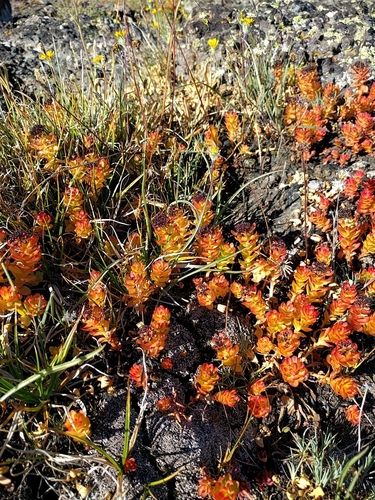
(c) Jess Beauchemin, some rights reserved (CC BY-NC)
What to Eat
Edible parts: Roots, Leaves, Stems
The young succulent leaves and shoots are eaten raw in salads, steamed as a vegetable, pickled, or served in oil. The stems can be cooked and eaten like asparagus. The roots are boiled, seasoned with butter and served with meat or fish, or pickled.
Where to Find It
An alpine and cold temperate plant. It grows in moist rocky or gravelly sites. It is native to dry sandy ground at higher altitudes and subarctic areas. It suits hardiness zones 1-8.
Alaska, Arctic, Asia, Australia, Britain, Canada, Central Asia, Europe, Germany, Greenland, Iceland, India, Ireland, Italy, Japan, Kazakhstan, Korea, Lithuania, Mediterranean, Mongolia, North America, Norway, Russia, Scandinavia, Siberia, Slovenia, USA,
How to Identify
A small herb that keeps growing from year to year. It has a branching rootstock. Each branch produces a leafy annual stem. It grows 5-75 cm high and spreads 5-75 cm wide. It has thick, branching underground stems or rhizomes. These are fragrant when cut. The leaves are egg shaped or oblong and succulent. They can have a red tinge. The edges can have teeth. There are usually 1-3 flowering stems. These produce 25-70 greenish yellow flowers. The flowers are 6 mm across. The flowers are in flat topped clusters. The central flower of each cluster blooms first. Male and female flowers can be in different parts of the cluster Male flowers are yellow and female flowers are purple. The seed pods are plump and erect. They are reddish-purple.
How to Grow
Plants can be grown by seeds.
Medicinal Uses
The leaves and roots are used medicinally.
Notes
There are about 400 Sedum species.
Names & Synonyms
Ekutuk, Eveeahkluk, Navadni rožni koren, Shrolo
References (29)
- Ambasta, S.P. (Ed.), 2000, The Useful Plants of India. CSIR India. p 564
- Bremness, L., 1994, Herbs. Collins Eyewitness Handbooks. Harper Collins. p 211 (As Rhodiola rosea)
- Brickell, C. (Ed.), 1999, The Royal Horticultural Society A-Z Encyclopedia of Garden Plants. Convent Garden Books. p 867 (As Rhodalea rosea)
- Bowser, M., 2017, Handout on Edible Plants of the Kenai Peninsula. USFWS Kenai National Wildlife Refuge p 12 (As Rhodiola rosea)
- Cundall, P., (ed.), 2004, Gardening Australia: flora: the gardener's bible. ABC Books. p 1143(As Rhodiola rosea)
- Elias, T.S. & Dykeman P.A., 1990, Edible Wild Plants. A North American Field guide. Sterling, New York p 110
- Esperanca, M. J., 1988. Surviving in the wild. A glance at the wild plants and their uses. Vol. 2. p 184
- Fl. carniol. ed. 2, 1:326. 1771 (As rosea)
- Flora of China @ efloras.org Volume 8(As Rhodiola rosea)
- http://nordicfood lab/org/blog/2102/9/wild-edible-plants-an-overview (As Rhodiola rosea)
- http://www.botanic-gardens-ljubljana.com/en/plants
- Jackes, D. A., 2007, Edible Forest Gardens(As Rhodiola rosea)
- Jones, A., 2010, Plants that we eat. University of Alaska Press. p 66 (ssp. integrifolia)
- Hedrick, U.P., 1919, (Ed.), Sturtevant's edible plants of the world. p 602
- Heller, C. A., 1962, Wild Edible and Poisonous Plants of Alaska. Univ. of Alaska Extension Service. p 33
- Irving, M., 2009, The Forager Handbook, A Guide to the Edible Plants of Britain. Ebury Press p 292
- Kiple, K.F. & Ornelas, K.C., (eds), 2000, The Cambridge World History of Food. CUP p 1858
- Lim, T. K., 2015, Edible Medicinal and Non Medicinal Plants. Volume 9, Modified Stems, Roots, Bulbs. Springer p 73
- MacKinnon, A., et al, 2009, Edible & Medicinal Plants of Canada. Lone Pine. p 254 (As Rhodiola rosea)
- Moerman, D. F., 2010, Native American Ethnobotany. Timber Press. p 525
- Pl. hist. succ. t. 143. 1804 - an illegitimate, superfluous name (ICBN Art. 52) (Re Sedum rhodiola)
- Plants for a Future database, The Field, Penpol, Lostwithiel, Cornwall, PL22 0NG, UK. http://www.scs.leeds.ac.uk/pfaf/ (As Rhodiola rosea)
- Porsild, A.E., 1953, Edible Plants of the Arctic, Arctic 6:15-34, page 28 (As Rhodiola rosea)
- Rana, J.C. et al, 2011, Genetic resources of wild edible plants and their uses among tribal communities of cold arid regions of India. Genetic Resources and crop Evolution. (As Rhodiola rosea)
- Scotter, G. W., & Flygare, H., 1993, Wildflowers of the Canadian Rockies. Hurtig. p 122
- Shikov, A. N. et al, 2017, Traditional and Current Food Use of Wild Plants Listed in the Russian Pharmacopoeia. Frontiers in Pharmacology. Vol. 8 Article 841
- Singh, H.B., Arora R.K.,1978, Wild edible Plants of India. Indian Council of Agricultural Research, New Delhi. p 37 (As Sedum rhodiola)
- Sp. pl. 2:1035. 1753 (As Rhodiola rosea)
- Uphof, (As Rhodiola rosea)