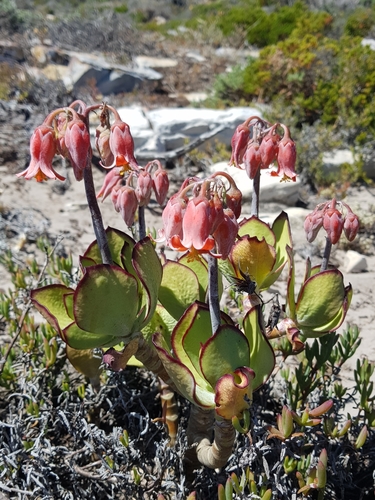
Sedum sediforme
(Jacq.) Pau
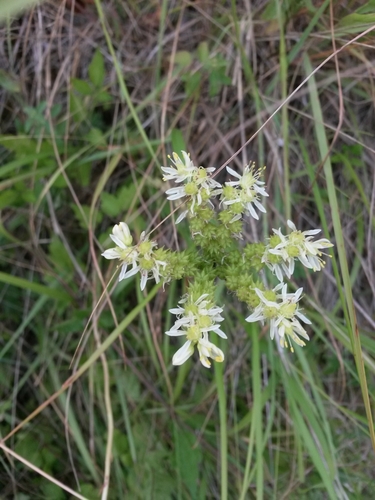
(c) Gaël, some rights reserved (CC BY-NC)

no rights reserved
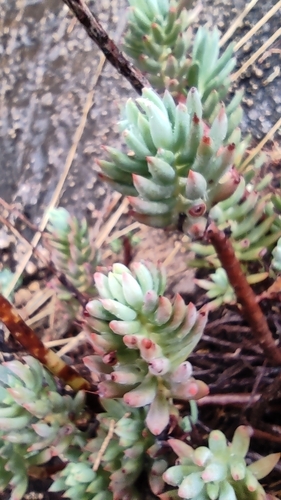
(c) Giorgos Nikolakakis, some rights reserved (CC BY-NC)
What to Eat
Edible parts: Leaves, Flowers - tea
The leaves are edible when cooked.
Where to Find It
It is a warm temperate to subtropical plant. It suits hardiness zones 8-11.
Australia, Europe, Greece, Italy, Mediterranean, Portugal, Spain, Tasmania,
How to Identify
A small succulent, evergreen herb. It grows 20-60 cm high and spreads 30-60 cm wide. It forms a mound. The leaves are small and fleshy. They are lance shaped. The flowering stems are erect. The flowers are green to yellow in heads.
How to Grow
Propagation: Surface sow seed in spring in well-drained soil in a sunny greenhouse position, keeping the soil consistently moist. Prick seedlings into individual pots when large enough to handle. Plant out during summer if sufficient growth has been made, otherwise overwinter in a cold frame or greenhouse and plant out the following early summer. Division is straightforward at almost any point during the growing season, though spring or early summer is preferred. Larger divisions can go directly into permanent positions; smaller ones are best potted up and grown on in a lightly shaded cold frame until well established, then planted out in summer.
Medicinal Uses
None known.
Other Uses
None known.
Wikipedia
Source ↗Evergreen perennial growing to 50 cm tall. Hardy to UK zone 8. Year-round foliage, flowering July to August. Hermaphrodite and insect-pollinated. Adapts to light sandy, medium loamy, and heavy clay soils. Suitable for mildly acidic to basic pH. Requires full sun. Prefers moist soil conditions.
Notes
There are about 400 Sedum species.
Names & Synonyms
Crespinell, Raim de pastor
References (9)
- Actas Mem. Prim. Congr. Nac. Esp. Zaragoza 246. 1909
- Baker, M. L. & de Salas, M. F., 2012, A Census of the Vascular Plants of Tasmania. (On line)
- Blamey, M and Grey-Wilson, C., 2005, Wild flowers of the Mediterranean. A & C Black London. p 71
- Bonet, M. A. & Valles, J., 2002, Use of non-crop food vascular plants in Montseny biosphere reserve (Catalonia, Iberian Peninsula). International Journal of Food Sciences and Nutrition (2002) 53, 225–248
- Cundall, P., (ed.), 2004, Gardening Australia: flora: the gardener's bible. ABC Books. p 1330
- Hibbert, M., 2002, The Aussie Plant Finder 2002, Florilegium. p 289
- Plants for a Future database, The Field, Penpol, Lostwithiel, Cornwall, PL22 0NG, UK. http://www.scs.leeds.ac.uk/pfaf/
- Rivera, D. et al, 2006, Gathered Mediterranean Food Plants - Ethnobotanical Investigations and Historical Development, in Heinrich M, Müller WE, Galli C (eds): Local Mediterranean Food Plants and Nutraceuticals. Forum Nutr. Basel, Karger, 2006, vol 59, pp 18–74 (subsp. dianium O. Bolos)
- Tardio, J., et al, Ethnobotanical review of wild edible plants in Spain. Botanical J. Linnean Soc. 152 (2006), 27-71