Sinomenium acutum
(Thunb.) Rehder & E. H. Wilson
Snailseed
(c) 曾昱承 Yu-Cheng Zeng, some rights reserved (CC BY-NC)
(c) 曾昱承 Yu-Cheng Zeng, some rights reserved (CC BY-NC)
(c) 曾昱承 Yu-Cheng Zeng, some rights reserved (CC BY-NC)
What to Eat
Edible parts: Leaves, Root
Both the root and leaves are edible when cooked.
Where to Find It
A tropical plant. It grows in the forests in river basins in S China. In Sichuan and Yunnan.
Asia, Britain, China, Europe, Himalayas, India, Indochina, Japan, Korea, Nepal, SE Asia, Thailand,
How to Identify
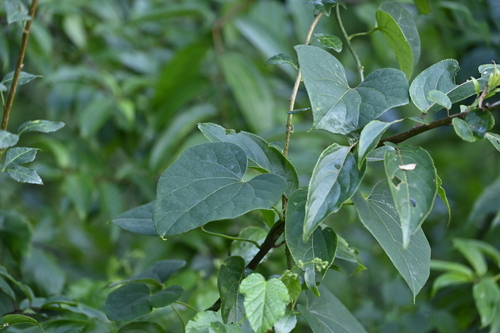
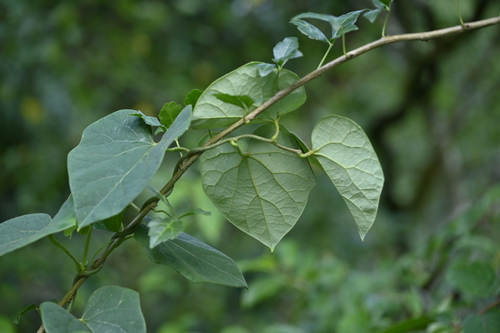
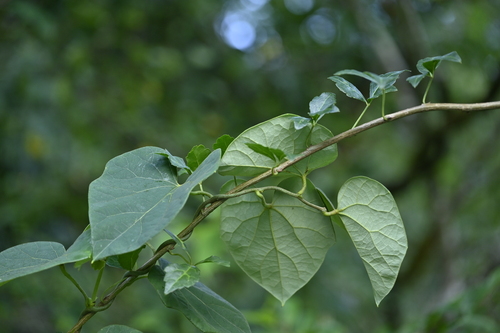
A woody vine. It can be 20 m long. The old stem are grey. The bark has irregular stripes along it. The leaf stalks are 5-15 cm long. The blade is leathery to papery. It is oval and 6-15 cm long and tapers to the tip. There can be 5-9 lobes. These are pointed. Leaves have 5 veins spreading out from the base. The flowering stalk is 20-30 cm long. Male and female flowers and plants are separate. The fruit is fleshy with a hard stone inside. It is red to purple. It is 5-6 mm across.
How to Grow
Propagation: Sow seed in late winter in a greenhouse. Once seedlings are large enough to handle, prick them out into individual pots and grow on under glass for at least their first winter. Plant out into permanent positions in late spring or early summer, after the last expected frosts. Half-ripe cuttings of 5–10 cm taken at a node in July or August, rooted in a frame, give a good percentage.
Medicinal Uses
The roots are anodyne and carminative. A decoction is used in the treatment of oedema, moisture-related beriberi and rheumatoid arthritis.
Other Uses
None known Special Uses
Wikipedia
Source ↗A deciduous climbing vine growing to 6 m tall. Flowers in June with seeds ripening from September to November. Dioecious species requiring both male and female plants for reproduction. Grows in light sandy to heavy clay soils with mildly acidic to basic pH. Tolerates semi-shade or full sun and prefers moist soil.
Notes
There is one Sinomenium species. It is used in medicine. It contains an alkaloid sinomenine used to treat arthritis.
Names & Synonyms
References (3)
- Lo Hsienshui, Chen Tao, Menispermaceae. Flora of China.
- Plants for a Future database, The Field, Penpol, Lostwithiel, Cornwall, PL22 0NG, UK. http://www.scs.leeds.ac.uk/pfaf/
- C. S. Sargent, Pl. wilson. 1:387. 1913


