Siphonodon celastrineus
Griff.
Ivory wood tree

(c) 刘光裕 Liu Guangyu, some rights reserved (CC BY-NC), uploaded by 刘光裕 Liu Guangyu

President and Fellows of Harvard College
What to Eat
Edible parts: Fruit
The fleshy layer surrounding the fruit is edible.
Known Hazards
Where to Find It
A tropical plant. It needs sunlight. It can tolerate drought. It grows in monsoon or dry mixed forests up to 1,300 m above sea level.
Asia, Cambodia, India, Indochina, Indonesia, Laos, Malaysia, Myanmar, Pacific, Papua New Guinea, PNG, Philippines, SE Asia, Thailand, Vietnam,
How to Identify
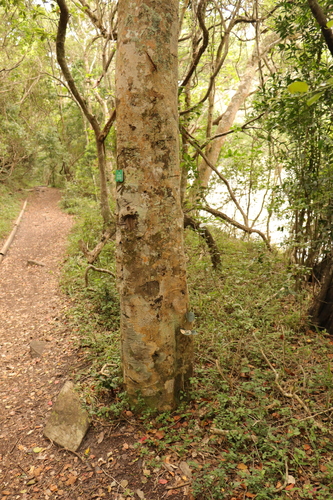
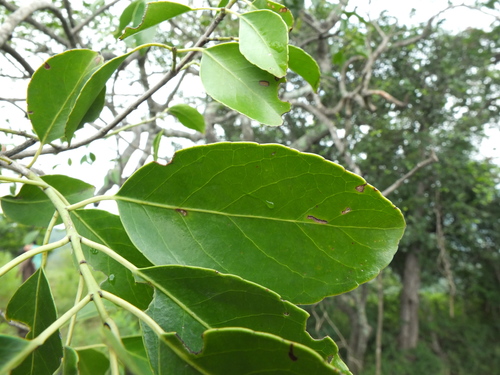
A medium sized tree. It grows 10-35 m high. The trunk is 20-70 cm across. It can have buttresses. Leaves are simple and oblong. They are 10-20 cm long by 4-8 cm wide. They are papery and shiny. The base is wedge shaped and it tapers towards the tip. There are 20-22 pairs of side veins. The leaf stalk is 1 cm long. The flowers are white and occur in clusters of 3. The fruit is a nut 3-4 cm long by 2.5-3.5 cm wide. The fruit are apple shaped and orange-yellow. There is a fleshy layer around the fruit. The flesh is edible. There are many hard seeds.
How to Grow
Plants can be grown from seeds.
Wikipedia
Source ↗Siphonodon celastrineus is a species of plant in the family Celastraceae. It is found in Cambodia, India, Myanmar, and Vietnam.
Notes
There are 7 Siphonodon species.
Names & Synonyms
Bak kok, Hpun-ja, Maduk, Mak loup, Myauk-okshti, Pohon danoklot kepu, Pohon kayu gading, Sang da, Woibaw
References (10)
- Borrell, O.W., 1989, An Annotated Checklist of the Flora of Kairiru Island, New Guinea. Marcellin College, Victoria Australia. p 61
- Forest Inventory and Planning Institute, 1996, Vietnam Forest Trees. Agriculture Publishing House p 93
- Hou, D., et al, Celastraceae. Flora of Thailand. 10, 2: 141-198 p 196
- Gardner, S., et al, 2000, A Field Guide to Forest Trees of Northern Thailand, Kobfai Publishing Project. p 121 (As celastrineus)
- Calcutta J. Nat. Hist. 4: 247 1843.
- Kachenchart, B., et al, 2008, Phenology of Edible Plants at Sakaerat Forest. In Proceedings of the FORTROP II: Tropical Forestry Change in a Changing World. Bangkok, Thailand.
- Natuhara, Y., et al, 2011, Uses of trees in paddy fields in Champasak Province, Southern Lao PDR. Landscape and Ecological Engineering. p 6
- Soepadmo, E. and Wong, K. M., 1995, Tree Flora of Sabah and Sarawak. Forestry Malaysia. Volume One. p 154
- Sukarya, D. G., (Ed.) 2013, 3,500 Plant Species of the Botanic Gardens of Indonesia. LIPI p 515
- Thitiprasert, W., et al, 2007, Country report on the State of Plant Genetic Resources for Food and Agriculture in Thailand (1997-2004). FAO p 95