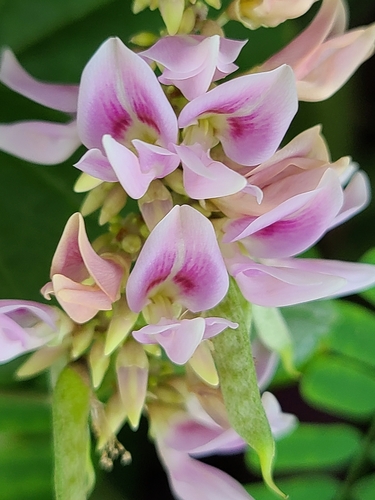
Smithia elliotii
Baker f.

Royal Botanic Gardens, Kew

Royal Botanic Gardens, Kew

Meise Botanic Garden
What to Eat
Edible parts: Leaves, Vegetable
The leaves are cooked as a side dish, with leaflets pulled off and cooked together with potash, producing a slimy texture. It is a minor vegetable of local importance sometimes sold in markets.
Where to Find It
A tropical plant. It grows in waste places and grasslands in wet sites in the highlands of West and Central Africa. It can grow in standing water. It grows between 1,150-2,700 m above sea level.
Africa, Burundi, Cameroon, Central Africa, Congo, East Africa, Ethiopia, Kenya, Madagascar, Malawi, Mozambique, Nigeria, Rwanda, Tanzania, Uganda, West Africa, Zambia,
How to Identify
An annual herb or small shrub. It has erect stems. It grows up to 1.5 m high. The leaves are 5-7 cm long and have 6-9 pairs of leaflets. The flowers are in groups of 3-6. They have brown bracts. The flowers contain both sexes. The fruit is a pod with 1-4 joints.
How to Grow
This species has a symbiotic relationship with certain soil bacteria; these bacteria form nodules on the roots and fix atmospheric nitrogen. Some of this nitrogen is utilized by the growing plant but some can also be used by other plants growing nearby.
Production
They are especially used near the end of the dry season.
Other Information
They are sometimes sold in markets. It is a minor vegetable of local importance.
Notes
There are about 30 Smithia species.
Names & Synonyms
Kadzulo, Kankula, Kasadzula, Umubazibazi
References (9)
- Burkill, H. M., 1985, The useful plants of west tropical Africa, Vol. 3. Kew.
- Chapman, J. D. & Chapman, H. M., 2001, The Forest Flora of Taraba and Andamawa States, Nigeria. WWF & University of Canterbury. p 186
- Fowler, D. G., 2007, Zambian Plants: Their Vernacular Names and Uses. Kew. p 40
- Grubben, G. J. H. and Denton, O. A. (eds), 2004, Plant Resources of Tropical Africa 2. Vegetables. PROTA, Wageningen, Netherlands. p 469
- Jardin, C., 1970, List of Foods Used In Africa, FAO Nutrition Information Document Series No 2.p 101
- Martin, F.W. & Ruberte, R.M., 1979, Edible Leaves of the Tropics. Antillian College Press, Mayaguez, Puerto Rico. p 200
- Peters, C. R., O'Brien, E. M., and Drummond, R.B., 1992, Edible Wild plants of Sub-saharan Africa. Kew. p 137
- Williamson, J., 2005, Useful Plants of Malawi. 3rd. Edition. Mdadzi Book Trust. p 226
- World Checklist of Useful Plant Species 2020. Royal Botanic Gardens, Kew