Sorbus intermedia
(Ehrhart) Persoon
Swedish Whitebeam
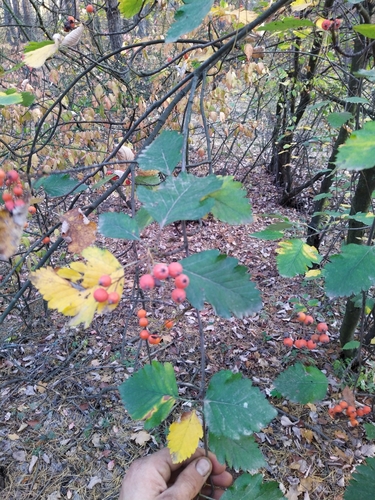
(c) Anton Biatov, some rights reserved (CC BY-NC)
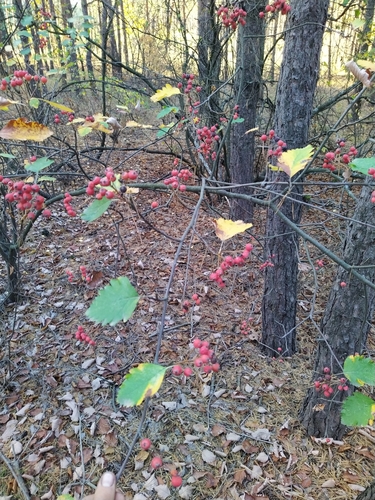
(c) Anton Biatov, some rights reserved (CC BY-NC)
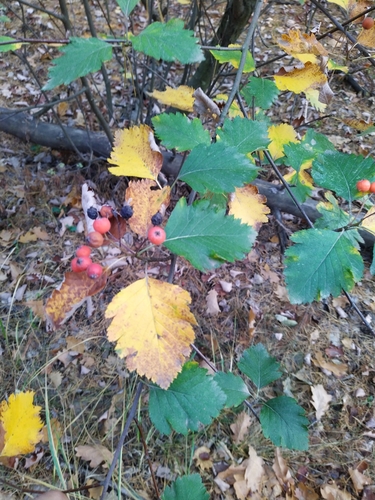
(c) Anton Biatov, some rights reserved (CC BY-NC)
What to Eat
Edible parts: Fruit
The fruit can be eaten raw or cooked, offering a mild if slightly bitter flavour with a mealy texture. Each fruit grows up to 13mm across, and they form in large clusters that make harvesting straightforward.
Where to Find It
It is a temperate plant. It is native to N.W. Europe. It grows in woods. It suits hardiness zones 5-9.
Australia, Belarus, Britain, Estonia, Europe, Norway, Scandinavia, Spain, Sweden,
How to Identify
A small compact tree. It grows to 15 m high. It loses its leaves during the winter. The crown forms a broad dome. The trunk is short. The bark is grey and cracks. It flakes off with age. The leaves are broad with shallow teeth and lobes. They are 10 cm long by 6 cm wide. The leaves are greenish above and yellowish grey-green underneath. They are hairy underneath. The leaves turn yellow in autumn. The flowers are white with pink stamens. They are 2 cm across. They are produced in dense clusters. These are 12 cm across. The fruit are long and scarlet. They are 1.5 cm long. They occur in bunches.
How to Grow
Propagation: Seed is best sown as soon as it is ripe in a cold frame, though with sufficient quantity it can go directly into an outdoor seedbed. Stored seed benefits from 2 weeks of warm stratification followed by 14–16 weeks of cold stratification, so sow as early in the year as possible. Prick seedlings into individual pots once large enough to handle. Top-growth is very slow in the first year or two as the plants focus on root development, so keep them in a cold frame through their first winter before planting out into permanent positions in late spring.
Medicinal Uses
None known.
Other Uses
This tree tolerates maritime exposure and works well as part of a shelterbelt planting. When regularly trimmed, it forms a dense deciduous hedge.
Wikipedia
Source ↗A deciduous tree reaching 12m tall and wide at a medium growth rate, hardy to UK zone 5. It flowers in May with seeds ripening September to October. Hermaphroditic and self-fertile, pollinated by insects. Grows well in light sandy, medium loamy, and heavy clay soils with good drainage; tolerates mildly acid to mildly alkaline conditions and very extreme pH. Adapts to semi-shade or full sun, prefers moist soil, and tolerates maritime exposure and atmospheric pollution. Known for attracting wildlife.
Other Information
The fruit are foraged and eaten in restaurants in Sweden.
Notes
There are about 75 Sorbus species.
Names & Synonyms
Leivamari, Morzal, Pooppuu, Svensk-asal
References (17)
- Bodkin, F., 1991, Encyclopedia Botanica. Cornstalk publishing, p 939
- Brickell, C. (Ed.), 1999, The Royal Horticultural Society A-Z Encyclopedia of Garden Plants. Convent Garden Books. p 970
- Coombes, A.J., 2000, Trees. Dorling Kindersley Handbooks. p 276
- Cundall, P., (ed.), 2004, Gardening Australia: flora: the gardener's bible. ABC Books. p 1357
- Girard, N. J., 2020, Sustainable Foraging of Wild Edible Plants in Norway. A Biocultural Approach. M. Sc. thesis Norwegian University. p 135
- Harris, E & J., 1983, Field Guide to the Trees and Shrubs of Britain. Reader's Digest. p 147
- Hedrick, U.P., 1919, (Ed.), Sturtevant's edible plants of the world. p 540 (As Pyrus intermedia)
- http://nordicfood lab/org/blog/2102/9/wild-edible-plants-an-overview
- Kalle, R. & Soukand, R., 2012, Historical ethnobotanical review of wild edible plants of Estonia (1770s-1960s) Acta Societatis Botanicorum Poloniae 81(4):271-281
- Luczaj, L. et al, 2012, Wild food plant use in 21st century Europe: the disappearance of old traditions and the search for new cuisines involving wild edibles. Acta Soc Bot Pol 81(4):359–370
- Luczaj, L. et al, 2013, Wild edible plants of Belarus: from Rostakinski's questionnaire of 1883 to the present. Journal of Ethnobiology and Ethnomedicine 9:21
- Pardo-de-Santayana, M., et al, 2007, Traditional knowledge of wild edible plants used in the northwest of the Iberian Peninsula (Spain and Portugal): a comparative study. Journal of Ethnobiology and Ethnomedicine 2007, 3:27
- Plants for a Future database, The Field, Penpol, Lostwithiel, Cornwall, PL22 0NG, UK. http://www.scs.leeds.ac.uk/pfaf/
- Soukand, R. & Kalle, R., 2016, Perceiving the Biodiversity of Food at Chest-height: use of the Fleshy Fruits of Wild Trees and Shrubs in Saaremaa, Estonia. Hum Ecol 44:265–272
- Svanberg, I, 2012, The use of wild plants as food in pre-industrial Sweden. Acta Societatis Botanicorum Poloniae. 81(4): 317-327
- Syn. pl. 2(1):38. 1806
- Tardio, J., et al, Ethnobotanical review of wild edible plants in Spain. Botanical J. Linnean Soc. 152 (2006), 27-71
More from Rosaceae


