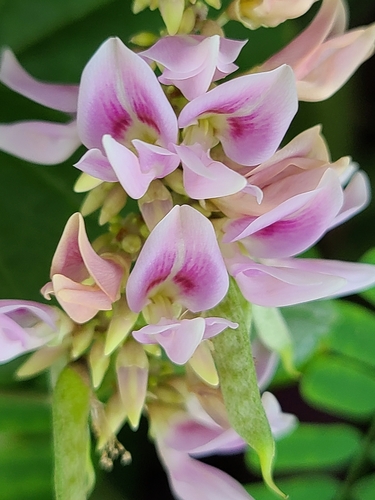
Sphenostylis stenocarpa
(Hochst. ex A. Rich.) Harms
African yam bean

Wikimedia Commons - Tracey Slotta @ USDA-NRCS PLANTS Database

(c) i_c_riddell, some rights reserved (CC BY), uploaded by i_c_riddell

Fatrabbit at English Wikipedia (via Wikimedia Commons)
What to Eat
Edible parts: Seeds, Leaves, Tubers, Root, Pods, Vegetable
Immature seedpods are cooked and used as a vegetable; the pods grow up to 25cm long and 15mm wide. The seeds are rich in protein and are boiled and eaten as a vegetable or added to soups; each seed is about 9mm long. The roots, which have white flesh and a flavour similar to potato, can be eaten raw or cooked and are also rich in protein. Leaves are cooked and used as a vegetable.
Where to Find It
It is a tropical plant. It grows from sea level up to 1800 m altitude. It grows in grassland and woodland and sometimes in marshy sites. It can grow in arid places.
Africa, Angola, Benin, Burkina Faso, Burundi, Cameroon, Central Africa, Chad, Congo DR, Côte d'Ivoire, East Africa, Ethiopia*, Ghana, Guinea, Guinée, Ivory Coast, Kenya, Malawi, Mozambique, Nigeria, Southern Africa, Tanzania, Togo, Uganda, West Africa, Zambia, Zimbabwe,
How to Identify
A vigorous climbing vine. It is a herb that grows 1.5-2 m high. It has tuberous roots. The leaves have 3 leaflets. They are 14 cm long and 5 cm wide. The flowers are pink, purple or greenish-white. They are 2.5 cm long. They are on stout stalks in the axils of leaves. The seed pods are smooth. They are flat but have both edges raised. They are 25-30 cm long by 1-1.5 cm wide. The seeds vary in shape, size and colour. They can be 1 cm long by 0.7 cm wide. They can be cream or brown. There are small narrow tubers under the ground. They can be 5-7.5 cm long and weigh 50-150 g. The flesh is white and watery.
Nutrition Score: 60/100
| Part | Moisture | kJ | kcal | Protein | Vit A | Vit C | Iron | Zinc |
|---|---|---|---|---|---|---|---|---|
| Seeds | 0 | 1578 | 378 | 1.8 | — | — | 550 | — |
| Seeds | 9 | 1470 | 352 | 19.2 | — | — | — | — |
| Tubers | 64 | 542 | 130 | 3.8 | — | — | — | — |
| Seeds boiled | 67.9 | 485 | 115 | 7 | — | — | 1.3 | 1.1 |
How to Grow
It can be grown from seed or tubers.
Propagation: Sow seed in situ. Division of tubers is also an option.
Medicinal Uses
None known.
Other Uses
This species has a symbiotic relationship with certain soil bacteria that form nodules on the roots and fix atmospheric nitrogen.
Wikipedia
Source ↗Sphenostylis stenocarpa, the African yam bean, is a species of plant in the family Fabaceae which is native to Africa. It is an important source of food in many parts of Africa. The tubers are fried, boiled or roasted, and are higher than the seeds in protein.
Production
Tubers are ready for harvest about 8 months after planting. The seeds are produced after 5 months. Tubers can weigh 500 g.
Other Information
It is a commercially cultivated vegetable. The tubers are eaten especially by children.
Names & Synonyms
Adagora barracha, Amalumbwe, Chinaka, Chinkhoma, Diegemtenguere, Girigiri, Ground Squirrel’s bean, Igname haricot, Mpempo, N'taco, Nkhoma, Norouko, Nsama, Odudu, Okpa odudu, Pempo, Sese
References (36)
- Abbiw, D.K., 1990, Useful Plants of Ghana. West African uses of wild and cultivated plants. Intermediate Technology Publications and the Royal Botanic Gardens, Kew. p 31, 42
- Bot. Jahrb. Syst. 26:309. 1899
- Burkill, H. M., 1985, The useful plants of west tropical Africa, Vol. 3. Kew.
- Busson, 1965,
- Dakora, F. D., 2013, Biogeographic Distribution, Nodulation and Nutritional Attributes of Underutilized Indigenous Agrican Legumes. Acta Horticulturae Number 979 Vol. 1. p 53
- Dansi, A., et al, 2012, Diversity of the Neglected and Underutilized Crop Species of Importance in Benin. The Scientific World Journal. Volume 2012, Article ID 932947, 19 pages
- Epenhuijsen C.W. van., 1974, Growing Native vegetables in Nigeria. FAO Rome, p 89
- Ezeagu, I. E., 2009, Nutritional Value of Tropical Plant Seeds. in Modification of Seed Composition to Promote Health and Nutrition. Agronomy Monograph 51. American Society of Agronomy,
- Facciola, S., 1998, Cornucopia 2: a Source Book of Edible Plants. Kampong Publications, p 111
- Grivetti, L. E., 1980, Agricultural development: present and potential role of edible wild plants. Part 2: Sub-Saharan Africa, Report to the Department of State Agency for International Development. p 32
- INFOODSUpdatedFGU-list.xls
- Jardin, C., 1970, List of Foods Used In Africa, FAO Nutrition Information Document Series No 2.p 20, 29, 104
- Kay, D.E., 1973, Root Crops, Digest 2, Tropical Products Institute, London, p 1
- Kays, S. J., and Dias, J. C. S., 1995, Common Names of Commercially Cultivated Vegetables of the World in 15 languages. Economic Botany, Vol. 49, No. 2, pp. 115-152
- Kiple, K.F. & Ornelas, K.C., (eds), 2000, The Cambridge World History of Food. CUP p 1714
- Kuhnlein, H. V., et al, 2009, Indigenous Peoples' food systems. FAO Rome p 261
- Latham, P & Mbuta, A., 2017, Useful Plants of Central Province, Democratic Republic of Congo. Volume 2. Salvation Army p 183
- Lim, T. K., 2015, Edible Medicinal and Non Medicinal Plants. Volume 9, Modified Stems, Roots, Bulbs. Springer p 79
- Lulekal, E., et al, 2011, Wild edible plants in Ethiopia: a review on their potential to combat food insecurity. Afrika Focus - Vol. 24, No 2. pp 71-121
- Macmillan, H.F. (Revised Barlow, H.S., et al) 1991, Tropical Planting and Gardening. Sixth edition. Malayan Nature Society. Kuala Lumpur. p 329
- Malaisse, F., 1997, Se nourrir en floret claire africaine. Approche ecologique et nutritionnelle. CTA., p 69
- Martin, F.W. & Ruberte, R.M., 1979, Edible Leaves of the Tropics. Antillian College Press, Mayaguez, Puerto Rico. p 200
- Menninger, E.A., 1977, Edible Nuts of the World. Horticultural Books. Florida p 100
- Meregini, O. A., 2005, Some endangered plants producing edible fruits and seeds in Southeastern Nigeria. Fruits, Vol. 60 pp 211-220
- Peters, C. R., O'Brien, E. M., and Drummond, R.B., 1992, Edible Wild plants of Sub-saharan Africa. Kew. p 138
- Potter, D., 1992, Economic Botany of Sphenostylis (Leguminosae). Economic Botany. 46(3) pp 262-275
- Reis, S. V. and Lipp, F. L., 1982, New Plant Sources for Drugs and Foods from the New York Botanical Garden herbarium. Harvard. p 140
- Royal Botanic Gardens, Kew (1999). Survey of Economic Plants for Arid and Semi-Arid Lands (SEPASAL) database. Published on the Internet; http://www.rbgkew.org.uk/ceb/sepasal/internet [Accessed 29th April 2011]
- Terra, G.J.A., 1973, Tropical Vegetables. Communication 54e Royal Tropical Institute, Amsterdam, p 76 (Also as Sphenostylis congensis)
- Tindall, H.D., 1983, Vegetables in the Tropics, Macmillan p 290
- Ulian, T., et al, 2020, Unlocking plant resources to support food security and promote sustainable agriculture. Plants, People, Planet. 2020;2:421–445.
- USDA, ARS, National Genetic Resources Program. Germplasm Resources Information Network - (GRIN). [Online Database] National Germplasm Resources Laboratory, Beltsville, Maryland. Available: www.ars-grin.gov/cgi-bin/npgs/html/econ.pl (10 April 2000)
- Vickery, M.L. and Vickery, B., 1979, Plant Products of Tropical Africa, Macmillan. p 25
- Wiersema, J. H. & Leon, B., 2013, World Economic Plants. A Standard Reference CRC Press. 2nd Ed. p 652
- Williamson, J., 2005, Useful Plants of Malawi. 3rd. Edition. Mdadzi Book Trust. p 234
- World Checklist of Useful Plant Species 2020. Royal Botanic Gardens, Kew