Spinacia oleracea
L.
Spinach

(c) Anne The Librarian, some rights reserved (CC BY-NC-ND)
(c) Subhajit Roy, some rights reserved (CC BY-NC-ND), uploaded by Subhajit Roy

(c) Harald, some rights reserved (CC BY-NC-ND)
What to Eat
Edible parts: Leaves, Seeds sprouts, Vegetable
Leaves can be eaten raw or cooked — tender young leaves work well in salads, while older leaves are used as greens or added to soups. The leaves contain oxalic acid (6–8% in young leaves, 23–27% in the cotyledons). Seeds can be eaten raw or cooked and can be sprouted and added to salads. Chlorophyll extracted from the leaves serves as an edible green dye. Nutritional composition per 100g dry weight (285 calories, 0% water): Protein 28g, Fat 5.5g, Carbohydrate 40g, Fibre 8g, Ash 23g; Calcium 800mg, Phosphorus 415mg, Iron 80mg, Sodium 650mg, Potassium 4500mg; Vitamin A 50mg, Thiamine (B1) 0.7mg, Riboflavin (B2) 2mg, Niacin 8mg, Vitamin C 600mg. Vitamin A figures are in milligrams; values are based on median figures from available reports.
Known Hazards
Where to Find It
It is a temperate plant. It does not suit the tropical lowlands and grows best where the temperature varies between 10°C and 20°C or above 2000 m altitude. The kind with very prickly seeds is frost resistant. Plants need a deep well drained soil. It is a cool season, short day plant. In Nepal it grows to about 1400 m altitude. It suits hardiness zones 6-9.
Afghanistan, Africa, Andorra, Armenia, Asia, Australia, Austria, Balkans, Bangladesh, Bosnia and Herzegovina, Britain, Bulgaria, Caucasus, Central America, Central Asia, China, Costa Rica, Croatia, Cuba, Dominican Republic, East Africa, East Timor, Ecuador, Ethiopia, Europe, Fiji, France, Georgia, Germany, Haiti, Himalayas, India, Indochina, Iran, Iraq, Italy, Japan, Kenya, Korea, Laos, Macedonia, Malawi, Malaysia, Mali, Mediterranean, Middle East, Nauru, Nepal, North America, Northeastern India, Pacific, Pakistan, Papua New Guinea, PNG, Peru, Philippines, Saudi Arabia, SE Asia, Serbia, Singapore, Slovenia, South Africa, Southern Africa, South America, Spain, Switzerland, Tajikistan, Tasmania, Thailand, Timor-Leste, Turkey, Türkiye, Turkmenistan, Uruguay, USA, Uzbekistan, Vietnam, West Africa, West Indies, Zimbabwe,
How to Identify
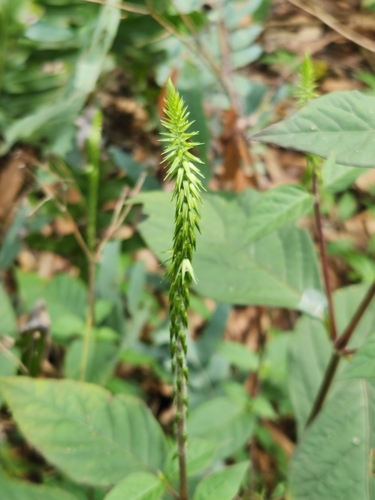
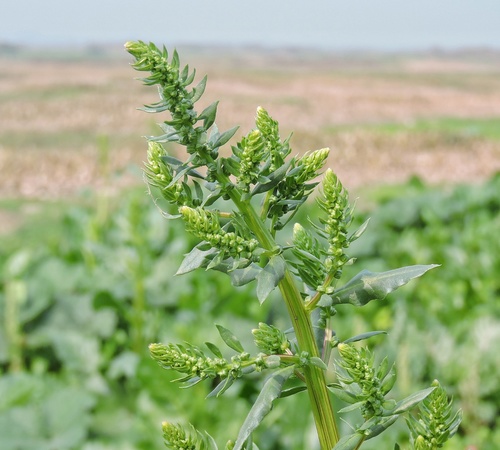
An annual leafy vegetable. It grows 60-90 cm high and spreads 30-45 cm wide. The broad leaves are produced in a clump on short stalks. The leaves at the base are large and leaves on the stalk are smaller. Plants are separately male and female. (So both types are needed if seed is to be produced.) Flowers are greenish in spikes.
Nutrition Score: 45/100
| Part | Moisture | kJ | kcal | Protein | Vit A | Vit C | Iron | Zinc |
|---|---|---|---|---|---|---|---|---|
| Leaves - raw | 91.6 | 61 | 15 | 2.9 | 32 | 52 | 2.71 | 0.5 |
| Leaves - boiled | 92.9 | 57 | 14 | 2.4 | 819 | 29 | 2.9 | 0.8 |
How to Grow
Plants grow best and produce their heaviest crop of leaves on a nitrogen-rich soil. They dislike very heavy or very light soils. They also dislike acid soils, preferring a neutral to slightly alkaline soil. Plants require plenty of moisture in the growing season, dry summers causing the plants to quickly run to seed. Summer crops do best in light shade to encourage more leaf production before the plant goes to seed, winter crops require a warm dry sunny position. Young plants are hardy to about -9°c. Spinach is often cultivated for its edible leaves, there are some named varieties. These varieties can be grouped into two main types as detailed below:- Forms with prickly seeds. These are the more primitive forms. Their leaves are more lobed and they are in general more cold tolerant and also more resistant of summer heat. They were more often used to produce a crop in the winter. Forms with round seeds have been developed in cultivation, These have broader leaves, tend to be less cold hardy and were also more prone to bolt in hot weather. They were used mainly for the summer crop. Most new cultivars are of the round seeded variety and these have been developed to be more resistant to bolting in hot weather, more cold tolerant, to produce more leaves and also to be lower in calcium oxalate which causes bitterness and also has negative nutritional effects upon the body. Some modern varieties have been developed that are low in oxalic acid. Edible leaves can be obtained all year round from successional sowings. The summer varieties tend to run to seed fairly quickly, especially in hot dry summers and so you need to make successional sowings every few weeks if a constant supply is required. Winter varieties provide leaves for a longer period, though they soon run to seed when the weather warms up. Spinach grows well with strawberries. It also grows well with cabbages, onions, peas and celery. A fast-growing plant, the summer crop can be interplanted between rows of slower growing plants such as Brussels sprouts. The spinach would have been harvested before the other crop needs the extra space. Spinach is a bad companion for grapes and hyssop. In garden design, as well as the above-ground architecture of a plant, root structure considerations help in choosing plants that work together for their optimal soil requirements including nutrients and water. Thick or swollen - fibrous or tap root.
Propagation: For a summer crop, sow seed in situ from March to June, making successional sowings roughly once a month to ensure a continuous supply. Seed germinates within about two weeks and the first leaves can be harvested around six weeks after sowing. For a winter crop, sow in situ during August and September.
Medicinal Uses
The plant is carminative and laxative, and has been shown in experiments to have hypoglycaemic properties. It has been used in the treatment of urinary calculi. The leaves have been used to treat febrile conditions and inflammation of the lungs and bowels. The seeds are laxative and cooling and have been used for difficult breathing and inflammation of the liver and jaundice.
Other Uses
A yellow dye is obtained from the leaves.
Wikipedia
Source ↗Spinacia oleracea is a fast-growing annual reaching 0.3 m (1 ft) tall, hardy to UK zone 5. Foliage is present year-round with flowers from June to September. The plant is dioecious with wind pollination, requiring both male and female plants for seed production. It adapts to light sandy, medium loamy, and heavy clay soils across mildly acid to mildly alkaline pH ranges, growing in semi-shade to full sun with preference for moist soil.
Production
The older leaves are picked off. They can be harvested starting at 8 weeks.
Other Information
It is a commercially cultivated vegetable. Not often seen in Papua New Guinea.
Notes
There are 3 Spinacia species. They are native to central Asia. Also put in the family Chenopodiaceae.
Names & Synonyms
Bapxoi, Bathai, Bo cai, Dumpabachhali, Espinaca, Epinard, Gobre palungo, Horen-so, Isfanaj, Isfanak, Matturbachhali, Mithapalanga, Palak shak, Palak, Palaksag, Palang, Palanga, Palangsag, Palong shak, Palungo sag, Pinnis, Sigeumchi, Sipinichi, špinača, Spinach soppu, Spinaksoppu, Valayati sag, Vasaylebachhali
References (58)
- Ambasta, S.P. (Ed.), 2000, The Useful Plants of India. CSIR India. p 593
- Anderson, E. F., 1993, Plants and people of the Golden Triangle. Dioscorides Press. p 222
- Ara, R. I. T., 2015, Leafy Vegetables in Bangladesh. Photon eBooks. p 77
- Bianchini, F., Corbetta, F., and Pistoia, M., 1975, Fruits of the Earth. Cassell. p 76
- Bussman, R. W., et al, 2016, A comparative ethnobotany of Khevsureti, Samtskhe-Javakheti, Tusheti, Svaneti, and Racha-Lechkhumi, Republic of Georgia (Sakartvelo), Caucasus. Journal of Ethnobiology and Ethnomedicine.
- Cheifetz, A., (ed), 1999, 500 popular vegetables, herbs, fruits and nuts for Australian Gardeners. Random House p 102
- Chin, H. F., 1999, Malaysian Vegetables in Colour. Tropical Press. p 75
- Creasy, R., 2000, The Edible Asian Garden. Periplus p 54
- Cundall, P., (ed.), 2004, Gardening Australia: flora: the gardener's bible. ABC Books. p 1362
- Dhyani, S.K., & Sharma, R.V., 1987, Exploration of Socio-economic plant resources of Vyasi Valley in Tehri Garwhal. J. Econ. Tax. Bot. Vol. 9 No. 2 pp 299-310
- Dogan, Y., et al, 2015, Of the importance of a leaf: the ethnobotany of sarma in Turkey and the Balkans. Journal of Ethnobiology and Ethnomedicine, 11:56
- Facciola, S., 1998, Cornucopia 2: a Source Book of Edible Plants. Kampong Publications, p 77
- Farooq, S., et al, 2012, Ethnobotanical Studies of the Flora of Tehsil Birmal in South Waziristan Agency, Pakistan. Pak. J. Weed Sci. Res. 18(3): 277-291
- Flora of China. www.eFloras.org
- Flora of Pakistan. www.eFloras.org
- Foo, J.T.S.(ed), 1996, A Guide to Common Vegetables. Singapore Science Foundation. p 23
- French, B.R., 1986, Food Plants of Papua New Guinea, A Compendium. Asia Pacific Science Foundation p 149
- Grubben, G. J. H. and Denton, O. A. (eds), 2004, Plant Resources of Tropical Africa 2. Vegetables. PROTA, Wageningen, Netherlands. p 513
- Hadfield, J., 2001, The A-Z of Vegetable Gardening in South Africa. Struik p 122
- Hedrick, U.P., 1919, (Ed.), Sturtevant's edible plants of the world. p 630
- Hovsepyan, R., et al, 2016, Food as a marker for economy and part of identity: traditional vegetal food of Yezidis and Kurds in Armenia. Journal of Ethnic Foods. 3:32-41
- http://www.botanic-gardens-ljubljana.com/en/plants
- Hu, Shiu-ying, 2005, Food Plants of China. The Chinese University Press. p 378
- Jardin, C., 1970, List of Foods Used In Africa, FAO Nutrition Information Document Series No 2.p 104
- Kahlon, L. K. & Singh, R., 2019, Traditional knowledge & Dynamics of edible plants of primitive tribal group ‘Paudi Bhuyan’ with changing demography migration patterns in Northern Odisha. Indian Journal of Traditional Knowledge Vol 18(1), pp 7-15
- Kapelle, M., et al, 2000, Useful plants within a Campesino Community in a Costa Rican Montane Cloud Forest. Mountain Research and Development, 20(2): 162-171.
- Kays, S. J., and Dias, J. C. S., 1995, Common Names of Commercially Cultivated Vegetables of the World in 15 languages. Economic Botany, Vol. 49, No. 2, pp. 115-152
- Khanal, R., et al, 2014, Documenting abundance and use of underutilized plant species in the mid hill region of Nepal. ECOPRINT 21: 63-71, 2014
- Kiple, K.F. & Ornelas, K.C., (eds), 2000, The Cambridge World History of Food. CUP p 1857
- Lazarides, M. & Hince, B., 1993, Handbook of Economic Plants of Australia, CSIRO. p 226
- Macmillan, H.F. (Revised Barlow, H.S., et al), 1991, Tropical Planting and Gardening. Sixth edition. Malayan Nature Society. Kuala Lumpur. p 370
- Manandhar, N.P., 2002, Plants and People of Nepal. Timber Press. Portland, Oregon. p 438
- Martin, F.W. & Ruberte, R.M., 1979, Edible Leaves of the Tropics. Antillian College Press, Mayaguez, Puerto Rico. p 118
- Oomen, H.A.P.C., & Grubben, G.J.H., 1978, Tropical Leaf Vegetables in Human Nutrition, Communication 69, Department of Agricultural research, RTI Amsterdam, p 93
- Pham-Hoang Ho, 1999, An Illustrated Flora of Vietnam. Nha Xuat Ban Tre. p 723
- Plants for a Future database, The Field, Penpol, Lostwithiel, Cornwall, PL22 0NG, UK. http://www.scs.leeds.ac.uk/pfaf/
- Plants of Haiti Smithsonian Institute http://botany.si.edu
- Purseglove, J.W., 1968, Tropical Crops Dicotyledons, Longmans. p 632
- Rashid, H. E., 1977, Geography of Bangladesh. Westview. p 281 (As Spicacea oleracea)
- Ruiters-Welcome, A. K., 2019, Food plants of southern Africa. Ph.D. thesis. Univ. of Johannesburg p 12
- Shah, S. K., 2014, Dietary contribution of underutilized minor crops and indigenous plants collected from uncultivated lands and forests in Nepal. in Promotion of Underutilized Indigenous Food Resources for Food Security and Nutrition in Asia and Pacific. FAO. Bangkok p 64
- Sharma, B.B., 2005, Growing fruits and vegetables. Publications Division. Ministry of Information and broadcasting. India. p 192
- Singh, A. G., Panthi, M. P., & Tewari, D. D., 2012, Wild Plants Used as Vegetable in Rupandehi District of Nepal and their Ethnomedicinal Importance. J. Nat. Hist. Mus. Vol. 26, 2012, 111-125
- Singh, S.R. and Singh, N.I., 1985, A Preliminary Ethnobotanical studies on wild edible plants in the markets of Manipur - 1. J. Econ. Tax. Bot. Vol. 6 No. 3 pp 699-703
- Smith, P.M., 1979, Spinach, in Simmonds, N.W., (ed), Crop Plant Evolution. Longmans. London. p 304
- Termote, C., et al, 2014, Assessing the potential of wild foods to reduce the cost of a nutritionally adequate diet: An example from eastern Baringo District, Kenya. Food and Nutrition Bulletin, vol. 35, no. 4
- Terra, G.J.A., 1973, Tropical Vegetables. Communication 54e Royal Tropical Institute, Amsterdam, p 76
- Torre, de la L., et al, 2008, Enciclopedia de las Plantas Útiles del Ecuador. Herbario QCA. Pontificia Universidad Católica del Ecuador. p 159
- Tronickova, E. & Krejcova, Z., 1987, Ortaggi, Instituto Geografico de Agostini, Cecoslovacchia. p 102
- USDA, ARS, National Genetic Resources Program. Germplasm Resources Information Network - (GRIN). [Online Database] National Germplasm Resources Laboratory, Beltsville, Maryland. Available: www.ars-grin.gov/cgi-bin/npgs/html/econ.pl (10 April 2000)
- van Wyk, B., 2005, Food Plants of the World. An illustrated guide. Timber press. p 354
- Welcome, A. K. & Van Wyk, B.-E., 2019, An inventory and analysis of the food plants of southern Africa. South African Journal of Botany 122 (2019) 136–179
- Wiersema, J. H. & Leon, B., 2013, World Economic Plants. A Standard Reference CRC Press. 2nd Ed. p 655
- Williamson, J., 2005, Useful Plants of Malawi. 3rd. Edition. Mdadzi Book Trust. p 234
- World Checklist of Useful Plant Species 2020. Royal Botanic Gardens, Kew
- www.eFloras.org Flora of China
- Zeven, A. C. & de West, J. M. J., 1982, Dictionary of cultivated plants and their regions of diversity. Wageningen. p 82
- Zhu Gelin (Chu Ge-ling); Steven E. Clemants, CHENOPODIACEAE [Draft], Flora of China