Acacia microbotrya
Benth.
Manna wattle, Gum Wattle

(c) Russell Cumming, some rights reserved (CC BY-NC), uploaded by Russell Cumming

(c) Russell Cumming, some rights reserved (CC BY-NC), uploaded by Russell Cumming

(c) Russell Cumming, some rights reserved (CC BY-NC), uploaded by Russell Cumming
What to Eat
Edible parts: Seeds, Gum
The seeds are pounded to make flour which is cooked in dampers. The gum is sweet and edible.
Known Hazards
Where to Find It
It is a temperate plant. A native of south west Western Australia. It occurs in sandy loams. It needs well drained sites. It prefers open sunny positions. It is drought resistant. It could be damaged by frost.
Australia*,
How to Identify
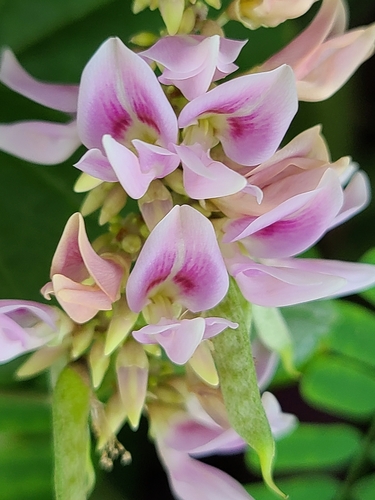
A shrub or small tree. It grows 5 m tall. There are prickles along the stem. The leaves are twice divided and there are 8-18 pairs of pinnae. There are up to 50 pairs of pinnules on each pinnae. The flowers are yellow. They are in large clusters at the ends of branches. The pods are flattened.
How to Grow
It is grown from seed. The seed need treatment to break the hard seed coat. Normally this is by putting the seeds in very hot water and letting the water cool down overnight then planting the seeds immediately.
Wikipedia
Source ↗Acacia microbotrya, commonly known as manna wattle or gum wattle, is a shrub or tree belonging to the genus Acacia and the subgenus Phyllodineae that is native to Western Australia. The Noongar peoples know the tree as Badjong, Galyang, Koonert or Menna.
Production
It is fast growing in warmer areas. The tree produces large quantities of edible gum in dry seasons. It can be stored for later use. The tree flowers in April to September. It does best with a rainfall over 38 mm.
Notes
There are about 1,350 Acacia species. Over 1,000 occur in Australia. Also as Mimosaceae.
References (8)
- Bindon, P., 1996, Useful Bush Plants. Western Australian Museum. p 22
- Bodkin, F., 1991, Encyclopedia Botanica. Cornstalk publishing, p 25
- Elliot, W.R., & Jones, D.L., 1982, Encyclopedia of Australian Plants suitable for cultivation. Vol 2. Lothian. p 84
- Hall, N. et al, 1972, The Use of Trees and Shrubs in the Dry Country of Australia, AGPS, Canberra. p 348
- Lazarides, M. & Hince, B., 1993, Handbook of Economic Plants of Australia, CSIRO. p 5
- London J. Bot. 1:353. 1842
- Maslin, B. R., et al, 1998, Edible Wattle Seeds of Southern Australia. CSIRO p 33
- Paczkowska, G . & Chapman, A.R., 2000, The Western Australian Flora. A Descriptive Catalogue. Western Australian Herbarium. p 316