Streptopus lanceolatus
(Aiton) Reveal
Rose twisted stalk

(c) Christian Grenier, some rights reserved (CC BY-NC), uploaded by Christian Grenier
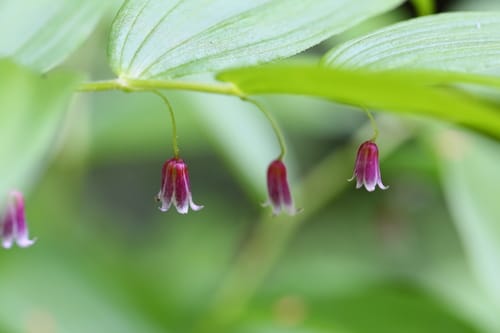
(c) T. Abe Lloyd, some rights reserved (CC BY-NC)
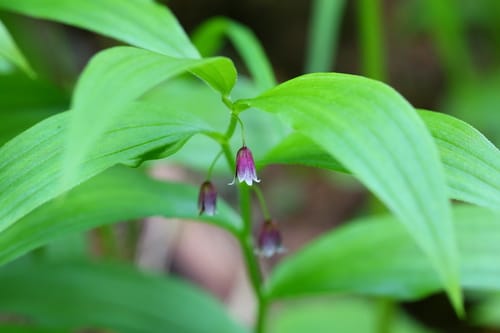
(c) T. Abe Lloyd, some rights reserved (CC BY-NC)
What to Eat
Edible parts: Fruit, Leaves, Stalks
Young leaves and shoots can be added to salads to impart a cucumber flavor, and the red berries can be eaten.
Known Hazards
Where to Find It
It is a temperate plant. It suits hardiness zones 3-8.
Canada, North America, USA,
How to Identify
A slender herb. It grows 30 cm tall. The stems are usually unbranched. The are curved. The leaves do not clasp the stem. The fruit are red berries.
Wikipedia
Source ↗Streptopus lanceolatus (rose twisted stalk, rosybells, rose mandarin, scootberry, liverberry, rose-bellwort), is an understory perennial plant native to the forests of North America, from Alaska to Labrador, south through the Great Lakes and Appalachian Mountain regions of the United States, as well as Montana, Washington state, Oregon, and St. Pierre & Miquelon. It grows primarily in mixed-wood forests, and throughout a wide range of soil and site conditions, preferring cool, acidic soils. Streptopus lanceolatus grows from a rhizome or seed, the stem having a zigzag shape, branched or sometimes unbranched. Up to 30 cm (12 in) tall with alternate wide lanced oval-shaped leaves with pointed tips and a rounded base, without leaf-stalks. The leaves are often finely toothed having fine hairs on the underside veins. Flowers appear as solitary individuals opposite each leaf in early summer (May to July) and are bell-shaped on 1–3 cm (0.4–1.2 in) long stalks bent midway, with 6 rose or white recurved petals with purple streaks. Fruit is an elongated red berry ripening in mid-summer (July to August). If berries are consumed in quantity, diarrhea can result. Streptopus lanceolatus can be distinguished from Solomon's seal and false Solomon's seal by the alternate leaves on a zigzag stem.
Notes
There are about 10 Streptopus species. Also put in the family Convallariaceae.
Names & Synonyms
Rose mandarin, Roseybells, Scootberry
References (6)
- Facciola, S., 1998, Cornucopia 2: a Source Book of Edible Plants. Kampong Publications, p 145 (As Streptopus roseus)
- Jackes, D. A., 2007, Edible Forest Gardens (As Streptopus roseus)
- Kermath, B. M., et al, 2014, Food Plants in the Americas: A survey of the domesticated, cultivated and wild plants used for Human food in North, Central and South America and the Caribbean. On line draft. p 839
- MacKinnon, A., et al, 2009, Edible & Medicinal Plants of Canada. Lone Pine. p 169 (As Streptopus roseus)
- Moerman, D. F., 2010, Native American Ethnobotany. Timber Press. p 546 (As Streptopus roseus)
- Plants for a Future database, The Field, Penpol, Lostwithiel, Cornwall, PL22 0NG, UK. http://www.scs.leeds.ac.uk/pfaf/ (As Streptopus roseus)


