Suaeda australis
(R. Br.) Moq.
Southern Seablite, Austral Seablite
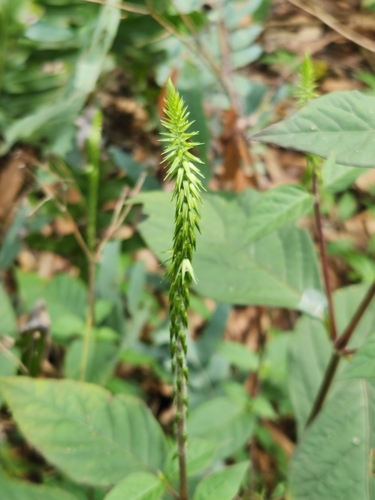
(c) distinguished_orca, some rights reserved (CC BY-NC), uploaded by distinguished_orca
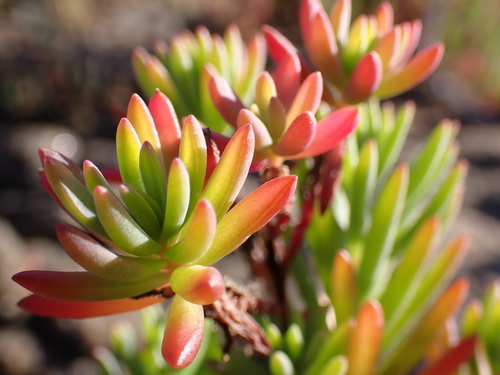
(c) Karin Cox, some rights reserved (CC BY), uploaded by Karin Cox

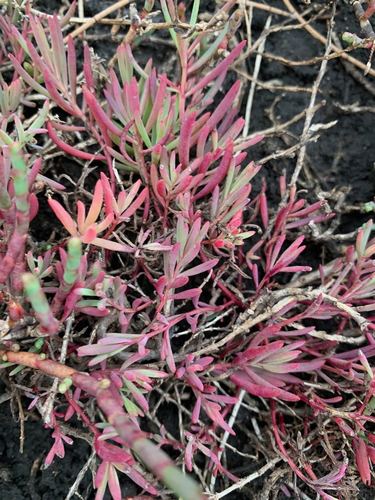
(c) Tindo2, some rights reserved (CC BY-NC)
What to Eat
Edible parts: Leaves
Stem tips can be eaten raw. They have a salty flavour with a crisp and pleasant texture, work well in salads, and can also be boiled as a vegetable, at which point they taste similar to salty beans. Young shoots can be pickled.
Where to Find It
It is a temperate plant. It can grow in subtropical places. It grows on seashores or beach sandy places and mangrove forest margins. It grows in salt marshes. It grows among inter-tidal rocks. Tasmania Herbarium.
Australia*, China, Japan, Korea, Taiwan, Tasmania*,
How to Identify
A small succulent shrub. It grows 20-50 cm tall. It is woody at the base. It can be upright or spreading. The leaves are fleshy and green. They are 1-3 cm long by 2 mm wide. Older stems and leaves can be pink, red or purple. The leaves can be opposite or alternate. The upper leaves are smaller. The flowers are small and green. They are 3 mm across. The flowers are rounded and there are several together at the base of the uppermost leaves.
How to Grow
Plants can be grown from cuttings. They need salty soils to grow well. They can also be grown from seed.
Propagation: Sow seed in spring directly in situ.
Medicinal Uses
None known.
Other Uses
None known.
Wikipedia
Source ↗Suaeda australis, the austral seablite, is a species of plant in the family Amaranthaceae, native to Australia.It was first described in 1810 by Robert Brown as Chenopodium australe. In 1831 Alfred Moquin-Tandon transferred it to the genus, Suaeda, to give its present name.
Notes
There are about 100 Suaeda species. Also put in the family Chenopodiaceae.
Names & Synonyms
Nan fang jian peng
References (20)
- Alice, L. & O'Quinn, T., Australian Bush Superfoods. Explore Australia p 158
- Caton, J.M. & Hardwick, R. J., 2016, Field Guide to Useful Native Plants from Temperate Australia. Harbour Publishing House. p 100
- Cherikoff V. & Isaacs, J., The Bush Food Handbook. How to gather, grow, process and cook Australian Wild Foods. Ti Tree Press, Australia p 197
- Curtis, W.M., 1993, The Student's Flora of Tasmania. Part 3 St David's Park Publishing, Tasmania, p 580
- Dashorst, G.R.M., and Jessop, J.P., 1998, Plants of the Adelaide Plains & Hills. Botanic Gardens of Adelaide and State Herbarium. p 62
- Flora of Australia, Volume 4, Phytolaccaceae to Chenopodiaceae, Australian Government Publishing Service, Canberra (1984) p 313
- Hardwick, R.J., 2000, Nature's Larder. A Field Guide to the Native Food Plants of the NSW South Coast. Homosapien Books. p 42
- Harris, S., Buchanan, A., Connolly, A., 2001, One Hundred Islands: The Flora of the Outer Furneaux. Tas Govt. p 235
- Hastings Advance Community College, 2017, Uses for Native Plants of the Mornington Peninsula. 86pp. p 71
- Howells, C & Gulline, H., 2003, Coastal Plants of Tasmania. Plant Identikit. Australian Plant Society, Tasmania. p 35
- Low, T., 1991, Wild Food Plants of Australia. Australian Nature FieldGuide, Angus & Robertson. p 26
- Low, T., 1992, Bush Tucker. Australia’s Wild Food Harvest. Angus & Robertson. p 137
- Melzer, R. & Plumb, J., 2011, Plants of Capricornia. Belgamba, Rockhampton. p 518
- Paczkowska, G. & Chapman, A.R., 2000, The Western Australian Flora. A Descriptive Catalogue. Western Australian Herbarium. p 208
- Plants for a Future database, The Field, Penpol, Lostwithiel, Cornwall, PL22 0NG, UK. http://www.scs.leeds.ac.uk/pfaf/
- Ryan, M. (Ed.), 2003, Wild Plants of Greater Brisbane. Queensland Museum. p 41
- Tasmanian Herbarium Vascular Plants list p 22
- Whiting, J. et al, 2004, Tasmania's Natural Flora. Tasmania's Natural Flora Editorial Committee PO Box 194, Ulverstone, Tasmania, Australia 7315 p 47
- Woolmore, E et al, 2002, King Island Flora: A Field Guide. p 39
- Zhu Gelin (Chu Ge-ling); Steven E. Clemants, CHENOPODIACEAE [Draft], Flora of China