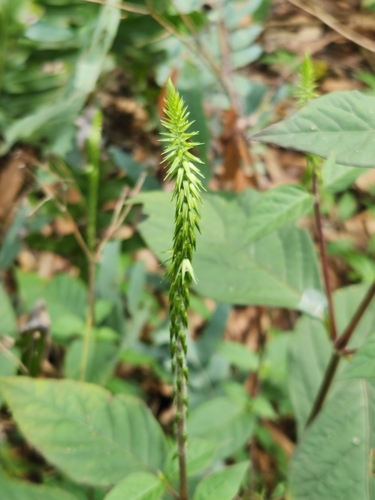
Suaeda corniculata
(C. A. Mey.) Bunge
Jiao guo jian peng

(c) Dina Nesterkova, some rights reserved (CC BY-NC), uploaded by Dina Nesterkova

(c) Dina Nesterkova, some rights reserved (CC BY-NC), uploaded by Dina Nesterkova
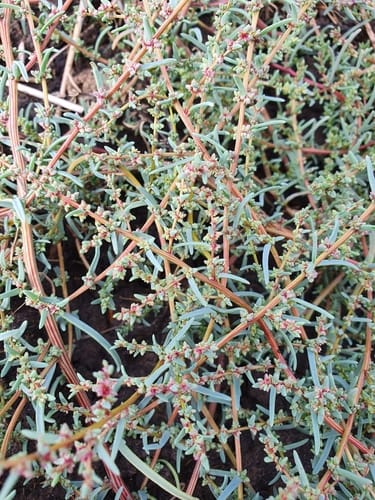
(c) Анна Митрошенкова, some rights reserved (CC BY)
What to Eat
Edible parts: Seeds
The seeds can be cooked whole or ground into a powder and mixed with cereals. This is considered a famine food, used only when other food sources have been exhausted.
Where to Find It
It is a temperate plant. It grows on salty-alkaline soil deserts, lake banks, riversides. It grows in the eastern forests in Manchuria. It can grow in arid places.
Asia, China, Europe, Manchuria, Mongolia, Russia, Siberia, Ukraine,
How to Identify
An annual herb, It grows 60 cm tall. The stems can lie along the ground or be erect. They are light green and slightly curved. The leaves are narrow and do not have leaf stalks. They are 1-2 cm long by 1-2 mm wide. The seeds are 1-1.5 mm across.
How to Grow
Propagation: Sow seed in spring, direct in situ.
Medicinal Uses
None known
Other Uses
None known
Wikipedia
Annual herb reaching 16 inches tall. Wind-pollinated hermaphrodite flowering August to September with seeds ripening the same period. Tolerates light sandy, medium loamy, and heavy clay soils across mildly acidic to mildly alkaline pH ranges, including saline conditions. Requires full sun and moist soil. Salt-tolerant and suitable for coastal exposure.
Notes
Also put in the family Chenopodiaceae.
References (4)
- BARANOV,
- Plants for a Future database, The Field, Penpol, Lostwithiel, Cornwall, PL22 0NG, UK. http://www.scs.leeds.ac.uk/pfaf/
- Trudy Imp. S.-Peterburgsk. Bot. Sada 6:429. 1880
- Zhu Gelin (Chu Ge-ling); Steven E. Clemants, CHENOPODIACEAE [Draft], Flora of China