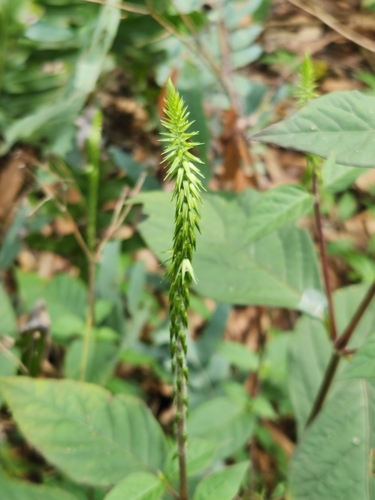
Suaeda glauca
(Bunge) Bunge
Sea blite, Jian peng, Common seepweed

(c) Chuangzao, some rights reserved (CC BY-NC), uploaded by Chuangzao

(c) V.S. Volkotrub, some rights reserved (CC BY-NC), uploaded by V.S. Volkotrub

(c) Chuangzao, some rights reserved (CC BY-NC), uploaded by Chuangzao
What to Eat
Edible parts: Leaves, Vegetable
Young leaves and stems can be eaten raw or cooked. They have a crunchy, tender texture and a salty flavour. An oil is also obtainable from the plant.
Where to Find It
It is a temperate climate plant. It grows on salty-alkaline soils of beaches, wastelands, canal banks, field margins. It grows in wetlands.
Asia, China, Japan, Korea, Mongolia, Siberia,
How to Identify
An annual herb. It grows up to 1 m tall. The stems are light green and they have slight furrows along them. The branches are slender. The leaves do not have leaf stalks. They are succulent and narrow and cylinder shaped. They are greyish-green. They are 2-5 cm long by 1-5 mm thick. They become smaller upward. The flowers occur as 2-5 in the axils. The fruit is a round but flattened pouch 2 mm across.
How to Grow
We have very little information on this species and do not know if it will be hardy in Britain, though judging by its native range it should succeed outdoors in many parts of this country. It is cultivated as a vegetable in China. It dislikes shade, see the plants native range for other ideas on its cultivation needs.
Propagation: Sow seed in spring, direct in situ.
Medicinal Uses
None known
Other Uses
The oil extracted from the seed is used industrially.
Wikipedia
Annual plant reaching 2 feet tall. Wind-pollinated hermaphrodite flowering July to September with simultaneous seed ripening. Adapts to light sandy, medium loamy, and heavy clay soils across mildly acidic to mildly alkaline ranges, including saline soils. Requires full sun and moist conditions. Tolerates maritime exposure.
Other Information
It is a commercially cultivated vegetable.
Notes
Also put in the family Chenopodiaceae.
Names & Synonyms
Namunjae
References (10)
- Bull. Acad. Imp. Sci. Saint Petersbourg 25:362. 1879
- Hu, Shiu-ying, 2005, Food Plants of China. The Chinese University Press. p 378
- Hwang, H., et al, 2013, A Study on the Flora of 15 Islands in the Western Sea of Jeollanamdo Province, Korea. Journal of Asia-Pacific Biodiversity Vol. 6, No. 2 281-310
- Kays, S. J., and Dias, J. C. S., 1995, Common Names of Commercially Cultivated Vegetables of the World in 15 languages. Economic Botany, Vol. 49, No. 2, pp. 115-152 (As Suaeda asparagoides)
- Kim, H. & Song, M., 2013, Ethnobotanical analysis for traditional knowledge of wild edible plants in North Jeolla Province (Korea). Genetic. Resour. Crop Evol. (2013) 60:1571-1585
- Plants for a Future database, The Field, Penpol, Lostwithiel, Cornwall, PL22 0NG, UK. http://www.scs.leeds.ac.uk/pfaf/
- Wujisguleng, W., & Khasbagen. K., 2010, An integrated assessment of wild vegetable resources in Inner Mongolian Autonomous Region, China. Journal of Ethnobiology and Ethnomedicine 6:34
- Zeven, A. C. & de West, J. M. J., 1982, Dictionary of cultivated plants and their regions of diversity. Wageningen. p 34
- Zhang, Y., et al, 2014, Diversity of wetland plants used traditionally in China: a literature review. Journal of Ethnobiology and Ethnomedicine. 10:72
- Zhu Gelin (Chu Ge-ling); Steven E. Clemants, CHENOPODIACEAE [Draft], Flora of China