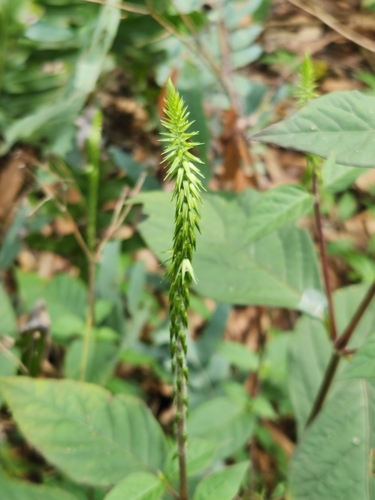
Suaeda maritima
(L.) Dumort.
Annual Sea Blite, Indian saltwort
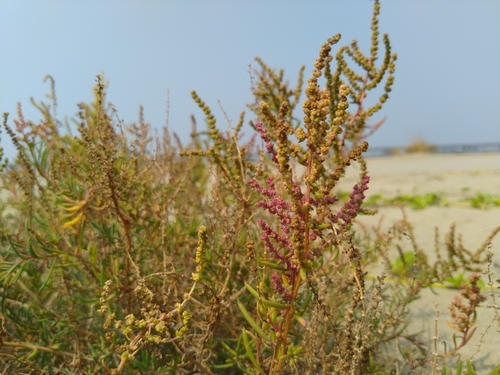
(c) danielchurch, some rights reserved (CC BY-NC)
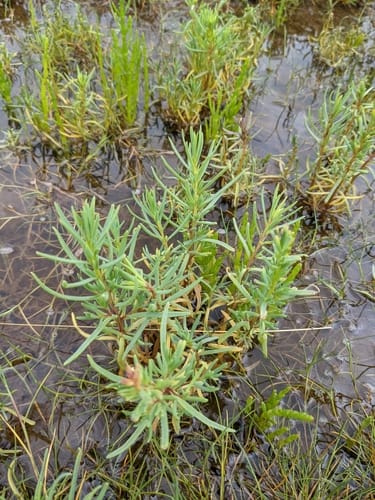
(c) Owen and Carol Fawcett., some rights reserved (CC BY-NC)

no rights reserved, uploaded by 葉子
What to Eat
Edible parts: Leaves, Seeds, Flower
Young leaves can be eaten raw or cooked and have a pleasant salty flavour, making a nice addition to salads in small quantities. They are often combined with other vegetables to moderate their saltiness. Young shoots can be pickled in vinegar and eaten on their own or used as a relish. The seeds are also edible raw or cooked.
Where to Find It
A temperate plant. It grows on salt flats near the sea. It can be used to reclaim salty land. It also grows in the tropics in Java. Tasmania Herbarium.
Asia, Australia, Britain, China, Europe, India, Indochina, Indonesia, Ireland, Korea, Mediterranean, SE Asia, Tasmania, Thailand, Vietnam,
How to Identify
A low shrubby herb. It is an annual plant. It grows 7-50 cm high. It is branched from the base. The leaves are succulent and narrow. They are alternate. They can be green, red or purple. The flowers are small. They are green and occur in clusters.
How to Grow
Plants can be grown from seeds.
Propagation: Sow seed in spring, direct in situ.
Medicinal Uses
None known
Other Uses
The ashes of the plant yield a soda used in the production of glass and soap.
Wikipedia
Source ↗Suaeda maritima is a species of flowering plant in the family Amaranthaceae known by the common names herbaceous seepweed and annual seablite.
Notes
Chemical composition (after Hooper): Water = 83.70% (fresh). Fat = 2.58% (dry). Albumenoids = 11.10% (dry). Carbohydrates = 38.80% (dry). Fibre = 10.17% (dry). Ash = 18.13% (dry). Nitrogen = 1.77% (dry). Phosphoric acid = .55% (dry). Silicates = 1.89% (dry). Also put in the family Chenopodiaceae.
Names & Synonyms
Alur, Geria, Haehongnamul, Ilakoora, Kayey-kaseeray-keray, Khari lani, Kodee-kasseray-kura, Kodee kasseery kura, Koyey kasseray keeray, Lana lani, Lani, Lano, Moras, Nariumari, Phidiep bien, Ravakada, Uppukeerai, Vellakeerai, Vellakora, Yella keeray, Yella kura
References (26)
- Ambasta, S.P. (Ed.), 2000, The Useful Plants of India. CSIR India. p 608
- Arora, R. K., 2014, Diversity in Underutilized Plant Species - An Asia-Pacific Perspective. Bioversity International. p 46
- Blamey, M and Grey-Wilson, C., 2005, Wild flowers of the Mediterranean. A & C Black London. p 40
- Bodkin, F., 1991, Encyclopedia Botanica. Cornstalk publishing, p 957
- Burkill, I.H., 1966, A Dictionary of the Economic Products of the Malay Peninsula. Ministry of Agriculture and Cooperatives, Kuala Lumpur, Malaysia. Vol 2 (I-Z) p 2146
- Esperanca, M. J., 1988. Surviving in the wild. A glance at the wild plants and their uses. Vol. 2. p 213
- Facciola, S., 1998, Cornucopia 2: a Source Book of Edible Plants. Kampong Publications, p 77
- Hedrick, U.P., 1919, (Ed.), Sturtevant's edible plants of the world. p 637
- Heyne, K., 1927, p 604
- HOOPER,
- Irving, M., 2009, The Forager Handbook, A Guide to the Edible Plants of Britain. Ebury Press p 194
- Kim, H. & Song, M., 2013, Ethnobotanical analysis for traditional knowledge of wild edible plants in North Jeolla Province (Korea). Genetic. Resour. Crop Evol. (2013) 60:1571-1585
- Maisuthisakul, P., 2012, Phenolic Constituents and Antioxidant Properties of some Thai Plants. Chp. 9 in Book Phytochemicals - A Global Perspective of Their Role in Nutrition and Health
- Martin, F.W. & Ruberte, R.M., 1979, Edible Leaves of the Tropics. Antillian College Press, Mayaguez, Puerto Rico. p 182
- Martin, F.W. & Ruberte, R.M., 1979, Edible Leaves of the Tropics. Antillian College Press, Mayaguez, Puerto Rico. p 182 (As Suaeda nudiflora)
- McMakin, P.D., 2000, Flowering Plants of Thailand. A Field Guide. White Lotus. p 73
- Ochse, J.J. et al, 1931, Vegetables of the Dutch East Indies. Asher reprint. p 105
- Plants for a Future database, The Field, Penpol, Lostwithiel, Cornwall, PL22 0NG, UK. http://www.scs.leeds.ac.uk/pfaf/
- READ,
- SHORTT, (As Salsola indica and Suaeda indica)
- Singh, H.B., Arora R.K.,1978, Wild edible Plants of India. Indian Council of Agricultural Research, New Delhi. p 37
- Singh, H.B., Arora R.K.,1978, Wild edible Plants of India. Indian Council of Agricultural Research, New Delhi. p 37 (As Suaeda nudiflora)
- Tasmanian Herbarium Vascular Plants list p 22
- WATT, (As Suaeda nudiflora)
- WATT,
- World Checklist of Useful Plant Species 2020. Royal Botanic Gardens, Kew