Suaeda salsa
(L.) Pallas
Winged suaeda, Salt goosefoot, Heresu

(c) Chuangzao, some rights reserved (CC BY-NC), uploaded by Chuangzao

(c) Chuangzao, some rights reserved (CC BY-NC), uploaded by Chuangzao
(c) Radim Paulič, some rights reserved (CC BY-NC), uploaded by Radim Paulič
What to Eat
Edible parts: Leaves, Seeds, Seeds - oil
The leaves can be eaten raw or cooked and have a distinctly salty flavour. The small seeds, ranging from 0.8 to 1.5mm in diameter, can be cooked whole or ground into a powder, though they are considered a famine food used only as a last resort.
Where to Find It
It is a temperate climate plant. It grows on salty and alkaline soils of beaches, lake shores. It grows in wetlands.
Asia, China, Europe, Korea, Mongolia,
How to Identify
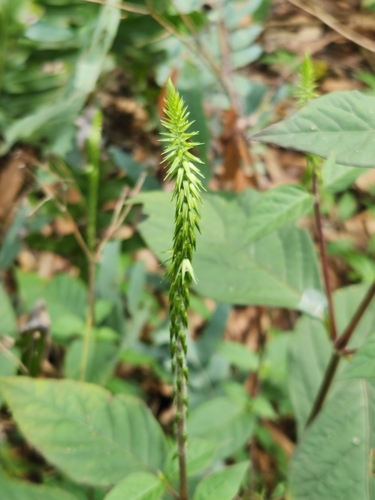
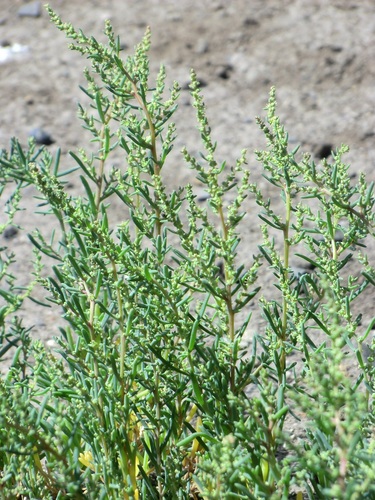
An annual herb. It grows 20-80 cm high. It has many branches. It turns red in autumn. The leaves are narrow and 1-3 cm long by 1-2 mm wide. They are rounded lower down and grooved higher up. The flowers occur as 3-5 in a group in the axils of leaves.
How to Grow
Propagation: Sow seed in spring directly in situ.
Medicinal Uses
None known
Other Uses
None known
Wikipedia
Suaeda salsa is a compact annual reaching 0.5 m tall. It flowers from July to October with seeds maturing August through October. This hermaphroditic plant is wind-pollinated and thrives in light sandy, medium loamy, or heavy clay soils across mildly acidic to basic pH ranges, including saline soils. It requires full sun and prefers moist conditions, tolerating maritime exposure well.
Other Information
It is commonly eaten in Hebei in China.
Notes
Also put in the family Chenopodiaceae.
Names & Synonyms
References (8)
- Centofanti, T. & Banuelos, G., 2019, Practical uses of Halophytic Plants as Sources of Food and Fodder. CAB International. p 334
- Hu, Shiu-ying, 2005, Food Plants of China. The Chinese University Press. p 379
- Khasbagan, Hu-Yin Huai, and Sheng-Ji pei, 2000, Wild Plants in the Diet of Athorchin Mongol Herdsmen in Inner Mongolia. Economic Botany 54(4): 528-536
- Plants for a Future database, The Field, Penpol, Lostwithiel, Cornwall, PL22 0NG, UK. http://www.scs.leeds.ac.uk/pfaf/
- Wujisguleng, W., & Khasbagen. K., 2010, An integrated assessment of wild vegetable resources in Inner Mongolian Autonomous Region, China. Journal of Ethnobiology and Ethnomedicine 6:34
- www.eFloras.org Flora of China
- Zhang, Y., et al, 2014, Diversity of wetland plants used traditionally in China: a literature review. Journal of Ethnobiology and Ethnomedicine. 10:72
- Zhu Gelin (Chu Ge-ling); Steven E. Clemants, CHENOPODIACEAE [Draft], Flora of China