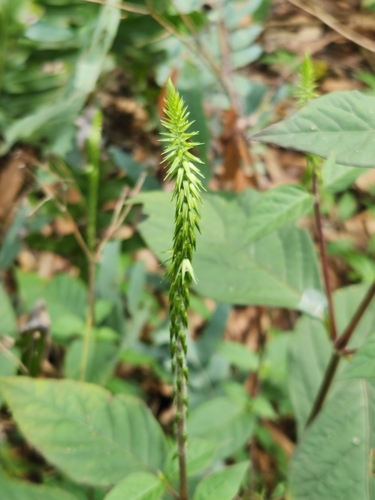
Suaeda nigra
(Raf.) J. F. Macbr.
Desert seepweed, Mojave seablite, Bush seepweed

(c) BJ Stacey, some rights reserved (CC BY-NC), uploaded by BJ Stacey

(c) W. Terry Hunefeld, some rights reserved (CC BY-NC)

(c) Eric Knight, some rights reserved (CC BY), uploaded by Eric Knight
What to Eat
Edible parts: Leaves, Seeds
The leaves are cooked and have a salty flavour. They are used as a condiment to add saltiness when cooking other foods.
Where to Find It
It is a warm temperate plant. It can tolerate salty conditions.
Caribbean, Mexico, North America, USA,
How to Identify
Annual herb reaching 1.5 m tall with wind-pollinated hermaphrodite flowers blooming August to October. Tolerates light sandy, medium loamy, and heavy clay soils across mildly acidic to basic pH ranges, including saline soils. Requires full sun and moist soil with good maritime exposure tolerance.
How to Grow
Propagation: Sow seed in spring, direct in situ.
Medicinal Uses
None known
Other Uses
None known
Wikipedia
Source ↗Suaeda nigra, often still known by the former name Suaeda moquinii, is a species of flowering plant in the amaranth family, known by the vernacular names bush seepweed or Mojave sea-blite.
Other Information
It is cultivated.
Notes
Also put in the family Chenopodiaceae.
Names & Synonyms
Romerito, Waada
References (9)
- Centofanti, T. & Banuelos, G., 2019, Practical uses of Halophytic Plants as Sources of Food and Fodder. CAB International. p 334 (As Suaeda moquinii)
- Couture, M. D., 1978, Recent and Contemporary Foraging Practices of the Harney Valley Paiute. Thesis, Portland State University
- Coutre, M. D., et al, 1986, Foraging Behaviour of a Contemporary Northern Great Basin Population. Journal of California and Great Basin Anthropology Vol. 8(2) pp 150-160 (As Suaeda intermedia)
- Kermath, B. M., et al, 2014, Food Plants in the Americas: A survey of the domesticated, cultivated and wild plants used for Human food in North, Central and South America and the Caribbean. On line draft. p 840
- Mapes, C. & Basurto, F., 2016, Biodiversity and Edible Plants of Mexico. Chapter 5 in R. Lira, et al. (eds.), Ethnobotany of Mexico, Ethnobiology, Springer. p 111
- Moerman, D. F., 2010, Native American Ethnobotany. Timber Press. p 546 (Also as Suaeda moquinii)
- Plants for a Future database, The Field, Penpol, Lostwithiel, Cornwall, PL22 0NG, UK. http://www.scs.leeds.ac.uk/pfaf/
- Wiersema, J. H. & Leon, B., 2013, World Economic Plants. A Standard Reference CRC Press. 2nd Ed. p 667
- World Checklist of Useful Plant Species 2020. Royal Botanic Gardens, Kew